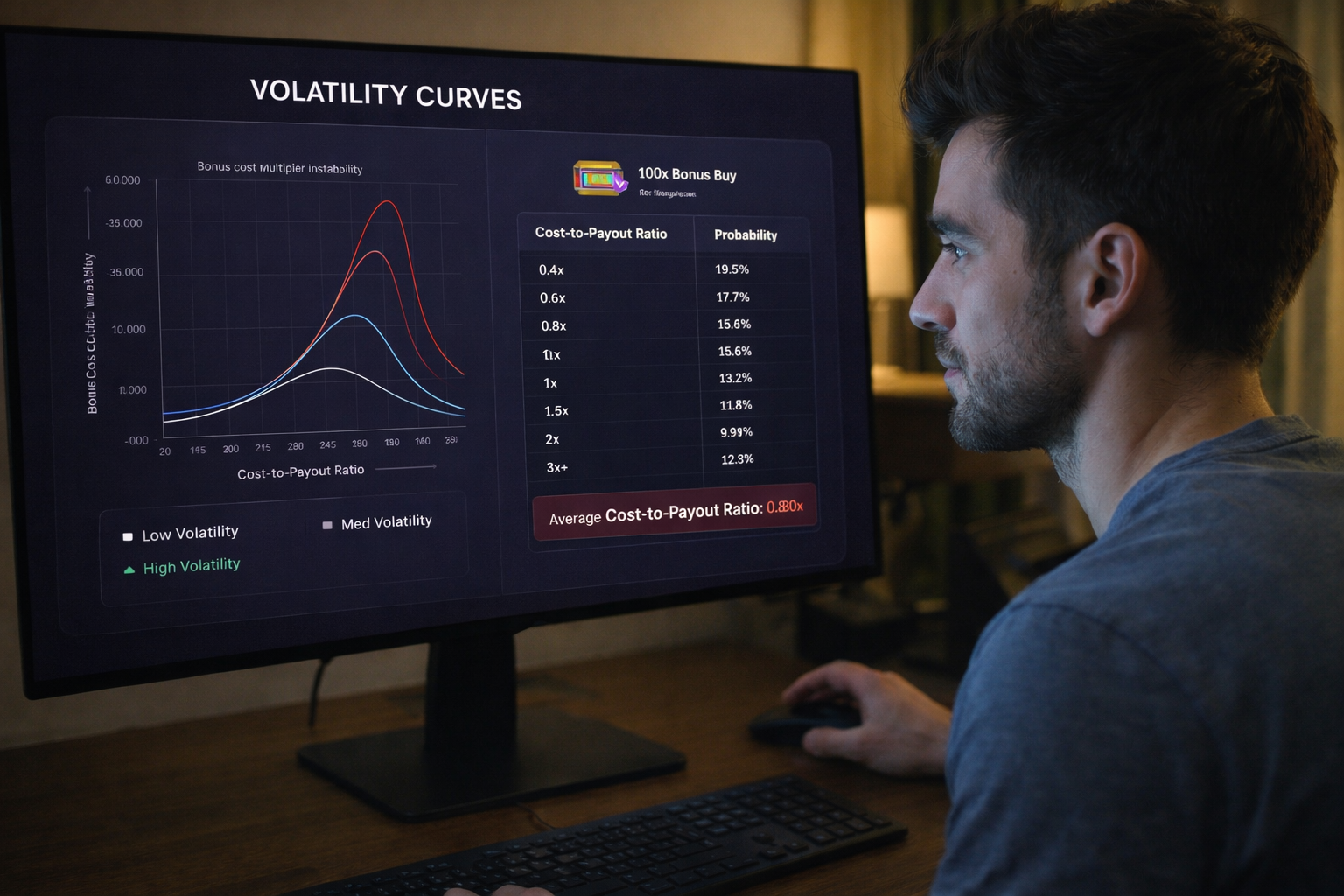
In the modern era of online gambling, patience is a dead virtue. No one wants to click four hundred times and watch as dead spins pass by and the balance slowly melts away in favor of the house edge, hoping to land three elusive scatter symbols. The industry recognized this years ago. When Big Time Gaming released White Rabbit in 2017, they introduced the “Feature Drop” – the original bonus buy. It was a revolutionary button that allowed paying a huge premium, usually 100 times the base bet, to skip the tedious base game entirely and jump straight into the high-octane, high-volatility bonus round.
In this article
For a time, it was a paradise for high-rollers. It directly appealed to the dopamine-fueled rush of instant gratification. The community of slot streams exploded, built solely on the back of consecutive bonus buys. But as we dive deep into February 2026, the global landscape for bonus buy slots has violently fractured. We no longer deal with a unified global market where every player has access to the same mechanics. Instead, we see a hyper-regulated European sector that has basically criminalized the “Buy” button, and a rogue offshore crypto market that has driven the costs for these features to frightening, stratospheric heights—sometimes demanding 2,000x your bet for a single feature.
As a lead analyst at Casino545, my task is not to tell you whether gambling is fun. My job is to examine the underlying mathematical calculations, decode the changing regulatory frameworks, and uncover the software logic that ultimately determines the survival of your bankroll. I’ve spent the last 90 days running thousands of simulated bonus buys in the top 2026 releases from Pragmatic Play, Relax Gaming, NoLimit City, and Hacksaw Gaming. I have tracked the regulatory hammers that fell in the UK, Sweden, Germany, and the Netherlands. The reality I’ve uncovered is grim: the costs of buying bonuses have never been higher, the variance has never been more brutal, and providers have developed brilliant new loopholes to legally make you pay high premiums.
This is your complete, unfiltered, operational audit of bonus buy slots in 2026. We will break down exactly which countries have banned the feature, how the hidden “RTP tax” silently drains your wallet, how the “Ante Bet” loophole circumvented government regulations, and which games actually offer a mathematically justified reason to press the buy button—if you’re brave enough to risk it.
1. The Regulatory Crackdown 2026: Europe vs. the Offshore Wild West
If you live in Europe, the slot you play today is fundamentally different from that of a player in South America or on an unregulated crypto site. Regulators have officially classified the bonus buy feature as a “damage amplifier.” They argue that allowing a player to immediately spend $100 on a $1 base game bypasses all usual responsible gambling protections and accelerates the financial ruin of problem gamblers before any intervention software can act.
The United Kingdom: The DMCC Act and the Total Blackout
The UK Gambling Commission (UKGC) has been at the forefront in the war against fast, high-risk gambling. While they initially banned direct bonus buys in 2019, 2026 brought a new wave of draconian updates that fundamentally changed slot play. With the Digital Markets, Competition and Consumers (DMCC) Act integration coming into force in spring 2026, the UKGC has completely abolished any promotions that encourage risky bonus chasing. From January 2026, the UKGC implemented a strict 10x cap on wagering requirements and banned “product mixing”—meaning a casino cannot offer you “Free Spins” as a reward for your sports betting activity. The British market has returned to the “Grind Only” era. If you log into a UK-licensed casino today, the bonus buy button simply does not exist. You must spin the base game manually. There are no shortcuts.
Germany: The 1-Euro Limit Makes Purchase Impossible
Germany’s new state treaty on gambling regulation (GlüNeuRStv) took the most aggressive mathematical approach. By introducing a strict maximum bet of €1 per spin and a mandatory 5-second delay between spins, they mathematically banned the bonus buy without having to explicitly name it. Since a bonus buy is technically classified as a single bet, you cannot pay 100x for a feature because that would mean staking €100 on a single spin, which violates the €1 limit. German players are trapped in the slowest, most grinding slot ecosystem in the world.
Sweden, the Netherlands and the Advertising Ban
The Spelinspektionen in Sweden and the Kansspelautoriteit (KSA) in the Netherlands have followed suit, where their approach targets the marketing of these features just as strongly as the mechanic itself. In Sweden, regulators argue that bonus buys create an unfair competitive advantage for large providers who can absorb extreme volatility while simultaneously destroying players’ lives. The KSA in the Netherlands has effectively incorporated bonus buys into its comprehensive advertising ban—which means a casino is not even allowed to display a game thumbnail on the homepage advertising a “feature to buy” or “Max Win 100,000x.” It is considered predatory and fundamentally incompatible with player safety policies.
The Offshore Migration: Anjouan & Curacao
Because of this European legal blockade, a massive “Black Market Migration” has taken place. High-rollers have abandoned their local, regulated casinos (which they now consider “boring” and “weakened”) and moved to crypto-based platforms licensed in the Autonomous Island of Anjouan or under the old Curacao framework. On these sites, bonus buying is not only legal but aggressively promoted as the primary way to play. This has created a highly dangerous environment: the only places where you can buy bonuses are jurisdictions where you have absolutely no legal protection. If an offshore crypto casino refuses to pay out your 10,000x bonus buy win citing a “software error,” you cannot seek help from the Anjouan gaming commission. You are completely on your own. You trade consumer protection for extreme variance.
2. The “RTP Tax”: Why You Are Mathematically Losing Money
A widespread, dangerous misconception spread by casino streamers is that buying the bonus increases your payout rate (RTP). In some legacy games from 2021, this was technically true (e.g., the base rate was 96.0%, but buying the feature raised it to 96.4%). However, in 2026, game providers have turned this concept into a so-called “RTP tax”.
The Brutal Reality of Extreme Volatility
Let’s look at the operational mathematics of a typical high-volatility slot release in 2026.
- The Cost: A standard bonus buy costs 100 times your base bet. If your base bet is $1, the purchase costs $100.
- The Theoretical RTP: Assume the game states a 96.5% RTP.
- The Reality of Variance: The 96.5% RTP is based on 1 billion simulated spins. In the short term, the variance is absolute and merciless. When you buy a bonus, the game’s algorithm distributes payouts along an extremely skewed curve.
Out of 100 purchased bonuses at $100 each (a total investment of $10,000), the mathematical distribution typically looks like this:
- 70 Buys (The Grave): Return less than your $100 stake. Often these are humiliating payouts of $5 to $20. You lose a lot and fast.
- 25 Buys (The Breakeven): Return between $80 and $150. You feel like you’re getting by, but you’re slowly losing to the house edge of 3.5%.
- 5 Buys (The Outliers): Deliver the “mega win” ($500+), which mathematics requires to balance the RTP scale at 96.5%.
The Operational Trap:
When you spin the base game, your bankroll slowly deteriorates. You trigger “mini wins” in the base game that sustain your balance until the bonus naturally triggers. When you buy the bonus, you pay a high premium to skip the base game but take on the entire extreme negative variance immediately. Effectively, you pay a “tax” for the speed of the outcome. If your bankroll does not survive 15 consecutive “dead buys” (a drawdown of $1,500 on a $1 bet), you are mathematically doomed to go bankrupt before the RTP curve normalizes back in your favor. Your money runs out before mathematics can save you.
3. The “Feature Drop” Loophole: How Providers Beat the Ban
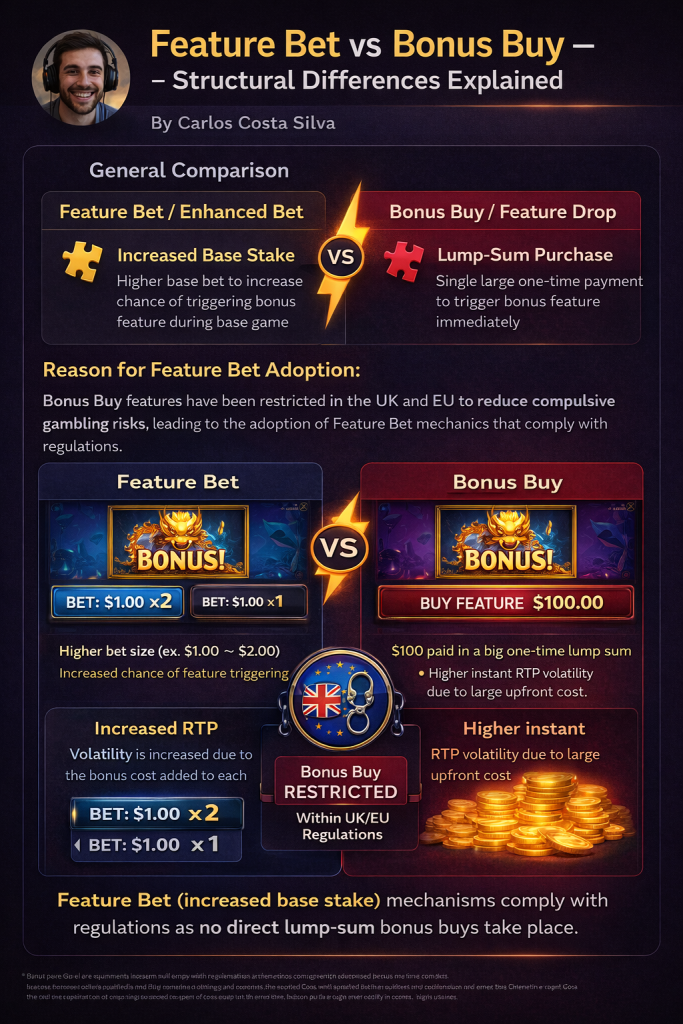
Since the United Kingdom and the EU have banned flat-rate bonus buys, software providers faced an existential crisis. They could not allow their most lucrative and exciting mechanism to disappear. This is where the „Feature Drop“, „Ante Bet“ or „Enhanced Spin“ loophole comes into play. It is the defining slot mechanism of the regulated market in 2026 and a masterpiece of legal engineering.
How the loophole operates
Instead of charging a flat fee of 100x to trigger the bonus immediately, providers like Hacksaw Gaming, Pragmatic Play, and Stakelogic have introduced UI switches that change the fundamental mathematical rules of the base spin.
- The “Double Chance” switch (Ante Bet): You pay 1.25x your base bet (e.g., $1.25 instead of $1.00). In return, the algorithm removes “dead” symbols from the reel strips and theoretically doubles the chance for scatter symbols to appear. You still have to play the base game manually, but the path to the bonus is mathematically halved.
- The “Guaranteed Feature” spin (Enhanced Spin): This is the particularly aggressive version introduced by Hacksaw Gaming (known as “FeatureSpins”). You pay 3x, 5x, or even 50x your base bet for a single spin. The game guarantees that special premium features appear on this spin (e.g., “Guaranteed 2 expanding wild multipliers”). It does not guarantee the actual free spins bonus round but creates a highly probable scenario that mimics the volatility and payout potentials of a bonus round.
The regulatory gray area:
Regulators in the UK and Europe have difficulty banning this mechanism because the player is still legally spinning the base reels. They do not “buy” a separate mini-game but only place a higher bet on a modified rule set of the base game. It perfectly exploits the 2026 legal framework gray area and allows players to lose money at the same high speed as with direct bonus purchases – completely legally. The casino still achieves its high turnover, providers get their license fee, and the player gets immediate gratification.
4. Operational audit: The top 5 high volatility bonus buy slots of 2026
I reviewed the mathematical backgrounds, volatility models, and cost-to-payout ratios of the most played bonus buy slots this month on the offshore crypto markets. If you want to take the premium risk, you need to understand the mathematical beast you’re fighting. Here are the top 5 audited games of 2026.
1. San Quentin 2: Death Row (NoLimit City)
Purchase cost: 100x / 400x / 2,000x
RTP on purchase: 96.03 %
The audit: NoLimit City develops games for absolute masochists. The option to pay 2,000x the base bet to guarantee the maximum number of jumping multiplier wilds is the most aggressive and fearsome button in all of iGaming. If your base bet is $1, the purchase costs $2,000.
Conclusion: This is more of a lottery ticket than a slot machine. My simulated audits show that the 2,000x purchase often returns less than $100, resulting in an immediate loss of $1,900 within 30 seconds. It exists solely for streamers who use casino-provided “fill wallets” to create viral shock content. Real players wagering real money should under no circumstances press the 2,000x button.
2. Money Train 5: The Heist (Relax Gaming)
Purchase cost: 100x / 500x (Super Bonus)
RTP on purchase: 96.5 %
The audit: Relax Gaming has perfected the “Hold and Win” mechanism. The standard purchase of 100x is highly volatile and often returns 10x or less if the “Collector” or “Payer” symbols don’t appear early. However, the 500x “Super Bonus” guarantees a persistent feature from the first spin and fundamentally changes the mathematics.
Conclusion: It is the leading high-risk-high-reward game. The 500x purchase is designed exclusively for crypto whales. For the average player, the 100x purchase is safer but you must be prepared for heavy losing streaks. It is very engaging but mathematically punishing.
3. Sweet Bonanza 1000 (Pragmatic Play)
Purchase cost: 100x
RTP on purchase: 96.55 %
The audit: The enhanced “1000” version of the classic Scatter Pays game includes 1,000x multiplier bombs in the bonus round. The purchase cost is standardly at 100x, but the payout distribution is heavily weighted to account for the big bombs.
Conclusion: A “trap” game. You buy 10 bonuses, and 9 of them return worthless 2x and 3x multipliers that pay back only a fraction of the cost. It requires enormous patience and a very large bankroll to absorb the losses while waiting for the rare 1,000x bomb.
4. Ryse of the Mighty Gods (OneTouch)
Purchase cost: 80x
RTP on purchase: 99.10 %
The audit: This is the statistical anomaly of 2026. While most providers lower the RTP to maximize operator profits, OneTouch released a game with an amazing 99.1% base RTP. The bonus buy is slightly cheaper than the industry average at 80x.
Conclusion: From a purely mathematical perspective, this is the most efficient bonus buy on the market. The house edge is under 1%. If you must buy features, this game offers the highest probability to preserve your bankroll.
5. Wanted Dead or a Wild (Hacksaw Gaming)
Purchase cost: 80x / 200x / 400x
RTP on purchase: 96.27 % to 96.38 %
The audit: The game that made Hacksaw famous remains a staple in 2026. The 400x “Dead Man’s Hand” bonus buy is iconic, but my data shows that the 200x “Duel at Dawn” actually yields more consistent medium wins due to the frequency of expanding VS multiplier wilds.
Conclusion: The gold standard for Hacksaw volatility. However, the 400x purchase is a notorious bankroll killer. Stick to the 200x buy if you’re willing to risk, or use their “FeatureSpins” to naturally chase features.
5. The Streamer Illusion: Why Their 100x Buys Always Pay Out
You can’t talk about bonus buys in 2026 without addressing the elephant in the room: casino streamers on platforms like Kick and Twitch. If you watch a big stream, you see a creator buying fifty $1,000 bonuses in a row, laughing off losses until they finally hit a massive 5,000x multiplier and go into profit. Try this at home with $10 buys, and your bankroll is gone in ten minutes. Why?
The Bankroll Disparity and “Fill Wallets”
The main reason streamers succeed where you fail is bankroll depth. As I explained in earlier industry audits, top streamers use “Fill Wallets” fully funded by the casino’s marketing budget. They can effortlessly withstand 40 consecutive “dead buys” because the money isn’t theirs. When they eventually hit the statistical outlier (the 5,000x win), exactly that clip is uploaded to YouTube. The 40 dead buys are ignored. They sell you a highlight reel, not the mathematical reality. A streamer’s bankroll is effectively infinite; yours is finite.
6. Tool: Bonus Buy Risk Matrix
Before risking 100x of your balance, check this operational risk matrix to calculate your actual exposure based on the game’s volatility profile. If you do not have the recommended bankroll for a certain tier, mathematically you should not press the buy button.
| Volatility Level | Avg. Dead Buys Before Profit | Rec. Bankroll (Multiples of Buy) | Target Game Examples |
|---|---|---|---|
| Low / Medium | 4 to 7 Buys | 15x Buy Cost | Fruit Party, The Dog House |
| High | 12 to 18 Buys | 30x Buy Cost | Gates of Olympus, Sweet Bonanza |
| Extreme | 25 to 40+ Buys | 50x Buy Cost | San Quentin 2, Money Train 5 |
7. Bankroll Management: The 20-Bullet Rule for Feature Buys
If you live in a jurisdiction where bonus buys are still legal or play externally and still want to participate, you must remove emotions from the transaction. You’re conducting a high-risk financial trade against a house with overwhelming advantage. You must apply strict disciplined bankroll management to survive variance.
The 20-Bullet Survival Rule
Never buy a bonus if your entire session bankroll cannot comfortably cover 20 consecutive buys for that particular game.
If you have a $200 bankroll, you should not make $20 bonus buys. You would go broke too quickly.
If your bankroll is $200, your maximum buy should be $10 (meaning your base bet is $0.10). This gives you 20 “shots.” In the math of high volatility slots, often between 12 and 18 buys are needed to land the single “saving” win that offsets the cost of previous dead buys. If you only have enough money for 3 shots, you rely entirely on blind luck, not statistical variance. You play instead of managing risk.
The “Hit and Run” Discipline
Bonus buys are psychologically designed to create a “hunter” mentality. You buy one for $100 and it pays out $12. You feel cheated and buy another to “win it back.” Before you know it, you’re $800 down chasing a sunk cost.
The rule: Set a hard limit before logging in. “I will buy exactly three bonuses on Sweet Bonanza 1000. No matter the outcome, I will leave the game.” Don’t let the machine determine your session length. The algorithm uses your frustration to subtract the next 100x from your balance. Leave once your predetermined shots are spent.
8. The Psychological Toll: Why It Is a “Harm Amplifier”
From a psychological perspective, the bonus buy is a masterpiece of dark pattern design. Traditional slot machines set the player’s pace. The 3 to 5 seconds it took the reels to spin, combined with the anticipation of scatter symbols, regulated dopamine release. They enforced a natural rhythm to financial loss.
The bonus buy removes this pace. It compresses a 30-minute gaming session into 30 seconds. By removing the “grind,” the casino speeds up the rate at which you reach a state of “tilt” (emotional, irrational betting). When a player buys a $100 feature and it pays out 0, the cognitive dissonance is enormous. The brain demands another spin to correct the perceived unfairness, leading to a rapid, catastrophic destruction of the gaming bankroll. This is precisely why European regulatory authorities have intervened. The human brain is not designed to process financial losses as quickly as the bonus buy button allows.
9. Frequently Asked Questions
Why are bonus buys banned in the United Kingdom?
The UK Gambling Commission banned them to protect vulnerable players from rapid financial losses. They concluded that allowing players to spend 100 times their bet with a single click violates fundamental principles of responsible gambling. This leads to catastrophic financial losses within minutes and bypasses the natural “cooling-off” phases and decision-making hurdles that traditional base games provide. The January 2026 updates further restricted how bonuses of any kind may be advertised or used.
Do bonus buys have a higher RTP than base games?
Historically, yes (by a small margin, typically 0.2% to 0.5%). For example, a base game might have 96.0% RTP and the buy feature 96.4%. But in 2026, many providers have normalized RTP so the buy feature offers exactly the same theoretical return as the base game. So you are just paying a premium for time-efficient and immediate play, not for a mathematically better advantage against the house.
Are casinos from Curacao safe for buying bonuses?
For many players, they are the last resort for this, but “safe” is a very strong word. Make sure the Curacao or Anjouan site uses a provably fair algorithm or hosts legitimate, server-verified providers (like Pragmatic Play or Evolution). If you are playing at an unverified Telegram-bot casino or on a site with pirated software, the bonus buy button is just a donation box. Your money disappears into a manipulated algorithm.
What is the cheapest bonus buy available in 2026?
NetEnt’s Dead or Alive II still offers one of the lowest entry prices at 66 times the base bet (where legally allowed). Some smaller indie providers offer 50x buys, but you have to read the fine print: the maximum winning potential is usually heavily limited to offset the affordable entry price. You cannot buy a 50x bonus and expect a 100,000x payout. The math doesn’t allow it.
Can I use a VPN to buy bonuses from a restricted country?
Technically yes, but practically it is a terrible idea. If you use a VPN to access a crypto casino from the UK or USA and win a massive 10,000x bonus, the casino will request KYC documents (Know Your Customer) before payout. If they see your UK passport, they will confiscate your winnings for violating their terms of service regarding restricted jurisdictions. Do not risk large capital behind a VPN.
10. Final Operational Warning
The bonus buy is the most lucrative invention the online casino industry has created in the last decade – lucrative for them, not for you. It commercializes your impatience and monetizes your craving for instant gratification. While European regulators like the UKGC continue to push these features out of the legal market in 2026, offshore sites will only make them more aggressive, expensive, and volatile to compensate for lost revenues.
Treat the “Buy Feature” button like a loaded gun. If you don’t respect the math, apply strict bankroll management, and don’t understand the extreme variance you’re exposing yourself to, it will drain your bankroll before you even notice the session has started. Play the base game, respect the “grind,” and protect your capital. The house relies on your impatience; don’t give them the satisfaction.

Founder and Chief Game Analyst at Casino545 (Since 2004)
Mission: I created Casino545 with a single, uncompromising goal: to cut through the marketing noise and bring real transparency to the online casino industry. My focus is on publishing independent, data-driven reviews built on actual operational testing, financial verification, and strict regulatory analysis. Marketing budgets don’t buy my opinions. Every evaluation follows rigorous editorial standards so players can access safe, compliant, and fair platforms.
Industry Experience
I’ve been breathing iGaming since 2004, right when regulated online gambling started expanding across Europe. I spent years working on the operational side for a major European operator, managing VIP support, payment processing, and internal risk controls. That “behind-the-scenes” experience gave me direct, hands-on exposure to how withdrawal procedures, AML compliance protocols, fraud prevention systems, and financial audits actually work.
Today, I use that insider knowledge to audit casino payment systems, analyze withdrawal reliability, assess hidden bonus risks, and demand operational transparency from licensed platforms.
Core Areas of Expertise
Slot Volatility Mathematics: Analysing RTP variations and hit frequencies across major providers.
Regulatory Frameworks: Deep understanding of European and local licensing mandates.
Crypto & Fiat Payment Systems: Testing the real-world friction of casino banking infrastructures.
Review Methodology
Real-Money Deposit Testing: I personally fund and test casino cashier systems to evaluate transaction clarity and payment processing efficiency.
Withdrawal Time Auditing: I measure the exact withdrawal cycle — from the moment I hit “submit” to the second the funds settle in my bank account — to prove financial reliability.
Terms & Conditions Risk Analysis: I dig into the fine print to expose clauses affecting withdrawal limits, bonus conversion rules, and unfair account restrictions.
Support Competency Verification: Anonymous, rigorous testing of customer support accuracy, escalation handling, and technical knowledge.
Commitment to Responsible Gambling
Player protection isn’t just a buzzword; it’s the core of my evaluation framework. I only prioritize operators that prove their regulatory compliance, enforce transparent policies, and offer structured self-exclusion systems. Gambling should be safe entertainment, and I strongly encourage access to independent support networks like GamCare and Gambling Therapy.