
By Lars Jensen
There is no such thing as free Bitcoin. If a crypto casino is offering you a 300% deposit match or 500 free spins, they are not acting out of generosity. They are executing a mathematically calculated customer acquisition strategy. In 2026, the marketing has evolved, but the underlying equation remains the same. The house fully expects you to lose the bonus, your initial deposit, and your patience. If you claim a bonus without running the numbers, you are essentially signing a digital contract designed to drain your liquidity.
In this Article:
The Architecture of a Bonus: Web2 vs. Web3
To understand how to exploit a bonus, you must first understand how it is structured on the backend. The mechanism of a casino bonus has changed dramatically with the rise of decentralized finance (DeFi) and Web3 gambling platforms.
The Traditional Web2 Database Lock
On a standard centralized crypto casino (like Stake or Roobet), a bonus is just a number in a SQL database. You deposit 1 BTC. The casino updates your interface to show 2 BTC. However, they place a flag on your account database row that restricts the withdrawal function. The system monitors your total bets. Once the bet counter reaches the target number, the restriction flag is lifted. You are trusting their internal servers to count your wagers accurately.
The Web3 Smart Contract Lock
In true decentralized casinos, the architecture is entirely different. When you accept a deposit match, your crypto and the casino’s crypto are pooled together into an escrow Smart Contract. This contract has hard-coded rules. You literally cannot withdraw your initial deposit because it is cryptographically locked. The contract includes a function that listens to your betting volume on the blockchain. Once the wager_target_met variable returns true, the contract unlocks and allows you to call the withdrawal function. If you try to withdraw early, the transaction will simply fail and you will waste network gas fees.
Wagering Requirements Deconstructed
The core defense mechanism of any crypto casino bonus is the Wagering Requirement (or Rollover). This is a multiplier applied to your funds that dictates how much total volume you must bet before the funds become yours.
A 40x multiplier sounds standard. But you must read the fine print to see exactly what that multiplier is being applied to. There are two distinct formulas, and one is a financial death trap.
Formula 1: Bonus Only (The Fair Method)
In this model, the multiplier applies exclusively to the bonus money you received.
- Deposit: $1,000
- Bonus: $1,000 (100% Match)
- Multiplier: 40x
- Calculation: $1,000 (Bonus) x 40 = $40,000.
You must place $40,000 worth of bets to clear the lock. This is achievable with the right strategy and a high RTP game.
Formula 2: Deposit + Bonus (The Predator Method)
This is where casinos manipulate the math. They advertise a “low” 30x wagering requirement, but they apply it to your combined total.
- Deposit: $1,000
- Bonus: $1,000 (100% Match)
- Multiplier: 30x (D+B)
- Calculation: ($1,000 + $1,000) x 30 = $60,000.
By shifting the formula, a “lower” 30x requirement actually forces you to wager 50% more volume than a 40x Bonus-Only requirement. Never accept a D+B bonus without doing this exact calculation first.
Expected Value (EV): The Mathematics of Winning
As a code-truster, I do not rely on luck. I rely on Expected Value (EV). EV is the mathematical formula that tells you exactly how much a bonus is worth over the long run. If the EV is positive (+EV), the bonus is mathematically profitable to take. If the EV is negative (-EV), taking the bonus guarantees a long-term loss.
Here is the formula to calculate the EV of any crypto casino bonus:
EV = Bonus Amount – (Total Wagering Requirement * House Edge)
Example of a Negative EV Bonus (-EV)
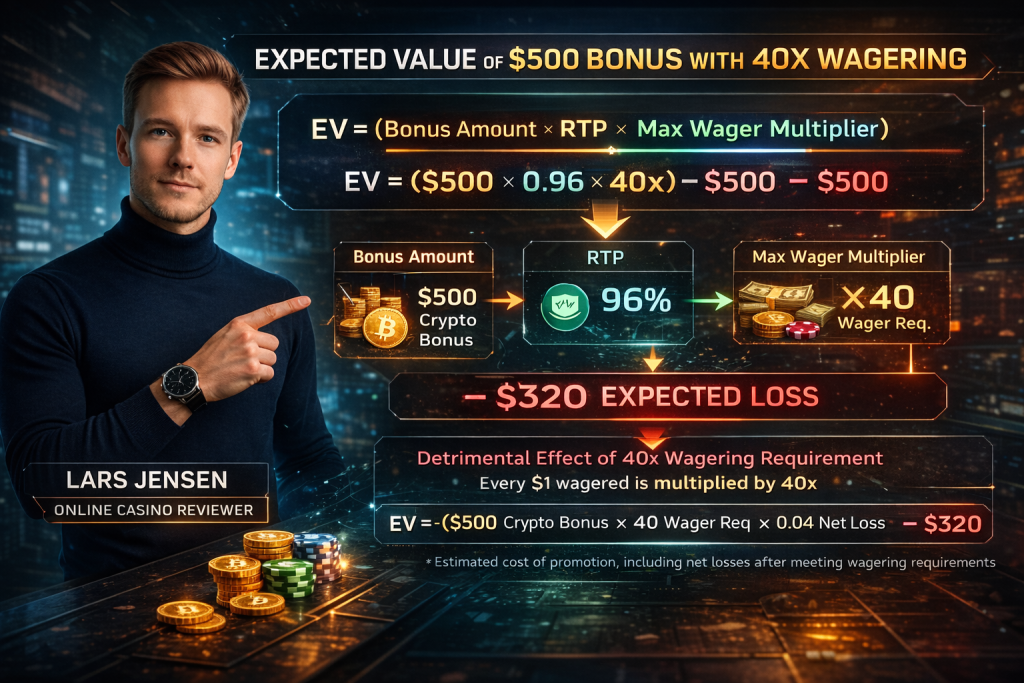
Let us look at a standard offer. You deposit $500 and get a $500 bonus with a 40x (Bonus Only) requirement. You plan to wager it on a crypto slot with a 96% RTP (which means the House Edge is 4%).
- Bonus Amount: $500
- Total Wagering: $500 x 40 = $20,000
- House Edge: 4% (or 0.04)
- Expected Loss from Wagering: $20,000 x 0.04 = $800
- Total EV: $500 (The Bonus) – $800 (The Expected Loss) = -$300.
Mathematics dictates that if you accept this bonus, you will not only lose the $500 bonus, but you will also eat $300 into your original cash deposit. This is a trap.
How to Find Positive EV (+EV)
To turn the math in your favor, you need three things: a low wagering requirement, a high bonus amount, and a game with an extremely low house edge. Suppose you find a VIP bonus: $1,000 bonus, 25x wagering, and the casino allows you to play Crypto Blackjack (House Edge 0.5% with perfect basic strategy).
- Bonus Amount: $1,000
- Total Wagering: $1,000 x 25 = $25,000
- House Edge: 0.5% (or 0.005)
- Expected Loss from Wagering: $25,000 x 0.005 = $125
- Total EV: $1,000 – $125 = +$875.
This bonus is highly profitable. You are mathematically expected to walk away with $875 in pure profit. When casinos spot players hunting these specific math loops, they usually ban them. This is called “Bonus Abuse.”
Sticky vs. Non-Sticky Bonuses
The liquidity structure of a bonus is just as important as the multiplier. In 2026, you must know whether you are accepting a “Sticky” or “Non-Sticky” (Parachute) bonus.
Sticky Bonuses (Avoid)
A sticky bonus is fused to your deposit instantly. The moment you click “Claim,” your real money and the bonus money merge into a single locked balance. Even if you hit a massive 10,000x multiplier on your very first spin, you cannot withdraw it. You are forced to complete the entire wagering requirement, exposing your massive win to the statistical drain of the house edge. This is terrible OpSec for your bankroll.
Non-Sticky Bonuses (The Gold Standard)
Also known as a parachute bonus or lifeline bonus. In this structure, your real money and the bonus money are kept separate. You play with your real money first. If you win big using your real money, you can instantly cancel the bonus, forfeit the bonus funds, and withdraw your real cash winnings immediately. The bonus only activates (and the wagering lock only applies) if your real money balance hits zero. It acts as a true second chance rather than a prison.
The Hidden Terms: Max Bet and Game Weights
Crypto casinos know that mathematically sharp players will use high variance strategies to beat their bonuses. To prevent this, they code specific restrictions into the bonus terms. If you violate these terms even once, the casino’s backend script will automatically void your bonus and confiscate all winnings.
The Maximum Bet Rule
When you have an active bonus, you cannot bet your entire balance on a single hand of Roulette to double up. Almost every casino enforces a Max Bet limit, usually around $5 or equivalent in crypto (e.g., 0.0001 BTC). If you bet $5.50 on a single slot spin, the system flags your account. You might win the spin, but when you go to withdraw days later, the security team will deny the payout citing a “Terms of Service Breach.” Always adjust your bet sizing the second a bonus is credited.
Game Contribution Percentages
Remember the +EV Blackjack example earlier? Casinos know about that too. To stop you from grinding out low-house-edge games, they apply “Game Weights” or “Contribution Percentages.”
A typical weight chart looks like this:
- Crypto Slots: 100% contribution. (Bet $1, $1 is removed from the wagering requirement).
- Roulette: 10% contribution. (Bet $1, only $0.10 is removed from the wagering requirement).
- Blackjack / Baccarat: 5% contribution.
- Provably Fair Dice / Crash: 0% contribution (Restricted).
If Blackjack only contributes 5%, your 40x wagering requirement effectively becomes an 800x wagering requirement. You are forced back onto the slots where the house edge will consume the EV.
Free Spins: The Hidden Wagering Loophole
Marketing emails touting “200 Free Spins on Registration” are highly misleading. The spins themselves are free, but the money you win from them is not.
When you spin the 200 free rounds, the resulting crypto you accumulate is credited to your account as “Bonus Money,” subject to its own wagering requirement. For example, if you win $50 from your free spins, and the free spin wagering rule is 40x, you now have to wager $2,000 using only that $50 before you can withdraw it. The probability of surviving a $2,000 wager grind with a $50 starting balance on a slot machine is mathematically microscopic.
The only exception to this rule is “Wager-Free Spins.” These are rare in 2026, usually reserved for top-tier VIPs. If a casino offers wager-free spins, whatever you win is credited instantly to your withdrawable cold-wallet balance.
Bonus Hunting and Device Fingerprinting
If a player finds a mathematically profitable bonus, the logical next step is to claim it multiple times. This is called multi-accounting or “Gnoming.” In the early days of crypto, you could just use a VPN and a new email address. Today, that will get your funds frozen instantly.
As I detailed in my previous guides, casinos now use extreme device fingerprinting. When you claim a bonus, their scripts log your Canvas Fingerprint, your WebGL renderer strings, your audio context hardware, and your WebRTC IP leaks. If you try to open a second account to claim a welcome bonus again, the algorithm matches the fingerprint hashes. The database tags both accounts as “Linked/Fraud.”
If you are implementing advanced OpSec to remain anonymous, ensure your browser isolation is perfect. Use completely separate hardware setups or heavily modified anti-detect browsers if you value your funds. Never underestimate the tracking capabilities of a casino protecting its liquidity.
The Telegram Bonus Drop Trend
The current meta in 2026 crypto gambling revolves around Telegram and Discord “Bonus Drops.” These are short cryptographic text strings (e.g., LARS_DROP_77X) posted in private channels that reward the first 500 users with instant crypto.
While these seem lucrative, they are engineered to exploit FOMO (Fear Of Missing Out) and require you to meet previous wagering thresholds. A typical Telegram drop will state: “Must have wagered $3,000 in the last 7 days to claim.” This forces players to continuously churn their balances, paying the mathematical “tax” of the house edge every day just to remain eligible for random airdrops.
Do not chase drops. Only claim them if your natural, calculated playstyle already meets the requirements. Altering your betting strategy to chase a $10 airdrop is fundamentally poor bankroll management.
Conclusion: Treat Bonuses Like Leverage
A crypto casino bonus is not a gift. It is financial leverage. Just as leverage amplifies your buying power in crypto trading, a bonus amplifies your betting volume. But leverage comes with liquidation risks, and a bonus comes with wagering locks.
Before you click claim, extract the numbers. Read the JSON arrays in the network tab to see if the game weights are fair. Run the Expected Value equation. Check if the smart contract logic is sticky or non-sticky. If the math yields a negative result, reject the bonus and play with your raw deposit. Trusting the math is the only way to survive the variance.
FAQ: Crypto Casino Bonuses
Can I use a VPN to claim a bonus restricted in my country?
Technically yes, but strategically no. If the casino has a KYC step for withdrawals, providing an ID that contradicts your VPN IP address will immediately void the bonus and your winnings. Only attempt this on strictly No-KYC Web3 casinos that do not require identity verification at the withdrawal phase.
What does “Max Cashout” mean on a bonus?
This is a cap on your winnings. If you claim a No-Deposit bonus with a $100 Max Cashout limit, and you win $5,000 on a slot, the casino will manually deduct $4,900 from your account upon withdrawal. Always check the terms for maximum profit caps before investing your time.
Why did my bonus get cancelled randomly?
The most common reasons are breaching the Max Bet rule, playing a restricted game (like a high RTP Crash game or live dealer table), or letting the bonus expire. Most deposit bonuses have a strict 7-day or 14-day time limit. If the wagering is not completed by the precise timestamp, the smart contract burns the funds
Are VIP bonuses actually better?
Yes. Mathematical value scales with your VIP tier. VIP bonuses usually strip away the predatory terms. They offer lower wagering multipliers (often 10x or even wager-free rakeback) and higher maximum bet limits. The casino offers these because they know the VIP player already generates enough natural volume to offset the cost of the bonus.
Can I hedge my bets to clear wagering requirements?
No. Betting on Red and Black simultaneously in Roulette to clear volume is known as “Minimal Risk Wagering.” The casino’s backend scripts automatically scan for opposing bets. This will trigger a fraud alert, resulting in an immediate ban and forfeiture of your entire wallet balance.

Crypto Gambling Expert & Blockchain Tech Lead (Since 2013)
Mission: I trust code, not promises. The crypto gambling space is still the Wild West, and my job at Casino545 is to guide you through it safely. I don’t care about flashy marketing; I verify that “Provably Fair” algorithms are actually fair and that your crypto withdrawals are mathematically protected from technical loopholes and hidden terms.
Industry Experience
I mined my first Bitcoin back in 2013 and have been deeply immersed in blockchain architecture and cyber security ever since. Before joining Casino545, my daily routine involved auditing DeFi smart contracts and stress-testing the payment gateways of newly launched crypto casinos to ensure they were watertight.
That hardcore technical background allows me to spot what regular reviewers completely miss. I can read the hash-strings of a crypto game to verify cryptographic fairness, and I know exactly how to differentiate a legitimate blockchain licensing protocol from a fake trust seal.
Core Areas of Expertise
- Cryptographic Fairness: Decompiling client-seed and server-seed hashes to prove RNG legitimacy.
- Smart Contract Auditing: Finding backdoors or exploitable code in decentralized gambling platforms (Web3).
- Privacy & KYC Protocols: Stress-testing anonymity claims and withdrawal friction in crypto-only environments.
Review Methodology
- The Blockchain Speed Test: I run live deposit and withdrawal cycles using BTC, ETH, and USDT, measuring the exact block confirmation times against the casino’s marketing claims.
- Provably Fair Verification: I manually verify the seeds and hashes on high-volatility games like Crash, Dice, and Plinko to guarantee results are 100% tamper-proof.
- Anonymity Check: I stress-test the KYC process to expose whether a “No-KYC” casino truly respects your privacy, or if they trap your funds behind sudden document requests the moment you win.
- Smart Contract Audits: For decentralized casinos, I dig into the underlying code to ensure there are no malicious withdrawal lockups.
Commitment to Player Security
Crypto gambling offers unmatched financial freedom, but it comes with permanent risks — there are no chargebacks on the blockchain. I advocate heavily for mandatory 2FA (Two-Factor Authentication) architectures and prioritize educating players on how to secure their wallet keys before they ever connect to a gambling dApp.