
Welcome to April 2026. The Bitcoin halving cycles have done their work, the markets are moving, and crypto casinos are seeing record-breaking deposits. But as I sit here in my Lisbon office monitoring the on-chain data, I see a disturbing trend. Players are taking their hard-earned Ethereum and Solana and throwing it away on flashy live dealer game shows with terrible math.
I am a blockchain tech lead. I usually talk about smart contracts, hash strings, and decentralized security. But today, I am stripping away the heavy tech talk. We are going to discuss something purely normal, but mathematically critical: Live Casino Games. Because whether you are trusting a Provably Fair algorithm or a human dealer shuffling physical cards in a studio in Malta, the house edge works exactly the same way. It is a mathematical tax on your bankroll.
Players love live casinos because they offer the human element. You see the cards dealt. You see the roulette wheel spin. You can chat with the dealer. It feels safe. It feels real. But this psychological comfort makes you lazy. It makes you place bad bets. This guide is your ultimate reality check for crypto live casinos in 2026. We are going to look at the games people actually play, tear down the odds, and show you exactly how to stop bleeding your crypto to the house.
In this Article:
The April 2026 Live Casino Landscape
If you log into any major crypto casino right now, the live dealer lobby is dominated by two giants: Evolution Gaming and Pragmatic Play Live. This month alone, we have seen them roll out even more “multiplier” games. These are traditional games like Roulette or Baccarat, but they inject random 500x multipliers to attract players who want slot-machine payouts at a table game.
Here is the truth: these studios are not building these games to give you more money. They are building them to increase the house edge while masking it with entertainment. The production value is incredible. The dealers are trained TV presenters. The graphics are stunning. But as a numbers guy, I do not care about the studio lighting. I care about the Expected Value (EV). If you want to survive the live casino lobby, you must learn to separate the entertainment from the mathematics.
Crypto Blackjack: The Only Game That Matters
If you are gambling with crypto and you want the absolute best chance of walking away with a profit, you should only be playing Live Blackjack. When played with perfect Basic Strategy, the house edge in Blackjack is around 0.5%. This makes it the fairest game in the entire casino.
The 6:5 Scam
However, casinos have introduced a silent killer. Traditionally, if you hit a Blackjack (an Ace and a 10-value card), the payout is 3:2. This means a $100 crypto bet pays $150 in profit.
In recent years, many live tables have quietly changed this payout to 6:5. This means your $100 bet only pays $120. This seemingly small change increases the house edge by nearly 400%. It destroys your long-term bankroll. Before you sit at a live crypto table, look at the felt. If it says “Blackjack pays 6 to 5,” close the window immediately. Only play on 3:2 tables.
Basic Strategy is Not Optional
You cannot play Blackjack based on “gut feeling.” If you have a 16 against a dealer’s 10, you hit. You will probably bust and lose, but mathematically, hitting saves you more money over ten thousand hands than standing. You must memorize a Basic Strategy chart. Do not split tens. Always split Aces and Eights. Never take Insurance.
Does Card Counting Work in Live Crypto Casinos?
The short answer is no. In a physical casino, a card counter tracks the ratio of high cards to low cards. In live dealer online games, the studios use an 8-deck shoe, and they cut the cards exactly in the middle. This means they shuffle after only 4 decks are played. This is called “deck penetration.” With only 50% deck penetration, the mathematical advantage of card counting never materializes. Do not buy software that promises to count cards on Evolution Gaming. It is mathematically useless.
Live Roulette: Physics vs. The Wheel
Roulette is the classic casino game. It is elegant, it is simple, and it is a massive trap for crypto players who do not understand the board.
European vs. American Roulette
There is only one rule you need to know about live roulette: Never play the American version.
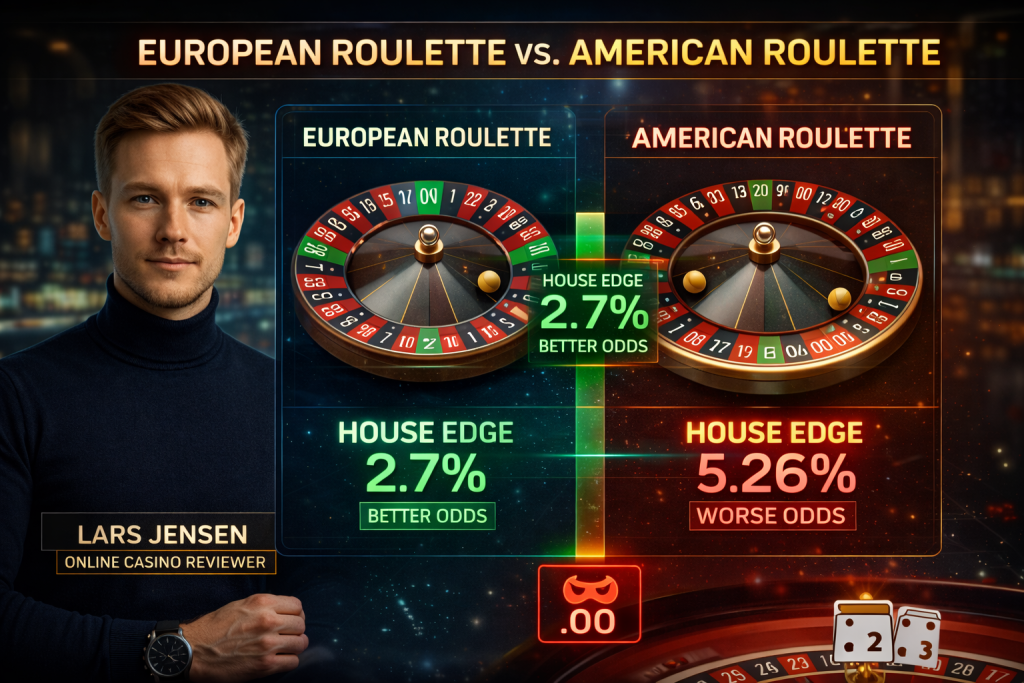
European Roulette has one zero (0). The house edge is 2.7%. American Roulette has a zero and a double zero (00). That extra pocket increases the house edge to 5.26%. You are literally doubling the casino’s profit margin for no reason. In a physical casino in Las Vegas, you might be forced to play American because it is the only table open. Online, you have the choice. Always click the European table.
The Myth of Hot and Cold Numbers
When you open a live roulette stream, the interface will proudly display the “Hot” and “Cold” numbers from the last 500 spins. This is a psychological trick. It is designed to exploit the Gambler’s Fallacy—the belief that past independent events affect future events.
The roulette ball has no memory. It does not know that the number 17 has not hit in three hours. The probability of the ball landing on 17 is exactly 1 in 37 on every single spin, regardless of history. Betting on “Hot” numbers is not a strategy. It is superstition. Trust the math, not the interface.
Lightning Roulette: The Multiplier Trap
Evolution’s “Lightning Roulette” is incredibly popular in crypto casinos right now. Every spin, lightning strikes 1 to 5 numbers, applying multipliers up to 500x. It sounds amazing, but there is a catch. To fund these massive multipliers, the casino reduces the standard payout for a straight-up number win from 35:1 down to 29:1.
If you hit your number, but it is not struck by lightning, you are being shortchanged. The overall RTP (Return to Player) of Lightning Roulette is 97.3%, which is the same as standard European Roulette, but the volatility is massive. You will experience much longer losing streaks. If you play this, you are chasing a lottery ticket, not grinding a steady profit.
Game Shows: The Entertainment Tax
In April 2026, the most crowded lobbies in any crypto casino are the Game Shows. Titles like Crazy Time, Monopoly Live, Sweet Bonanza Candyland, and Funky Time have tens of thousands of active players at any moment.
These games are hosted by energetic presenters. They feature massive physical wheels, augmented reality bonuses, and non-stop action. They are incredibly fun to watch. They are also the fastest way to drain your crypto wallet.
The Terrible Mathematics of the Big Wheel
Let us look at Crazy Time, the industry leader. The game is essentially a giant wheel of fortune. You can bet on numbers (1, 2, 5, 10) or bonus games (Coin Flip, Pachinko, Cash Hunt, Crazy Time).
The RTP of these bets ranges from 94.4% to 96.0%. Compared to Blackjack (99.5%) or Baccarat (98.9%), this is a terrible return. The house edge on some of these bets is nearly 6%. You are paying a premium for the entertainment value of the augmented reality graphics and the screaming host.
The “Bet on Everything” Fallacy
Many players use a strategy where they bet a small amount of crypto on every single bonus segment to ensure they never “miss out” when a bonus hits. This is mathematical suicide. Most of the time, the wheel lands on a number like 1 or 2. Your bets on the bonuses are swept away. When the bonus finally does hit, the average payout is often around 15x to 25x, which does not cover the slow bleed of all your losing bets.
If you want to play game shows, treat them like a movie ticket. You are spending money to be entertained for an hour. Do not treat them as a viable way to grow your crypto portfolio.
Live Baccarat: The High Roller’s Choice
If you watch the high-stakes crypto streamers, you will notice they spend a lot of time on Live Baccarat. There is a very good mathematical reason for this.
Baccarat requires absolutely no skill. You simply bet on the “Player” or the “Banker.” The dealer does all the work according to strict drawing rules. However, the house edge on the Banker bet is an incredibly low 1.06%. The house edge on the Player bet is 1.24%.
Why the Banker Bet is Better
Because of the drawing rules, the Banker hand wins slightly more often than the Player hand. To balance this, the casino takes a 5% commission on winning Banker bets. Even with this 5% commission, the Banker bet remains mathematically superior.
Never, under any circumstances, bet on the “Tie.” The payout looks tempting at 8:1, but the house edge is a staggering 14.36%. It is one of the worst bets in the entire casino.
Bankroll Management for Live Tables
Having a mathematical edge means nothing if you run out of money before the variance balances out. Bankroll management is what separates gamblers from investors.
The 1% Rule
If your dedicated crypto casino bankroll is $1,000 (whether in USDT, BTC, or ETH), you should never risk more than 1% ($10) on a single round of Blackjack or Roulette. If you sit down at a $50 minimum table with a $1,000 bankroll, you only have 20 bullets. A cold streak of 10 hands will wipe out half your portfolio. You must give the math time to work. Bet small, grind the edge, and survive the variance.
The Crypto Volatility Factor
This is a uniquely 2026 problem. If you are playing live casino games using a volatile asset like Ethereum, you are fighting two markets at once. You are fighting the house edge of the casino, and you are fighting the global crypto market.
Imagine you bring 1 ETH to the table when it is worth $4,000. You play perfectly for two hours and make a 10% profit. You now have 1.1 ETH. But during those two hours, the global price of ETH drops by 15%. You beat the dealer, but your fiat purchasing power still went down.
If you want to play serious sessions at the live tables, convert your bankroll to a stablecoin like USDT or USDC first. This isolates your risk. You only have to worry about the cards, not the market charts.
Live Dealer Pitfalls to Avoid
Beyond the game rules, the live casino environment has its own specific traps designed to take your money.
Side Bets are Scams
When you sit at a Live Blackjack table, you will see circles for side bets like “Perfect Pairs” or “21+3.” These allow you to bet on getting a pair on your first two cards, or making a poker hand with the dealer’s upcard.
They offer massive payouts, up to 100:1. They are also mathematical garbage. The house edge on these side bets ranges from 6% to over 10%. The casino puts them there because they know Basic Strategy players are grinding a 0.5% edge, and they want to claw that margin back. Never play the side bets. Hide them in the UI settings if you have to.
Tipping the Dealer
Live casino interfaces have a “Tip” button. The dealers are friendly, they congratulate you when you win, and it feels natural to throw them a $5 chip.
I am not telling you to be rude, but you must understand the math. When you tip the dealer, you are voluntarily taking money out of your bankroll with an Expected Value of zero. If you are trying to grind a 0.5% edge on Blackjack, tipping $5 every time you win a big hand completely destroys your mathematical advantage. If you are playing for fun, tip away. If you are playing to win, keep your chips.
Connection Latency
Live dealer games operate in real-time. If you are playing from a mobile connection and you lag, the game does not stop for you. In Blackjack, if your timer runs out because of a bad connection, the system will automatically “Stand” your hand. If you had a 12 against a dealer’s 10, standing is a terrible move, and you just lost your crypto because of your Wi-Fi.
Before you commit serious money to a live table, ensure your ping is stable. If the video stream is buffering, do not place a bet.
How to Spot a Fair Live Stream
One of the oldest conspiracy theories in online gambling is that the live streams are pre-recorded or heavily edited. In 2026, the major providers are strictly regulated and audited by independent agencies like eCOGRA. Evolution Gaming and Pragmatic Play are publicly traded companies; they are not risking their multi-billion dollar licenses to cheat you out of a $50 bet.
However, if you are playing on a smaller, unregulated crypto casino that uses proprietary live dealers, you should perform a basic verification.
- Look for a television screen in the background of the studio showing a live international news channel (like CNN or Sky Sports).
- Use the chat box to ask the dealer a specific, time-sensitive question.
- Call a phone number in the studio if they provide one on screen.
If the dealer interacts with the chat naturally and the background monitors match the current April 2026 news cycle, the stream is live and authentic.
Conclusion
The live casino lobby is a masterpiece of modern web architecture and human psychology. It bridges the gap between the cold, calculated world of cryptocurrency and the visceral thrill of a real casino floor.
But you must remember that every smiling dealer, every flashing multiplier, and every spinning wheel is backed by cold, hard mathematics. They are not your friends. They are the opposing force. To survive the live tables in 2026, you must become a machine yourself. Play European Roulette, grind the Banker bet in Baccarat, memorize Blackjack Basic Strategy, and ignore the game shows. Protect your bankroll, trust the math, and never bet the farm on a side bet.
Frequently Asked Questions
Are live dealers better than RNG software games?
It depends on your goal. RNG (Random Number Generator) software games are faster, which means you can play more hands per hour. Live dealers are slower, which preserves your bankroll longer but restricts volume. Mathematically, a 99.5% RTP RNG Blackjack game and a 99.5% RTP Live Blackjack game yield the exact same long-term results.
Can the dealer see me through my webcam?
No. The video stream is strictly one-way. The dealer can see your username, your chat messages, and the bets you place on their digital monitor, but they have no access to your camera or microphone. Your privacy is fully maintained.
Why did the dealer change the shoe so early?
Casinos enforce strict deck penetration rules (usually cutting the shoe in half) specifically to prevent card counters from gaining a mathematical advantage. It ensures the true count never gets high enough for a player to profitably increase their bet sizes.
What happens if the dealer makes a mistake?
Dealers are human and they do make physical mistakes (e.g., dropping a card off the table or scanning the wrong barcode). When this happens, a “Pit Boss” is called over. The hand is paused, the cameras are reviewed, and the mistake is corrected according to strict regulatory guidelines. If the hand cannot be salvaged, all bets are refunded to the players’ wallets.
Can I use bonuses on live casino games?
Usually, no. Because the house edge on games like Blackjack and Baccarat is so low, casinos severely restrict them from bonus wagering. If a casino does allow it, they will apply a “Game Weight,” meaning a $10 bet on Live Blackjack might only count as $0.50 toward clearing your bonus rollover requirement.

Crypto Gambling Expert & Blockchain Tech Lead (Since 2013)
Mission: I trust code, not promises. The crypto gambling space is still the Wild West, and my job at Casino545 is to guide you through it safely. I don’t care about flashy marketing; I verify that “Provably Fair” algorithms are actually fair and that your crypto withdrawals are mathematically protected from technical loopholes and hidden terms.
Industry Experience
I mined my first Bitcoin back in 2013 and have been deeply immersed in blockchain architecture and cyber security ever since. Before joining Casino545, my daily routine involved auditing DeFi smart contracts and stress-testing the payment gateways of newly launched crypto casinos to ensure they were watertight.
That hardcore technical background allows me to spot what regular reviewers completely miss. I can read the hash-strings of a crypto game to verify cryptographic fairness, and I know exactly how to differentiate a legitimate blockchain licensing protocol from a fake trust seal.
Core Areas of Expertise
- Cryptographic Fairness: Decompiling client-seed and server-seed hashes to prove RNG legitimacy.
- Smart Contract Auditing: Finding backdoors or exploitable code in decentralized gambling platforms (Web3).
- Privacy & KYC Protocols: Stress-testing anonymity claims and withdrawal friction in crypto-only environments.
Review Methodology
- The Blockchain Speed Test: I run live deposit and withdrawal cycles using BTC, ETH, and USDT, measuring the exact block confirmation times against the casino’s marketing claims.
- Provably Fair Verification: I manually verify the seeds and hashes on high-volatility games like Crash, Dice, and Plinko to guarantee results are 100% tamper-proof.
- Anonymity Check: I stress-test the KYC process to expose whether a “No-KYC” casino truly respects your privacy, or if they trap your funds behind sudden document requests the moment you win.
- Smart Contract Audits: For decentralized casinos, I dig into the underlying code to ensure there are no malicious withdrawal lockups.
Commitment to Player Security
Crypto gambling offers unmatched financial freedom, but it comes with permanent risks — there are no chargebacks on the blockchain. I advocate heavily for mandatory 2FA (Two-Factor Authentication) architectures and prioritize educating players on how to secure their wallet keys before they ever connect to a gambling dApp.