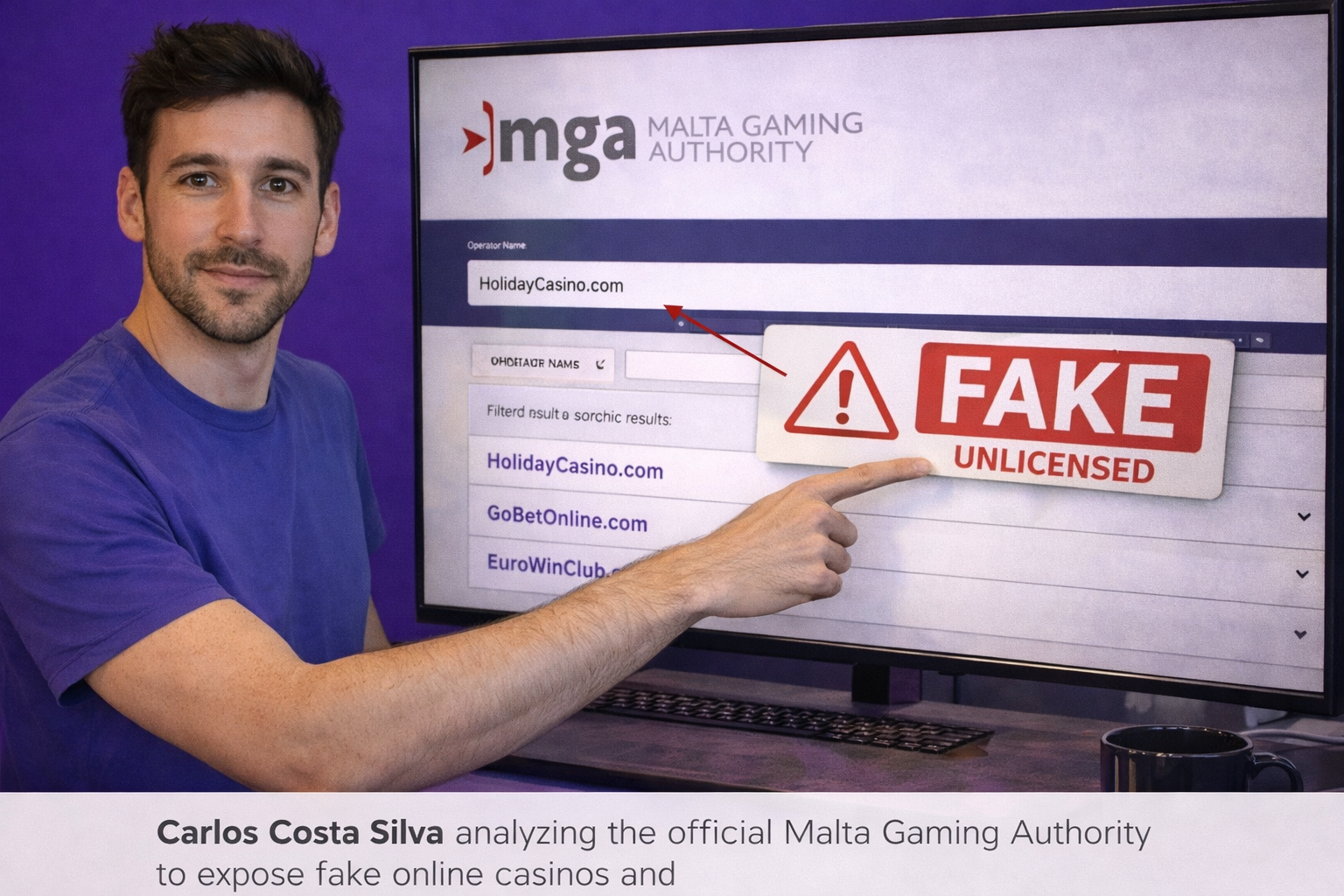
Welcome back to Casino545. I am Carlos Costa Silva, Founder and Chief Game Analyst. As we navigate the incredibly complex and increasingly hostile iGaming landscape of March 2026, my objective remains identical to the very day I established this platform back in 2004. I am here to cut entirely through the aggressive marketing noise, completely dismantle the deceptive practices of rogue operators, and bring absolute, data-driven transparency to the online casino industry. Over the past several weeks, a highly disturbing and mathematically devastating operational trend has accelerated across the European regulated market. We are witnessing an unprecedented, highly coordinated surge in sophisticated, counterfeit casino platforms. These rogue entities are explicitly and maliciously designed to perfectly mimic legitimate, trusted brands. They are illegally displaying stolen regulatory seals, pirating certified software, and manipulating search engines to trick players into depositing their hard-earned fiat currency into offshore black holes. Today, I am executing a comprehensive, exhaustive audit of this black-market explosion. I am going to break down the Malta Gaming Authority’s recent aggressive crackdown on these fraudulent URLs, explain the deep technical mechanics behind how pirated slot software actually operates on the backend, and provide you with a rigorous, foolproof framework to technically verify the authenticity of any online casino before you risk a single Euro of your bankroll.
In this article
The Epidemic of Clone Casinos in Q1 2026: A Historical Perspective
To truly understand the sheer scale and the financial danger of the fake online casino epidemic we are facing in March 2026, you must first understand the operational backend of the black market and how it has evolved over the last two decades. During my early years working directly on the operational side for major European operators—where I managed VIP support floors, oversaw traditional fiat payment processing, and actively monitored internal financial risk and fraud controls—I witnessed the very first, crude attempts at casino cloning. A decade ago, a fake casino was incredibly easy to spot for anyone with a basic understanding of the internet. The graphics were usually terribly pixelated, the spelling across the homepage was atrocious, the promotional banners utilized stolen, copyrighted images of unlicensed characters, and the payment gateways were visibly broken or unencrypted.
I can assure you with absolute certainty that this is no longer the reality. In 2026, highly organized offshore criminal syndicates are utilizing incredibly advanced web-scraping technology and artificial intelligence to perfectly clone the front-end architecture of highly reputable, heavily licensed European casinos. They duplicate the exact hexadecimal color schemes, the sophisticated promotional sliders, the dynamic game thumbnails, the localized language translations, and most dangerously, the entire regulatory footer information. A casual player logging in on a Friday night via their mobile phone browser will see absolutely no visual difference whatsoever between the legitimate tier-one operator and the fraudulent clone site hosted on a rogue server.
The entire operational purpose of these clone sites is rapid, frictionless capital extraction. These syndicates do not care about long-term player retention, they do not have real VIP account managers, and they certainly do not operate sustainable business models based on a mathematical house edge. Their financial model is entirely predatory and based on 100% theft. They rely on incredibly aggressive black-hat SEO tactics, massive spam email campaigns utilizing purchased databases, and fake affiliate networks operating on social media to funnel unsuspecting traffic to their spoofed URLs. Once a player makes a fiat deposit—almost always incentivized by a massive, mathematically impossible 500% welcome bonus or hundreds of zero-wager free spins—those funds are immediately transferred out of the payment gateway and laundered through complex offshore crypto-mixers. You will never see that money again, and because the casino does not actually exist as a registered corporate entity anywhere in the world, you have absolutely zero legal recourse to recover your stolen bankroll.
The Malta Gaming Authority’s March 2026 Registry Crackdown
For many years, regulatory bodies across Europe were heavily criticized by industry insiders for acting far too slowly, often operating as passive administrative gatekeepers rather than active, aggressive enforcers of the law. However, the regulatory landscape is fundamentally shifting in response to player demands. The Malta Gaming Authority (MGA) has significantly sharpened its operational framework and enforcement protocols for 2026, explicitly recognizing the existential threat that these clone casinos pose to the overall integrity and public trust of the regulated European gambling market.
In a massive, coordinated enforcement sweep leading up to March 2026, the MGA’s compliance and enforcement division executed a deep review of hundreds of suspicious URLs. These URLs were flagged by internal auditors, submitted by legitimate operators who noticed their brands being cloned, and reported by independent player protection networks. The MGA discovered dozens of highly trafficked domains that were fraudulently claiming to hold an active Malta Gaming Authority license. These rogue operators were illegally hard-coding the official MGA logo into their website footers to manufacture a false sense of trust and regulatory compliance.
Instead of merely sending legally useless cease-and-desist letters to anonymous offshore shell companies hiding behind privacy proxies, the MGA has taken public, aggressive, and highly visible action. They have begun systematically publishing these unauthorized, fraudulent URLs directly on their official public registry, explicitly naming and shaming the fake platforms for the entire industry to see. This public crackdown is a vital, necessary step forward for player protection. However, you must understand the jurisdictional limitations of a regulatory body. The MGA cannot physically shut down servers hosted in unregulated, non-extradition jurisdictions like certain Caribbean islands or Eastern European territories. The regulatory body can issue severe public warnings, but the ultimate responsibility for protecting your fiat deposits falls entirely on your personal ability to conduct your own technical verification before you create an account.
Step-by-Step Technical Audit: Verifying the Dynamic MGA Seal
The most common and visually deceptive tactic utilized by fake online casinos in March 2026 is the deployment of a static regulatory seal. When you scroll to the absolute bottom of a legitimate, regulated online casino, you will always see the official logo of the regulatory body, usually the Malta Gaming Authority for European-facing sites. This logo is absolutely not supposed to be a simple, static picture downloaded from Google Images; it is supposed to be a highly complex, dynamic, cryptographically secure digital certificate.
Here is my exact, uncompromising operational methodology for verifying a casino license. This is a process you must execute every single time you consider registering at a new platform, regardless of how professional the website looks. When you click the MGA logo in the footer of the casino, the hyperlinked certificate must instantly redirect you to the official authorization registry hosted directly on the authoritative MGA government domain, which is specifically authorisation.mga.org.mt. This dynamic registry page will clearly and officially display the casino’s legally registered corporate holding name, their official physical operating address in Malta, their active B2C license number, the date the license was issued, and a highly detailed, comprehensive list of every single approved URL operating legally under that specific corporate license.
Rogue operators attempting to spoof this complex system rely entirely on player laziness and technical ignorance. They will simply copy and paste a static JPEG or PNG image of the MGA logo directly into their HTML footer. When you click it, nothing happens, or it merely refreshes the homepage. Alternatively, much more sophisticated scam syndicates will hyperlink the logo to a fake, meticulously cloned version of the MGA registry itself. If you click the regulatory seal and the resulting URL in your browser’s address bar says absolutely anything other than the official MGA government domain, you are standing inside a fraudulent casino. Close the browser immediately. Do not create a player account, do not submit your sensitive KYC documents, and absolutely, under no circumstances, deposit your fiat currency into their cashier.
Pirated Software: The Brutal Mathematics of Rigged Slots
The deception of a fake online casino extends far, far beyond a stolen logo in the footer. The actual games hosted on these rogue platforms are completely fraudulent and mathematically rigged. Legitimate, tier-one software providers, such as Pragmatic Play, Play’n GO, Hacksaw Gaming, or Nolimit City, strictly refuse to integrate their highly regulated gaming servers with unlicensed, unverified operators. Therefore, clone casinos cannot offer the real games. Instead, they must utilize pirated, reverse-engineered versions of popular slot machines bought on the dark web.
As an expert heavily focused on Slot Volatility Mathematics, I have deeply audited the backend behavior of these pirated games, and the results are terrifying. A legitimate slot machine operates via a certified Random Number Generator (RNG). This RNG is relentlessly audited by independent testing agencies like eCOGRA, GLI, or iTech Labs to ensure that the advertised Return to Player (RTP) percentage is mathematically accurate over billions of simulated spins. The actual math model is hosted securely on the provider’s server, and the casino merely acts as a visual window to that server. The casino cannot change the outcome of a spin.
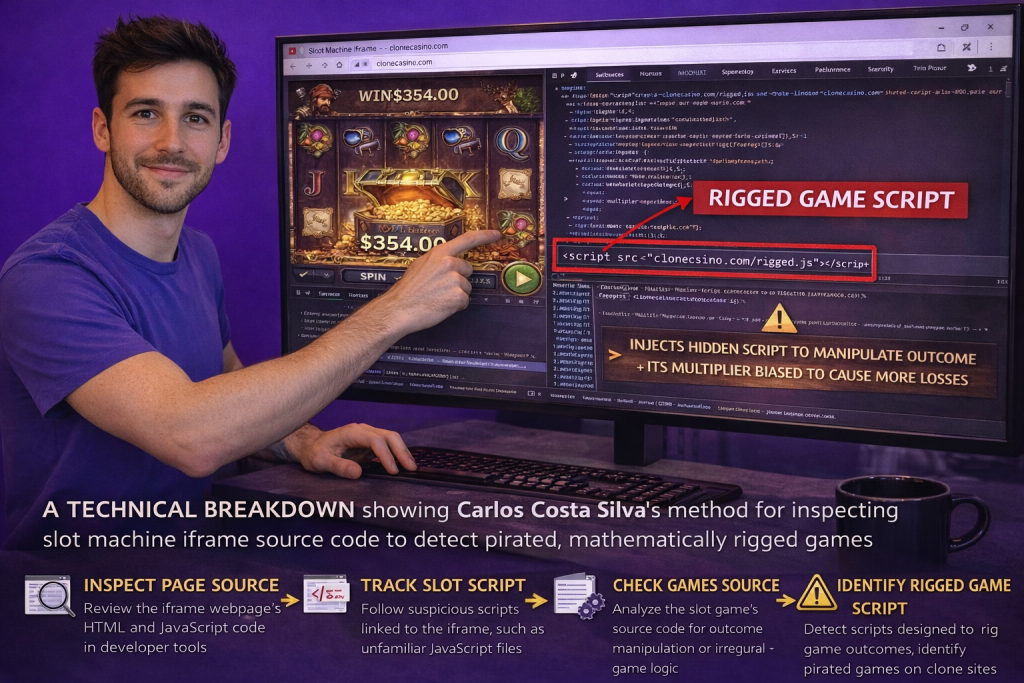
Pirated games, however, are hosted directly on the rogue casino’s private servers. The criminal syndicate possesses absolute, unrestricted backend access to the mathematical framework of the game. They actively and maliciously manipulate the source code to drop the RTP from a standard 96% down to 10%, 5%, or even absolute zero. They can specifically program the slot machine to deliver small, teasing wins during your first fifty spins to keep you engaged and convince you the game is real, while mathematically hard-coding the software to ensure that a premium bonus round or a maximum win multiplier is literally impossible to ever trigger. You are not experiencing a bad run of natural variance; you are being actively robbed by rigged, weaponized mathematics.
Inspecting iFrames: How to Spot a Fake Game Server
You do not have to be a software engineer to identify pirated slot software. You can technically audit the server requests yourself using basic browser tools. When you load a popular slot game on a new casino, right-click anywhere outside the game window and select “Inspect” or “Inspect Element” to open your browser’s developer tools. Search the source code for the “iframe” tag, which is the exact line of code that embeds the game onto the casino’s webpage.
A legitimate, certified game will always pull its data directly from the official developer’s server network. For example, a real Play’n GO game will show an iframe source URL pointing to an official Play’n GO server domain. A pirated game, however, will pull its data from an obscure, third-party offshore URL, an IP address with no domain name, or a server that closely mimics the real name but contains slight typographical errors (like play-n-go-games.net instead of the official corporate URL). If the server hosting the game does not match the actual software developer, you are playing a mathematically rigged, pirated clone.
The Payment Gateway Trap: How Your Fiat is Stolen
The cashier system of a fake online casino is a masterpiece of financial deception. When you decide to make a deposit at a legitimate, MGA-licensed casino, you are routed through highly secure, globally recognized payment service providers (PSPs) like Trustly, standard Visa/Mastercard processing, or verified e-wallets like Skrill and Neteller. These institutions require rigorous corporate verification before they allow a casino to process fiat payments.
Fake casinos cannot pass the compliance checks required to secure legitimate merchant processing accounts with traditional European banks. Therefore, their entire fiat payment processing infrastructure is a facade. In March 2026, the most common tactic is the “crypto-bridge” deception. You will go to the cashier, select Visa or Mastercard, and type in your deposit amount of €100. However, instead of processing a standard retail transaction, the fake casino uses a third-party, loosely regulated payment gateway to instantly purchase €100 worth of untraceable cryptocurrency on your behalf, which is then immediately forwarded to the scammer’s anonymous wallet.
Because you technically authorized the purchase of cryptocurrency through a third party, attempting to file a chargeback with your bank or credit card provider is incredibly difficult, if not impossible. The bank will argue that the cryptocurrency was successfully delivered to the wallet address provided, completely absolving them of the fraud. You must strictly audit the cashier. If a casino claims to accept standard bank transfers but forces you through obscure, multi-step third-party gateways that mention digital assets or crypto conversions in the fine print, abort the transaction immediately.
Weaponized KYC: The Hidden Danger of Identity Theft
Losing your fiat deposit is only the first layer of damage inflicted by a fake online casino. The secondary, and arguably much more dangerous, threat involves the weaponization of the Know Your Customer (KYC) verification process.
Legitimate online casinos are legally required by international Anti-Money Laundering (AML) directives to verify the identity of their players. They ask for a copy of your passport, a recent utility bill, and proof of your payment method. Legitimate operators store this highly sensitive data on secure, encrypted servers compliant with strict GDPR regulations.
Fake online casinos utilize the exact same KYC process, but for entirely malicious purposes. When you request a withdrawal of your fake winnings, the rogue operator will demand your identification documents, claiming it is standard compliance protocol. Once you upload high-resolution photographs of your passport, your bank statements, and the front and back of your credit card, they will immediately sell that complete identity package on the dark web. They are not verifying your account to process a withdrawal; they are harvesting your personal data for identity theft. Never submit your identification documents to a casino that you have not comprehensively verified through the official MGA registry.
Segregated Funds: The Financial Architecture of the MGA
My uncompromising, relentless insistence on playing exclusively at regulated casinos is not based on blind corporate loyalty; it is based strictly on the financial architecture of player protection. The absolute core pillar of the Malta Gaming Authority’s regulatory framework—and the reason I advocate for it so heavily—is the legally mandated segregation of player funds.
When you deposit €1,000 into a legitimate, MGA-licensed casino, that fiat currency is legally required by the Maltese government to be held in a completely separate, ring-fenced bank account. It absolutely cannot be mathematically mixed with the casino’s daily operational funds, their affiliate marketing budgets, their server costs, or their executive payroll. If the casino operator mismanages their corporate finances, suffers a massive structural failure, loses their market share, and is forced to file for bankruptcy, your deposited money and your pending withdrawals are legally protected by strict European financial law. The funds will be systematically returned to the player base by an independent, court-appointed liquidator.
Fake casinos, clone sites, and unregulated offshore platforms offer absolutely zero financial segregation. When you deposit your money into a rogue site, it goes directly into the syndicate’s operational wallet. They use your deposits to fund their criminal enterprise immediately. If they decide to shut down the URL tomorrow morning and rebrand under a different fake casino name by tomorrow afternoon, your entire bankroll vanishes instantly. There is no regulatory body to complain to, no Alternative Dispute Resolution service to utilize, and no legal framework to force the return of your funds. The MGA license is not just a shiny badge of trust placed on a website; it is the literal, legally binding financial shield protecting your fiat deposits from total vaporization.
My Real-Money Audit Methodology for Suspicious Platforms
In direct response to the massive March 2026 influx of fraudulent platforms, I have entirely tightened and expanded the Casino545 auditing methodology. I absolutely refuse to rely on affiliate assurances, promotional press releases, demo mode testing, or virtual credits provided by affiliate managers. To bring verifiable, data-driven transparency to my readers, I subject every single new casino to rigorous, uncompromising stress-testing using my own personal money.
My post-registration audit plan focuses entirely on exposing operational friction, verifying financial legitimacy, and testing the limits of the platform’s infrastructure. First, I execute strict fiat real-money deposit testing. I personally fund accounts using traditional, highly traceable methods such as Visa, Mastercard, and direct SEPA Bank Wire. As mentioned earlier, scammer casinos struggle to maintain legitimate merchant processing. If my deposit encounters bizarre routing, highly suspicious currency conversion fees, or relies on unknown third-party processors, I flag the casino immediately.
Second, I initiate the KYC verification protocol before playing a single spin. I want to see exactly how the operator handles my data. Legitimate operators process these documents securely and efficiently through automated, encrypted portals, typically within a few hours. Fake casinos will either accept the documents instantly without any real review, or they will ask me to send highly sensitive documents via an unencrypted email address, which is a massive data security violation.
The absolute final test is the withdrawal process. A fake casino will happily accept your deposits instantly, but they are mathematically and operationally designed to never, ever authorize a payout. If I successfully generate a profit during my live gameplay testing on verified software, I immediately trigger a fiat withdrawal. I measure the exact withdrawal cycle from the precise second I click submit in the cashier to the moment the funds actually settle in my local bank account. If an operator utilizes predatory compliance tactics to stall the payout indefinitely, or simply cancels the withdrawal without explanation, they are permanently blacklisted on Casino545.
Support Competency: Exposing Automated Bot Farms
The technical infrastructure of online casinos requires competent, highly trained human oversight. Software glitches occur, deposits can be delayed by banking networks, and bonuses can occasionally fail to trigger due to server latency. When these critical issues occur, your only lifeline is the casino’s customer support department. Therefore, anonymous, rigorous testing of customer support accuracy, escalation handling, and technical knowledge is a mandatory component of my audits.
During my operational career managing VIP support floors, I personally trained agents to manually query game server logs and resolve technical disputes within minutes. A competent support team in 2026 should be able to instantly verify your game round ID, check the external server status, and manually credit your account if an error occurred.
Fake online casinos absolutely do not invest capital in trained, human support staff. They rely entirely on automated AI chatbots designed to run you in frustrating circles, or they outsource their live chat to undertrained offshore agents who simply copy and paste generic responses from a script. During my audits, I purposely report complex technical issues, such as a frozen bonus buy round. If the agent cannot locate the specific transaction ID in their backend system, it is a glaring indication that the casino does not actually have access to the official game provider’s servers. They fail my competency verification instantly. When real fiat currency is on the line, professional, native-speaking human assistance is an absolute requirement, not a luxury.
Commitment to Responsible Gambling and Player Protection
Player protection is the absolute core of my evaluation framework. The existence of fake, unregulated casinos is the single greatest threat to vulnerable players in the market today. These rogue operators do not respect any responsible gambling protocols, they do not enforce deposit limits, and they actively, maliciously target players who have previously self-excluded from legitimate, regulated platforms.
I only prioritize and recommend operators that prove their regulatory compliance, enforce completely transparent policies, and offer easily accessible, highly structured self-exclusion systems. A safe, MGA-licensed casino allows you to set daily deposit limits, net loss limits, and strict session time limits seamlessly from your player dashboard the exact moment you register an account.
Gambling must always remain safe, controlled entertainment. It is absolutely not a way to generate income or solve financial problems. The mathematics guarantee that the house will always retain its edge, and on a fake casino running pirated software, that edge is mathematically 100%. I strongly encourage my readers to utilize independent support networks like GamCare and Gambling Therapy if you ever feel your gaming habits are causing financial or emotional stress. Utilize the responsible gambling tools provided, independently verify the casino licenses yourself, and never gamble with fiat funds you cannot comfortably afford to lose.
Conclusion: Your Bankroll, Your Responsibility
The massive, coordinated surge of fake online casinos in March 2026 is a direct, calculated threat to your bankroll and your personal identity. These organized offshore syndicates are utilizing highly sophisticated website cloning technology, mathematically rigged pirated software, and incredibly aggressive marketing tactics to steal your fiat deposits. The Malta Gaming Authority is actively cracking down on these fraudulent URLs by publishing them on public registries, but the ultimate, final responsibility for protecting your funds lies firmly in your own hands.
By heavily relying on actual operational testing, verifiable financial auditing, and strict regulatory analysis, Casino545 will continue to bring you the unvarnished, data-driven truth about the online casino industry. Do not let massive, impossible bonus offers blind you to the reality of the platform. Always manually verify the dynamic MGA license seal, audit the iframe server requests for pirated games, test the customer support competency with a complex technical question, and thoroughly evaluate the fiat withdrawal speeds with small deposits first. Stay smart, ruthlessly protect your bankroll, play safe, and I will see you in the data.
Frequently Asked Questions
How can I definitively tell if an online casino is using a fake MGA license seal?
You must manually click the Malta Gaming Authority logo located in the footer of the casino’s homepage. A legitimate license seal is a dynamic digital certificate and will immediately redirect you to the official authorisation.mga.org.mt government registry, displaying the casino’s active corporate details. If the logo is merely a static image that does not click, or if it redirects you to a suspicious URL that does not exactly match the official Maltese government domain, the casino is fake and you should leave the site immediately.
What happens to my money if I deposit at an unlicensed clone casino?
If you deposit fiat currency into a fake, unregulated casino, your funds are immediately absorbed into the criminal syndicate’s private operational wallets and quickly laundered through offshore crypto channels. Because the casino is not a legally registered corporate entity and operates entirely outside of European financial law, you have absolutely zero legal recourse to recover your stolen deposit. There is no regulatory body to complain to, no Alternative Dispute Resolution service, and no financial protection available.
Can a fake casino mathematically rig the slot machines to stop me from winning?
Yes. Legitimate slot machines run on certified Random Number Generators hosted on highly secure servers maintained by the official game developers. Fake casinos cannot access these legitimate servers, so they utilize pirated, reverse-engineered versions of the games hosted on their own private networks. They have complete backend access to the mathematical framework and will actively manipulate the source code to drop the Return to Player percentage to zero, ensuring you can never trigger a legitimate payout or bonus round.
Why do fake casinos offer such massive deposit bonuses and free spins?
Rogue operators use impossibly large welcome bonuses, such as a 500% deposit match or hundreds of zero-wager free spins, purely as bait to override a player’s critical thinking and financial caution. Because they use rigged software and have absolutely no intention of ever authorizing a fiat withdrawal, the size of the bonus costs them absolutely nothing mathematically. It is a highly predatory marketing tactic designed solely to quickly extract your initial real-money deposit before you realize the platform is completely fraudulent.
Is there any possible legal way to force a fake casino to process my fiat withdrawal?
Unfortunately, no. Once you have deposited funds into an unlicensed offshore platform, they hold complete operational control over your money. They will utilize endless stalling tactics, reject your identity documents repeatedly, or simply block your IP address and completely ignore your communications. This is precisely why conducting a rigorous technical audit and verifying the casino’s MGA license before you make a deposit is the only guaranteed way to protect your bankroll in 2026.

Founder and Chief Game Analyst at Casino545 (Since 2004)
Mission: I created Casino545 with a single, uncompromising goal: to cut through the marketing noise and bring real transparency to the online casino industry. My focus is on publishing independent, data-driven reviews built on actual operational testing, financial verification, and strict regulatory analysis. Marketing budgets don’t buy my opinions. Every evaluation follows rigorous editorial standards so players can access safe, compliant, and fair platforms.
Industry Experience
I’ve been breathing iGaming since 2004, right when regulated online gambling started expanding across Europe. I spent years working on the operational side for a major European operator, managing VIP support, payment processing, and internal risk controls. That “behind-the-scenes” experience gave me direct, hands-on exposure to how withdrawal procedures, AML compliance protocols, fraud prevention systems, and financial audits actually work.
Today, I use that insider knowledge to audit casino payment systems, analyze withdrawal reliability, assess hidden bonus risks, and demand operational transparency from licensed platforms.
Core Areas of Expertise
Slot Volatility Mathematics: Analysing RTP variations and hit frequencies across major providers.
Regulatory Frameworks: Deep understanding of European and local licensing mandates.
Crypto & Fiat Payment Systems: Testing the real-world friction of casino banking infrastructures.
Review Methodology
Real-Money Deposit Testing: I personally fund and test casino cashier systems to evaluate transaction clarity and payment processing efficiency.
Withdrawal Time Auditing: I measure the exact withdrawal cycle — from the moment I hit “submit” to the second the funds settle in my bank account — to prove financial reliability.
Terms & Conditions Risk Analysis: I dig into the fine print to expose clauses affecting withdrawal limits, bonus conversion rules, and unfair account restrictions.
Support Competency Verification: Anonymous, rigorous testing of customer support accuracy, escalation handling, and technical knowledge.
Commitment to Responsible Gambling
Player protection isn’t just a buzzword; it’s the core of my evaluation framework. I only prioritize operators that prove their regulatory compliance, enforce transparent policies, and offer structured self-exclusion systems. Gambling should be safe entertainment, and I strongly encourage access to independent support networks like GamCare and Gambling Therapy.