By Marco Rossi
There is a specific kind of silence at a high-stakes Baccarat table. In Macau, where I spent two years dealing, the silence is only broken by the sound of cards being squeezed and the sudden slam of a fist on the felt. Baccarat is the king of casino games. It moves the most money. It builds the biggest casinos. And unlike Blackjack, where players agonizingly count to 21, Baccarat players are looking for something else entirely: patterns.
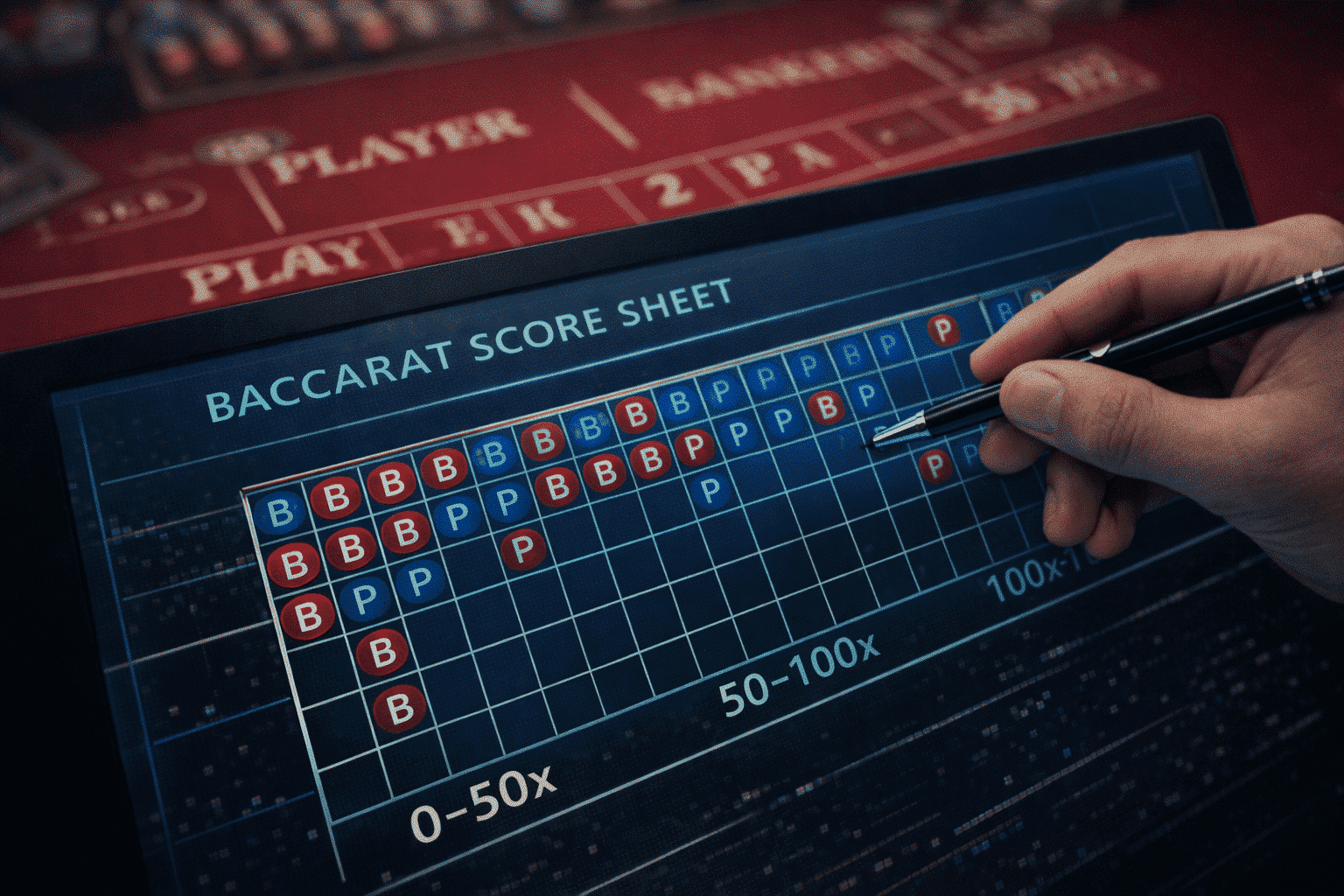
When you log into a Live Casino Baccarat lobby—whether it is Evolution, Playtech, or Pragmatic—you are immediately confronted with a grid of red and blue dots at the bottom of the screen. For the uninitiated, this looks like a game of Minesweeper gone wrong. For the professional, this is the “Roadmap.”
Let me be clear: Baccarat is a game of independent events. Mathematically, the past hand does not dictate the future hand. However, the “Shoe” behaves in ways that create trends. Clumps of high cards, clumps of low cards, and streaks of Banker or Player wins. The Roadmaps are not crystal balls; they are historical records designed to help you spot the “state” of the shoe. Is it choppy? Is it streaky? Is it neutral?
In this guide, we are going deep. We are going to move beyond the basic “Banker vs. Player” bet and learn how to read the Big Eye Boy, the Small Road, and the Cockroach Pig. If you want to play like a whale, you need to learn to read the water.
In This Article
The Fundamental Truth: Banker vs. Player
Before we dissect the roads, we must respect the math. Baccarat has one of the lowest house edges in the casino, which is why high rollers love it.
- Banker Bet: Wins 45.86% of the time. House Edge: 1.06% (including the 5% commission).
- Player Bet: Wins 44.62% of the time. House Edge: 1.24%.
- Tie Bet: Wins 9.52% of the time. House Edge: 14.36%.
Rule Number 1: Never bet the Tie. I don’t care if you have a “feeling.” A 14% house edge is an insult to your intelligence. It is a donation bin.
Rule Number 2: The Banker is mathematically superior. However, the 5% commission on Banker wins is annoying and slows down the game. Many players bet Player just to avoid the calculation, or they play “No Commission” Baccarat (which we will discuss later). But if you are playing purely for odds, the Banker is your default bet.
The Main Road: The Big Road (Da Lu)
The “Big Road” is the main grid you see. It tracks the outcome of every hand.
Red Circle = Banker Win
Blue Circle = Player Win
Green Line through a circle = Tie
The Big Road is organized in columns. A new column is started every time the winner changes. If the Banker wins three times in a row, you get three Red circles in a vertical column. If the Player wins the next hand, a new column starts with a Blue circle.
Reading the “Dragon”
The most sought-after pattern in the Big Road is the “Dragon.” This is a long streak of one color. I have seen Dragons go 15 or 20 hands deep. When a Dragon forms, the table goes wild. Everyone piles onto the streak.
Strategy: “Ride the Dragon.” If you see a streak of 4 or more, bet with it. Do not try to be the hero who predicts the end of the streak. “The trend is your friend until it bends.” Keep betting the streak until it loses. You will lose one unit at the end, but you might have won ten units on the way down.
Reading the “Ping Pong” (The Chop)
The opposite of the Dragon is “Ping Pong.” Banker, Player, Banker, Player. The columns never get deeper than one row.
Strategy: If the last twelve hands look like a zipper, do not bet on a streak. Bet on the chop. If Banker just won, bet Player.
The Derived Roads: Where the Pros Live
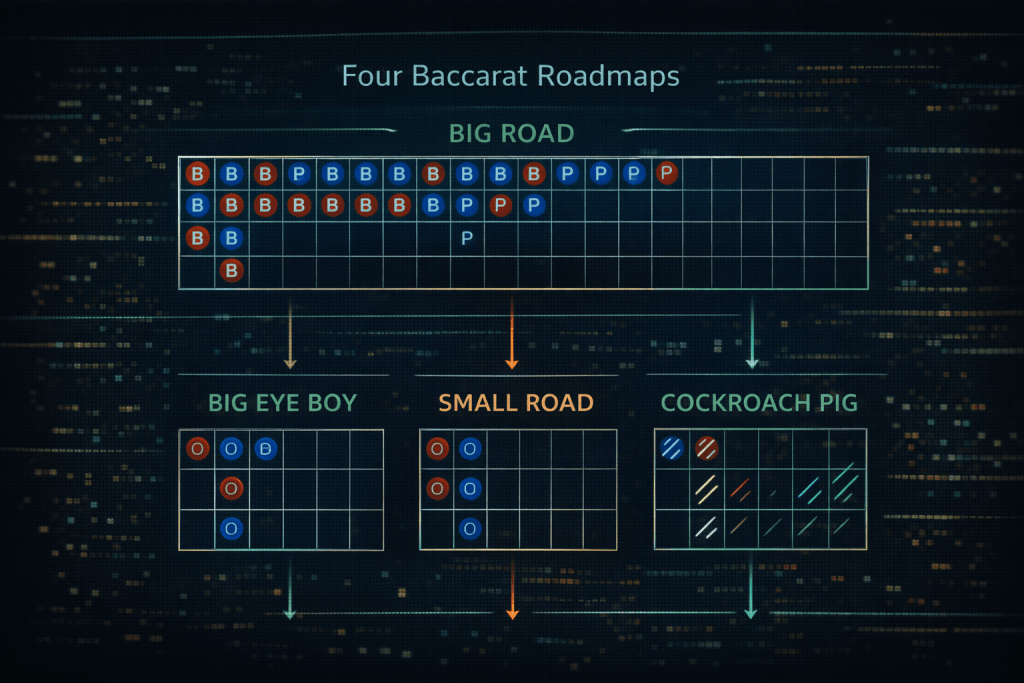
Below the Big Road, you will see three smaller, more confusing grids. These are the “Derived Roads.” They were invented in Macau to detect patterns within the patterns. They do not tell you if Banker or Player won; they tell you if the shoe is behaving predictably or chaotically.
These roads are:
1. Big Eye Boy (Da Yan Zai)
2. Small Road (Xiao Lu)
3. Cockroach Pig (Jia You Lu)
Crucial Concept: In derived roads, Red does NOT mean Banker, and Blue does NOT mean Player.
Red = Predictability / Order (The shoe is following a pattern).
Blue = Chaos / Disruption (The shoe changed its behavior).
1. Big Eye Boy
This looks at the Big Road and compares the current column to the previous column. It essentially asks: “Is the current streak doing the same thing the last streak did?”
If the Big Road shows a Banker streak of 3, and the previous Player streak was also 3, the Big Eye Boy marks Red (Order). If the Banker streak goes to 4, breaking the symmetry, the Big Eye Boy marks Blue (Chaos).
2. The Small Road
The Small Road works exactly like the Big Eye Boy, but it skips a column. It compares the current column to the column two spots back. It is looking for longer-term stability in the shoe mechanics.
3. The Cockroach Pig
This is the most sensitive road. It compares the current column to the column three spots back. It is often used to break ties when the other roads are conflicting.
How to Use Derived Roads for Betting
You do not need to calculate these yourself—the software does it. You need to look for congruence.
The “All Red” Signal:
Look at the next potential hand. The interface will usually show you “If Banker Wins” and “If Player Wins” buttons (often called “prediction buttons”).
Click them. If betting Banker would make the Big Eye Boy, Small Road, AND Cockroach Pig all turn Red, that is a very strong signal. It means that a Banker win would continue the established patterns of symmetry across all three derived roads.
The “Chaos” Signal:
If the roads are all Blue, the shoe is unpredictable. It is “choppy.” In this scenario, professional players often lower their bet size or sit out. A chaotic shoe is a dangerous shoe.
The “No Commission” Trap
You will see tables labeled “No Commission Baccarat” or “Super 6.” In these games, if you bet Banker and win, you get paid 1:1 (no 5% tax). It sounds great, right?
The Catch: If the Banker wins with a specific score of 6, you are only paid 0.5:1 (50% of your bet).
The math on this is brutal. The house edge on the Banker bet in No Commission Baccarat jumps to roughly 1.46%. That is nearly 40% worse than standard Baccarat.
Verdict: Avoid No Commission tables. Pay the 5% tax. It is cheaper in the long run.
Money Management: The Negative Progression Myth
I must address the Martingale system again because Baccarat players love it. They see a Banker streak and think, “Player must come next.” So they bet Player, double down, double down again.
In Baccarat, losing streaks can be devastatingly long. I have personally dealt a shoe with 18 Bankers in a row. A Martingale player betting against that streak would have lost the GDP of a small nation.
The 1-3-2-4 System
Instead, use a positive progression. Win more when you are winning; lose less when you are losing. The 1-3-2-4 system is excellent for Baccarat.
- Bet 1 unit. If you lose, restart. If you win…
- Bet 3 units. If you lose, you have lost 2 units total. If you win…
- Bet 2 units. If you lose, you are still UP 2 units. If you win…
- Bet 4 units. If you lose, you are UP 2 units. If you win, you are UP 10 units.
This system protects your profit. Once you win the second bet, you are guaranteed a profit even if the third bet loses.
Live Studio Nuances: Speed vs. Squeeze
Online, you have choices regarding the pacing.
Speed Baccarat:
Cards are dealt face up immediately. A round takes 27 seconds. This is for grinders. If you are playing the roadmap strict and fast, this is your table. But be careful—faster rounds mean you expose your bankroll to the house edge more times per hour.
Baccarat Squeeze:
The dealer slowly reveals the cards, bending the corners. This changes absolutely nothing about the outcome. The card is already determined. However, it recreates the tension of the Macau VIP rooms. If you are playing for entertainment and want to slow down your betting pace (which preserves bankroll), the Squeeze tables are actually a smart choice. You play fewer hands per hour, but enjoy them more.
Etiquette and “The Cut”
In live Baccarat, there is no physical interaction with the dealer regarding the cut, but the “Cut Card” is still vital. Usually, the shoe is replaced when about one deck remains (7 decks dealt).
If you are chatting in the lobby:
– Do not ask the dealer to “reveal” the card faster in a Squeeze game. That is the point of the game.
– Do not complain about the “Computer” fixing the game. Live Baccarat uses physical cards and scanners. It is one of the most transparent games exists.
Conclusion: The disciplined Approach
Baccarat is elegant, simple, and dangerous. The Roadmaps offer a way to navigate the chaos, but they do not control it. The cards do not know they are part of a “Big Eye Boy” pattern. They are just cards.
Use the roads to identify the current “personality” of the shoe. If the shoe is streaky, press your bets. If the shoe is choppy, flat bet or sit out. And always, always respect the bankroll. The goal is not to win every hand; it is to leave the table with more chips than you brought.
Frequently Asked Questions
What is the “Dragon Bonus”?
The Dragon Bonus is a side bet that pays out based on the margin of victory. For example, if your chosen side wins by 9 points (a “Natural” 9 vs 0), it pays 30:1. While tempting, the volatility is extreme. It is fun for a small flutter, but do not make it a core part of your strategy.
Should I ever bet on Tie?
No. Even with the 8:1 or 9:1 payout, the house edge is astronomical (over 14%). It is mathematically the worst bet on the table.
What does “Natural” mean in Baccarat?
A Natural is when the first two cards dealt to either the Banker or Player total 8 or 9. When this happens, the hand ends immediately. No third cards are drawn.
Can I count cards in Baccarat?
It is incredibly difficult and yields very little advantage. Unlike Blackjack, where high cards favor the player, the removal of cards in Baccarat changes the odds for Banker/Player very slightly. You would need to play thousands of hands to realize a profit of pennies. It is not worth the mental effort.
Why do players blow on the screen?
This is a superstition carried over from land-based Asian casinos. Players would blow on the cards to “blow away” the bad luck or a bad number (like a face card). In live dealer chat, you will often see people typing “blow” or using wind emojis. It’s just part of the culture.
Is the “Pair” bet worth it?
Betting on a Banker Pair or Player Pair usually pays 11:1. The house edge is roughly 10-11%. Like the Tie bet, it is a high-risk gamble. If you see a shoe that is “clumping” (lots of pairs appearing), you might try it, but don’t build a strategy around it.

Live Casino & Pöytästrategian Johtaja (Entinen Ammattijakaja)
Missio: En ainoastaan pelaa peliä; johdin sitä aiemmin. Tehtäväni Casino545:ssä on kuroa umpeen kuilu fyysisen kasinolattian ja näyttösi välillä. Hyödynnän kymmenen vuoden kokemustani ammattikrupieerina auttaakseni pelaajia tunnistamaan reilut pöydät, hallitsemaan matemaattiset strategiat ja välttämään kasinomyyttit, jotka kuluttavat pelikassaa.
Alan Kokemus
Urani alkoi vuonna 2012 Venetsian ja Monte Carlon arvostetuilla kasinolattioilla. Viiden vuoden ajan työskentelin ammattijakajana erikoistuen Blackjackiin, rulettiin ja baccarat’iin. Korttien jakaminen high rollereille opetti minulle kaikki alan niksit — kortinlaskennan vastatoimista reilua peliä sääteleviin tiukkoihin fyysisiin määräyksiin.
Vuonna 2017 siirryin verkkosektorille konsultoimaan suuria Live Dealer -studioita. Tämä sisäpiirin näkökulma antaa minulle mahdollisuuden arvioida asioita, joita satunnaiset pelaajat eivät huomaa: videostriimin viive, jakajan mikroilmeet ja onko digitaalinen kengän sekoitus todella satunnainen vai algoritmisesti vinoutunut.
Ydinosaamisalueet
- Live Dealer -mekaniikka: Kengän penetraation, sekoitusprotokollien ja fyysisten laitteiden eheyden analysointi.
- Matemaattinen Pöytästrategia: Blackjackin perusstrategian ja ruletin todennäköisyysmallien purkaminen.
- High-Roller VIP -protokollat: Pöytärajojen, VIP-kohtelun ja yksityissalongien reiluuden arviointi.
Arviointimenetelmä
- Jakaja-auditointi: Testaamme live-jakajat perusteellisesti ammattimaisuuden, menettelyvirheiden ja vuorovaikutuksen osalta. Pätevä jakaja tekee pelin; huolimaton vie etusi.
- Striimin Viivetesti: Varmistamme, onko 4K-videolähetys todella “live” vai keinotekoisesti viivästetty — kriittinen tekijä reaaliaikaisille panostusstrategioille.
- Strategian Varmennus: Testaan henkilökohtaisesti panostusjärjestelmiä (kuten Martingale tai Fibonacci) oikealla rahalla osoittaakseni matemaattisesti, mikä toimii ja mikä johtaa varmasti tappioon.
- Pöytärajojen Analyysi: Kartoitamme parhaat live-aulat sekä pienillä panoksilla pelaaville että VIP high rollereille, jotka etsivät maksimirajoja.
Sitoutuminen Vastuulliseen Pelaamiseen
Live-kasinopelit on suunniteltu immersiivisiksi ja nopeatempoisiksi. Henkilönä, joka on nähnyt pelaajien jahtaavan tappioita pöydän toiselta puolelta, kannatan vahvasti tiukkojen istuntorajojen asettamista. Suosittelemme vain live-kasinoita, jotka pakottavat “reality check” -toiminnot ja tarjoavat välittömät taukotyökalut pelikassan suojaamiseksi.