
Masterclass by: Marco Rossi
Let’s be brutally honest for a second. 98% of football bettors lose money in the long run.
They bet with their hearts. They bet on Manchester United because they “feel” like they are due a win after a bad run. They throw $50 on a 10-fold accumulator because the potential return looks life-changing. They chase their Saturday losses with reckless Sunday bets on leagues they know nothing about.
This is not betting. This is donating money to the bookmaker.
I am here to teach you how to be part of the 2%. The professionals. In 2026, beating the bookies isn’t about luck, “insider tips,” or gut feelings. It is about mathematics, strict discipline, and understanding markets that the casual punter ignores.
This guide is not for people who want a “quick win” to buy a beer. It is for those who want to treat sports betting as a serious investment class, similar to trading stocks or crypto. We are going to deconstruct the mechanics of the market, expose the flaws in public thinking, and give you a blueprint for long-term profitability.
In this article:
- Chapter 1: The Concept of “Value” (Implied Probability)
- Chapter 2: Mastering Asian Handicaps (The Pro’s Choice)
- Chapter 3: The Data Revolution (xG and Advanced Metrics)
- Chapter 4: Bankroll Management (The Kelly Criterion)
- Chapter 5: The Mental Game (Psychology of Betting)
- FAQ: Common Questions
Chapter 1: The Concept of “Value” (Implied Probability)
If you take nothing else from this article, take this: Never bet on a team just because you think they will win.
This sounds counter-intuitive, right? But professionals do not bet on winners; they bet on prices. You should only bet when the bookmaker’s odds are “wrong” compared to the true probability of the event.
The Math: Converting Odds to Probability
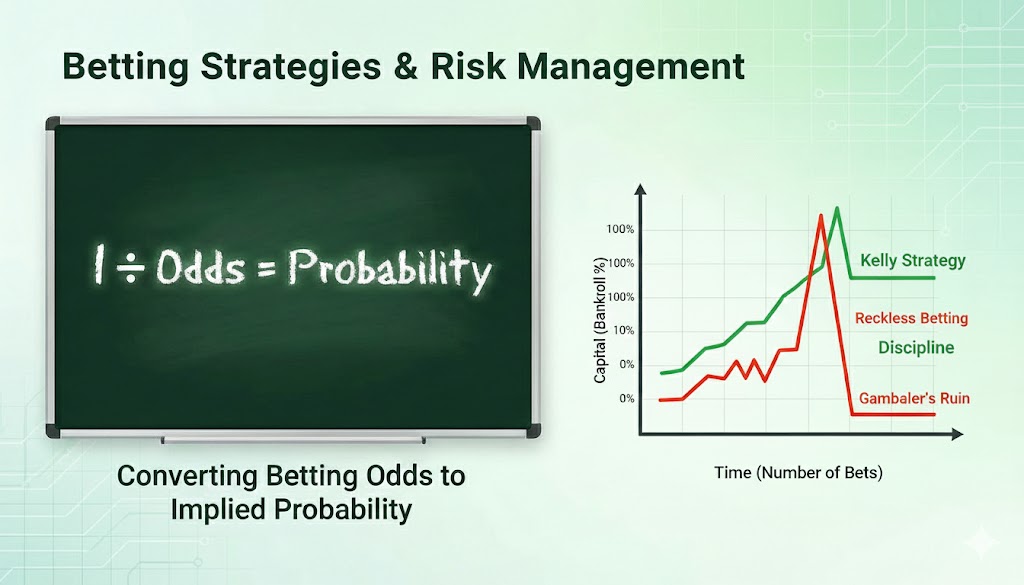
Every decimal odd represents a specific probability. To find it, use this simple formula:
1 ÷ Decimal Odd = Implied Probability
- Odds of 2.00: 1 ÷ 2.00 = 0.50 (50% Chance)
- Odds of 1.50: 1 ÷ 1.50 = 0.66 (66.6% Chance)
- Odds of 4.00: 1 ÷ 4.00 = 0.25 (25% Chance)
The “Value” Equation
Imagine I flip a fair coin. The chance of Heads is 50%. The “Fair Odds” should be 2.00.
- Scenario A: The bookie offers odds of 1.90. (This is bad value. You will lose money long-term because the payout is less than the risk).
- Scenario B: The bookie offers odds of 2.10. (This is Value. Even if the coin lands on Tails this time, if you make this bet 1,000 times, you are mathematically guaranteed to profit).
Marco’s Golden Rule: If your analysis (using xG, team news, form) says Real Madrid has a 60% chance of winning, but the bookie is offering odds of 2.00 (which implies only a 50% chance), you must bet. You have a 10% “edge” over the house. Over a season, these small edges accumulate into massive profits.
Chapter 2: Mastering Asian Handicaps (The Pro’s Choice)
Casual bettors love the 1X2 Market (Home Win, Draw, Away Win). Professionals almost exclusively play the Asian Handicap markets.
Why? Because the “Draw” is the bookmaker’s biggest weapon. In the 1X2 market, you have three outcomes, meaning you have a 66% chance of losing your bet if you pick a winner. In Asian Handicaps, you eliminate the draw, turning the game into a 50/50 binary choice. This significantly lowers your variance and protects your bankroll.
The “Quarter Lines” Cheat Sheet (2026 Edition)
Many players get confused by lines like -0.25 or +0.75. Do not be intimidated. It is simply splitting your stake between two bets.
| Handicap | Result: Team Wins | Result: Draw | Result: Team Loses |
|---|---|---|---|
| 0.0 (Draw No Bet) | Win | Refund (Push) | Loss |
| -0.25 | Win | Half Loss / Half Refund | Loss |
| -0.50 | Win | Loss | Loss |
| -0.75 | Win (Big Win if 2+ goals) | Loss | Loss |
| +0.50 (Double Chance) | Win | Win | Loss |
Pro Tip: Betting on the Underdog +0.50 is often much more profitable than betting on the Favorite -0.50. The public loves favorites, which pushes their odds down. The value usually lies with the unloved underdog who can scrape a 0-0 draw.
Chapter 3: The Data Revolution (xG and Advanced Metrics)
In 2026, looking at the “League Table” or “Last 5 Matches” is useless. Everyone has that information. To find an edge, you need to look at the Underlying Performance Metrics.
Understanding xG (Expected Goals)
xG measures the quality of a chance. A penalty is 0.76 xG. A shot from 40 yards is 0.02 xG. It tells you the story behind the scoreline.
Why does this matter? Because football is a low-scoring game with high variance.
Example: Team A beats Team B 2-0. The public thinks Team A is amazing.
The xG Reality: Team A had an xG of 0.35 (lucky deflection goals), while Team B had an xG of 2.10 but hit the post twice.
My Strategy for Finding Value with xG:
- The False Favorite: Identify teams that are “Over-performing” their xG (Scoring more than they create). They are lucky. Bet AGAINST them next week.
- The Hidden Gem: Identify teams that are “Under-performing” their xG (Creating chances but missing them). They are unlucky. Bet ON them next week.
Regression to the mean is the most powerful force in sports betting. Luck always runs out. Math is forever.
Chapter 4: Bankroll Management (The Kelly Criterion)
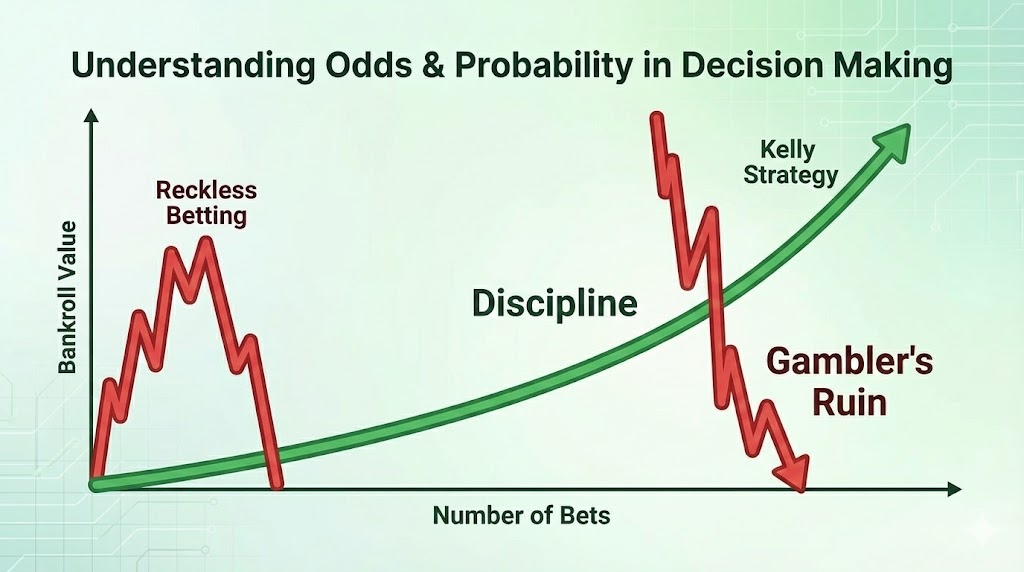
You can be the best analyst in the world, but without bankroll management, you will go bankrupt. It takes one bad run of variance to wipe you out. This is the boring part that saves your life.
The “Unit” System
Professional bettors strictly use “Units.”
1 Unit = 1% of your Total Bankroll.
If you have a $1,000 bankroll, your standard bet is $10.
If you are extremely confident (a 10/10 value spot), you might bet 3 Units ($30).
NEVER bet 10% or 20% of your bankroll on one game. This is suicide. Even a coin landing on Heads has a 50% chance, but you can easily flip Tails 10 times in a row.
The Kelly Criterion (Simplified)
For the math nerds, the Kelly Criterion calculates the exact optimal bet size based on your edge.
Formula: (BP – Q) / B
However, full Kelly is too volatile. I recommend “Quarter Kelly” betting. Calculate your edge, and bet 25% of what the formula suggests. This keeps your growth steady without the risk of ruin.
Chapter 5: The Mental Game (Psychology of Betting)
This is where 90% of bettors fail. It’s not the math; it’s the mind.
1. Handling “Tilt”
You bet on Liverpool. They dominate the game. They concede a 95th-minute penalty. You lose.
The amateur immediately bets double on the next game (usually a random 2nd division game) to “win it back.”
The professional closes the laptop and walks away.
Rule: Never place a bet within 30 minutes of a bad loss. Emotional betting has a negative ROI of -100%.
2. Avoiding “Market Noise”
Ignore the pundits on TV. Ignore the “Twitter Tipsters” with their 100% win rates (they delete their losing tweets). Trust your own data. If your model says bet, you bet. If your model says pass, you pass—even if it’s the Champions League Final and everyone else is betting.
Frequently Asked Questions
What is the best football betting strategy for beginners?
The best strategy for beginners is Asian Handicap betting. By eliminating the “Draw” option, you increase your chances of winning from 33% to 50%. Combined with strict bankroll management (betting only 1-2% of your balance per game), this offers the safest path to long-term profit.
How do I find “Value” in betting odds?
Value exists when the bookmaker’s odds imply a lower probability than the actual chance of the event happening. For example, if you calculate a team has a 50% chance of winning (Fair Odds 2.00) but the bookie offers odds of 2.20, that is a Value Bet. Over time, betting on value guarantees profit.
What is xG (Expected Goals) and why does it matter?
xG measures the quality of goalscoring chances created, rather than the actual goals scored. It is a better predictor of future performance. If a team is losing matches but has a high xG, they are likely “unlucky” and will start winning soon. Smart bettors back these teams before the market catches up.
Is the Martingale strategy good for football betting?
No, absolutely not. The Martingale strategy (doubling your bet after every loss) is mathematically guaranteed to bankrupt you. Eventually, you will hit a losing streak long enough to either hit the table limit or run out of money. Stick to “Flat Staking” or the “Kelly Criterion.”
🏆 Final Verdict: Discipline Wins Championships
Beating the bookies in 2026 is hard work. It requires ignoring your emotions, trusting the numbers, and grinding out small edges over thousands of bets.
Your Checklist for Success:
✅ Use Asian Handicaps to remove the draw.
✅ Check xG Data to spot “false” favorites.
✅ Never bet more than 1-3% of your bankroll.
✅ Keep a Spreadsheet of every single bet to track your ROI.
If you follow these pillars, you are already ahead of 98% of the market. Welcome to the pros.

Head of Live Casino & Table Strategy (Former Pro Dealer)
Mission: I don’t just play the game; I used to run it. My mission at Casino545 is to bridge the gap between the physical casino floor and your screen. I leverage a decade of experience as a professional croupier to help players spot fair tables, master mathematical strategies, and avoid the casino myths that drain bankrolls.
Industry Experience
My career began in 2012 on the prestigious casino floors of Venice and Monte Carlo. For five years, I worked as a professional dealer specializing in Blackjack, Roulette, and Baccarat. Dealing cards to high rollers taught me every trick of the trade — from card counting countermeasures to the strict physical regulations that govern fair play.
In 2017, I transitioned to the online sector to consult for major Live Dealer studios. That insider perspective allows me to evaluate what casual players completely miss: video streaming latency, dealer micro-expressions, and whether a digital shoe shuffle is truly random or algorithmically biased.
Core Areas of Expertise
- Live Dealer Mechanics: Analyzing shoe penetration, shuffle protocols, and physical equipment integrity.
- Mathematical Table Strategy: Deconstructing Blackjack basic strategy and Roulette probability models.
- High-Roller VIP Protocols: Evaluating table limits, VIP treatment, and private salon fairness.
Review Methodology
- The Dealer Audit: We rigorously test live dealers for professionalism, procedural mistakes, and interaction. A competent dealer makes the game; a sloppy one ruins your edge.
- Stream Latency Stress-Testing: We verify if the 4K video feed is truly “live” or artificially delayed, which is a critical factor for real-time betting strategies.
- Strategy Verification: I personally test betting systems (like the Martingale or Fibonacci) with real money to demonstrate mathematically what actually works and what guarantees ruin.
- Table Limits Analysis: We map out the best live lobbies, catering to both low-stakes grinders and VIP high rollers looking for maximum limits.
Commitment to Responsible Gambling
Live casino games are engineered to be immersive and fast-paced. As someone who has watched players chase losses from the other side of the table, I am a fierce advocate for setting strict session limits. We only recommend live casinos that enforce mandatory “reality checks” and offer immediate cooling-off tools to keep your bankroll safe.