Best Online Poker Sites for Real Money (2026) | Technical & Network Audit

Forget the marketing hype and the promises of easy tournament millions. If you want to survive in the highly predatory world of real-money online poker, you need to understand the underlying architecture of the platforms you are trusting with your bankroll. My name is Carlos Costa Silva, and as an independent casino and gaming network auditor with over twenty years in the iGaming sector, my job is to tear apart the software clients of the world's largest poker rooms. I look past the flashy tournament overlays to verify the raw mathematics of the card distribution, the strict segregation of player funds, and the aggressiveness of the operator's bot-detection security protocols.
In 2026, online poker remains the absolute ultimate test of skill, psychology, and mathematical discipline. Unlike algorithmic casino games where you are mathematically destined to lose to the house edge over time, peer-to-peer (PVP) poker pits you against other humans. Your decisions dictate your win rate. However, this environment introduces massive technical vulnerabilities: collusion, Real-Time Assistance (RTA) software, and automated bot rings. If you are playing on an unaudited, unregulated network, you are not playing poker; you are being actively robbed. This technical guide will break down exactly how legitimate poker networks generate random cards, how they legally charge you to play (the rake), and the massive red flags you must look for before making a deposit. Below this comprehensive audit, you will find our verified, technically secured list of the best online poker networks currently operating globally.
Table of Contents
- Our Auditor Verdict on Poker Network Technology
- Technical Audit: PRNG and Card Shuffling Integrity
- Game Integrity: Bot Detection and RTA Software
- The Mathematics of the Rake and Player Ecology
- Auditing the Formats: Cash Games vs. MTTs
- Player vs. Casino: The Mathematics of Live Dealer Poker
- The Auditor's Warning: Severe Red Flags in Online Poker
- Our Top-Rated Online Poker Sites for 2026
- Frequently Asked Questions About Online Poker
Our Auditor Verdict on Poker Network Technology
Online poker is a fundamentally different beast than traditional online casino gaming. When you play a slot machine, the operator makes money by paying out less than they take in. In online poker, the operator has absolutely no financial stake in the outcome of the hand. They simply provide the digital table, the security infrastructure, and the card-dealing algorithm, and they take a microscopic percentage of every pot (the rake) as a service fee.
Because the operator makes money regardless of who wins, a legitimate poker site has absolutely zero incentive to "rig" the game against you. Their entire business model relies on maintaining massive "player liquidity"—having enough active players online 24/7 to ensure that tournaments run and cash game tables are always full. The best online poker rooms in 2026 have evolved into massive digital ecosystems featuring integrated cryptocurrency cashiers, hyper-secure mobile applications, and biometric login protocols. We have aggressively audited the platforms below to ensure their player pools are globally robust, their PRNG algorithms are flawless, and their withdrawal times are immediate.
Key Technical Features of Top-Tier Poker Rooms
- Independently Verified PRNG: The card dealing software must be actively audited and certified by recognized authorities like BMM Testlabs or iTech Labs to ensure total mathematical unpredictability.
- Strict Fund Segregation: Top-tier operators are legally mandated to hold 100% of player bankrolls in completely separate, highly secure cold-storage or trust accounts, ensuring your money is never used to fund their corporate operating expenses.
- Aggressive Game Integrity Teams: The network must employ dedicated data scientists who use advanced machine learning algorithms to constantly scan hand histories for collusion, chip dumping, and automated bot usage.
- Transparent Rake Structures: We exclusively recommend sites that clearly publish their rake percentages and rake caps, allowing professional players to mathematically calculate their true win rates.
- High-Speed Global Liquidity: The platform must possess the server architecture capable of hosting over fifty thousand simultaneous connections during massive Sunday tournament series without a single millisecond of latency or disconnects.

Technical Audit: PRNG and Card Shuffling Integrity
The most common accusation thrown around by losing poker players is that "the software is rigged to generate action." From a technical auditing standpoint, this is a complete myth on fully licensed sites. Here is exactly how the cards are dealt mathematically.
The Pseudorandom Number Generator (PRNG)
Online poker sites do not use a single deck of digital cards; they use a highly encrypted mathematical engine called a Pseudorandom Number Generator. When a new hand begins, the PRNG requires a "seed." Modern tier-one poker clients generate this seed using external, unpredictable environmental factors—this can include the thermal noise of the server CPU, the exact microsecond movements of players' mice across thousands of screens, or even atmospheric data.
This highly chaotic seed is fed into a cryptographic hashing algorithm (such as SHA-256). The resulting hash is a massive string of alphanumeric characters that dictates the exact order of the fifty-two cards for that specific hand. We audit the certification of these PRNGs to ensure that the algorithm possesses zero pattern recognition. The distribution of full houses, bad beats, and river coolers mathematically mirrors the exact statistical probability of a physically shuffled deck in a Las Vegas casino over a sample size of millions of hands.
Game Integrity: Bot Detection and RTA Software
While you do not need to worry about the operator rigging the cards, you absolutely must worry about the other players at your table. In 2026, the primary threat to online poker is malicious software used by cheating players.
Real-Time Assistance (RTA) and GTO Solvers
Poker has been mathematically "solved" by supercomputers using Game Theory Optimal (GTO) strategy. Malicious players attempt to use RTA software—programs running on a secondary monitor that instantly tell the user the mathematically perfect decision (fold, call, raise, and exact sizing) for any given situation.
Our highest-rated poker networks combat this by utilizing incredibly aggressive, invasive client software. When you install a top-tier poker app, it actively scans your device's active background processes. If the client detects a known GTO solver or screen-scraping software running simultaneously, it instantly locks your account. Furthermore, Game Integrity teams run complex statistical variance reports on massive winning players. If a human player is making decisions that match computer-perfect GTO output 99.9% of the time, the data scientists will flag the account, freeze the funds, and ban the cheater, heavily redistributing the confiscated money back to the victims.
Collusion and Chip Dumping
Collusion occurs when two or more players sit at the same cash game table and secretly share their hole cards via Discord or Telegram, giving them a massive mathematical advantage over the rest of the table. Top poker networks run automated algorithms that constantly analyze the database for suspicious connections. If two specific IP addresses are constantly sitting at the same high-stakes tables and intentionally folding to each other's 3-bets while trapping other players, the software flags them for a manual audit.
The Mathematics of the Rake and Player Ecology
To play online poker profitably, you must mathematically beat two opponents simultaneously: the other players at the table, and the operator's rake.
Understanding Rake Caps
In a cash game, the casino takes a percentage of every pot that sees a flop—usually around 4% to 5.5%. However, the most critical number for an auditor is the "Rake Cap." This is the absolute maximum amount of money the casino can legally take from a single hand, regardless of how massive the pot becomes. If you are playing a $2/$4 No-Limit Hold'em game and two players go all-in for a $1,000 pot, a site with a 5% rake without a cap would take $50. However, a heavily audited, fair site will enforce a strict $3.00 Rake Cap. Understanding the rake structure is the absolute foundation of calculating your hourly win rate.
Rakeback and VIP Programs
To incentivize high-volume professional players (known as "grinders"), networks offer Rakeback programs. The operator physically returns a percentage of the rake you generated back to your account at the end of the week. If you generated $1,000 in rake and have a 30% flat rakeback deal, you receive $300 back. When we audit a poker site's value, we deeply analyze the mathematical transparency of their loyalty program. We fiercely reject networks that use hidden algorithms or confusing "loot boxes" to distribute rewards, heavily favoring sites that offer flat, mathematically calculable cashback percentages.
Auditing the Formats: Cash Games vs. MTTs
Different formats require completely different bankroll management strategies and mathematical approaches.
No-Limit Texas Hold'em (NLHE) Cash Games
This is the lifeblood of online poker. The blinds never increase, and the chips represent exact fiat or crypto value. Cash games require incredibly deep bankrolls to survive statistical variance. As a baseline mathematical rule, a professional player should never sit at a cash game table without having at least thirty to fifty "buy-ins" (100 big blinds each) safe in their main account balance to absorb inevitable downswings.
Multi-Table Tournaments (MTTs)
MTTs offer the incredible psychological allure of turning a massive return on investment (ROI) from a tiny buy-in. You pay a $20 entry fee, you are given a stack of tournament chips, and you play until one person holds all the chips. The operator simply takes a 10% fee upfront (e.g., a $20 + $2 tournament). However, the mathematical variance in MTTs is utterly brutal. Because you must navigate through fields of thousands of players, you can play perfectly and still go weeks without a single cash. Strict tournament players often maintain bankrolls of over two hundred average buy-ins to survive the mathematical droughts.
Lottery Sit & Gos (Spin & Gos)
These are hyper-turbo, three-handed tournaments where the prize pool is determined by a random digital spinner before the first card is dealt. The multiplier can range from 2x your buy-in up to an astronomical 10,000x. While these are incredibly popular for mobile users due to their speed, they carry the absolute highest variance of any poker format. The operator heavily skews the probability so that the spinner lands on the 2x multiplier roughly 70% of the time, making this format incredibly difficult to beat mathematically over the long term without a massive volume of play.
Player vs. Casino: The Mathematics of Live Dealer Poker
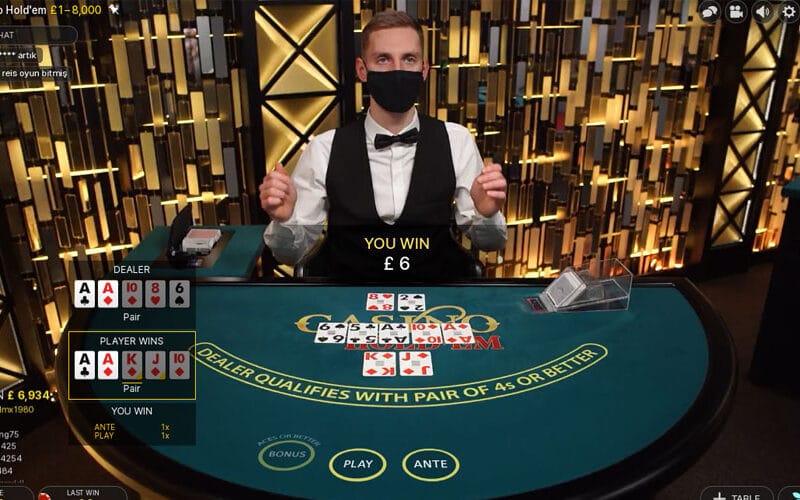
It is absolutely vital to completely separate peer-to-peer poker (where you play against humans) from "Casino Poker" (where you play directly against the house). Casino Poker is found in the Live Dealer or Table Games section of the operator's site, powered by studios like Evolution Gaming.
Casino Hold'em and Caribbean Stud
In games like Live Casino Hold'em, you are dealt two cards and must decide whether to fold or place a "Call Bet" to see the community cards and challenge the dealer's hand. Because the dealer must qualify (e.g., hold a Pair of 4s or better) for you to win the maximum payout, the mathematics are entirely fixed. You are not bluffing; you are simply calculating pot odds against a fixed paytable. Played perfectly, the house edge on base Casino Hold'em sits around 2.16%.
The Mathematical Trap of the "Bonus" Side Bets
Exactly like Live Blackjack, Casino Poker tables feature incredibly tempting Side Bets (such as the "AA+ Bonus" in Casino Hold'em or the "5+1" bet). You are betting that your specific hole cards plus the flop will create a massive poker hand like a Straight Flush. From an auditing perspective, you must avoid these circles entirely. The mathematical house edge on these side bets frequently exceeds 6.40%. They are mathematically engineered specifically to drain your bankroll while you wait for premium starting hands in the base game.
The Auditor's Warning: Severe Red Flags in Online Poker
Because online poker involves large sums of money held in peer-to-peer ecosystems, the risk of operator insolvency or predatory terms is high. You must aggressively audit the site's policies before depositing.
1. Anonymous Tables and Unverifiable Hand Histories
Some modern networks have moved to "Anonymous Tables," where players are just represented as "Player 1" and "Player 2" instead of having unique usernames. Operators claim this protects recreational players from being tracked by professionals. As an auditor, I vehemently oppose this. Anonymity completely destroys transparency. Without user tracking, independent watchdogs and players cannot pool hand histories to run statistical analysis to catch bots or colluding rings. If a poker network actively prevents you from downloading your own hand histories in text format to analyze in software like PokerTracker 4, it is a massive security red flag.
2. Predatory Withdrawal Fees
In 2026, there is absolutely zero technological or financial excuse for a poker operator to charge you to access your own money. The best crypto poker sites process Bitcoin, Ethereum, and USDT withdrawals instantaneously, directly to your cold wallet, for zero administrative cost (only the network gas fee applies). If you review a poker room's banking page and see terms like "5% processing fee on all withdrawals" or "maximum withdrawal of $2,000 per month," you must completely avoid that operator. Winning a $50,000 tournament is meaningless if the casino forces you to withdraw it in tiny installments over two years.
3. Ring-Fenced Liquidity
Poker requires massive liquidity to function. Due to complex local gaming regulations, some countries (like specific European nations or US states) force poker rooms to "ring-fence" their players—meaning players in that region can only play against other players physically located in that exact same region. This completely destroys the ecosystem. Cash games dry up, and tournament prize pools become incredibly small. As a player, you should always seek out fully licensed offshore or global networks that pool players internationally, guaranteeing massive guaranteed prize pools and 24/7 action.
Our Top-Rated Online Poker Sites for 2026
A world-class online poker experience depends entirely on network liquidity, the aggression of the game integrity security protocols, and the absolute mathematical fairness of the rake structure. You need a platform that offers massive Sunday tournament guarantees, instantaneous cryptocurrency withdrawals, and flawless mobile application stability for multi-tabling on the go. Our auditing team has meticulously tested the global networks to identify the absolute best rooms for both casual players and professional grinders. Every single platform listed below is fully licensed, utilizes certified PRNG shuffling algorithms, segregates player funds strictly, and provides the safest digital felt on the internet. Browse our verified rankings and take your seat.
Frequently Asked Questions About Online Poker
Are online poker sites mathematically rigged to create bigger pots?
No, this is a common myth. Fully licensed online poker sites utilize highly encrypted, third-party audited Pseudorandom Number Generators (PRNGs) to shuffle the virtual deck. The operator makes their revenue through a fixed percentage of the pot (the rake) regardless of who wins the hand. Rigging the software would instantly result in the loss of their operating license and the complete destruction of their business model.
What is the difference between a Cash Game and a Poker Tournament?
In a cash game, you sit down with actual real-money funds, the blind levels never change, and you can instantly stand up and leave with your money at any moment. In a tournament, you pay a strict entry fee for a set amount of virtual tournament chips. You must play until you are eliminated or until you win the entire event, and the blinds constantly increase to force the action.
Can players use software bots to cheat at online poker?
While malicious actors constantly attempt to use automated bots and Real-Time Assistance (RTA) solvers, the top-rated poker networks utilize incredibly aggressive security protocols. Their client software actively scans your device for forbidden background programs, and their data scientists use machine learning to analyze betting patterns to catch and immediately ban non-human accounts.
How does the online poker site make its money?
Online poker sites make their revenue entirely through a mechanic called the "Rake." In cash games, the software automatically deducts a small, mathematically capped percentage (usually around 4% to 5%) from every pot that reaches the flop. In tournaments, the operator charges a flat entry fee on top of the buy-in (for example, a $100 tournament might have an additional $9 fee that goes directly to the house).
Can I use a Heads-Up Display (HUD) software while I play?
This depends entirely on the specific terms of service of the poker network. Some traditional sites actively encourage the use of tracking software like PokerTracker or Hold'em Manager, displaying complex statistics about your opponents directly on the table. However, many modern networks have completely banned all third-party HUDs to create a safer, more balanced ecosystem for recreational players.
What is poker rakeback, and how do I earn it?
Rakeback is a loyalty reward system where the poker network refunds a percentage of the rake you generated back into your real-money account balance, usually on a weekly basis. To earn it, you simply need to play a high volume of cash games or tournaments. High-volume professional players utilize massive rakeback percentages to maintain profitability during mathematically difficult downswings.
Carlos Costa Silva
Founder and Chief Game Analyst at Casino545 (Since 2004)
Mission: I created Casino545 with a single, uncompromising goal: to cut through the marketing noise and bring real transparency to the online casino industry. My focus is on publishing independent, data-driven reviews built on actual operational testing, financial verification, and strict regulatory analysis. Marketing budgets don’t buy my opinions. Every evaluation follows rigorous editorial standards so players can access safe, compliant, and fair platforms.
Industry Experience: I’ve been breathing iGaming since 2004, right when regulated online gambling started expanding across Europe. I spent years working on the operational side for a major European operator, managing VIP support, payment processing, and internal risk controls. That “behind-the-scenes” experience gave me direct, hands-on exposure to how withdrawal procedures, AML compliance protocols, fraud prevention systems, and financial audits actually work. Today, I use that insider knowledge to audit casino payment systems, analyze withdrawal reliability, assess hidden bonus risks, and demand operational transparency from licensed platforms.
Core Areas of Expertise:
- Slot Volatility Mathematics: Analysing RTP variations and hit frequencies across major providers.
- Regulatory Frameworks: Deep understanding of European and local licensing mandates.
- Crypto & Fiat Payment Systems: Testing the real-world friction of casino banking infrastructures.
Review Methodology:
- Real-Money Deposit Testing: I personally fund and test casino cashier systems to evaluate transaction clarity and payment processing efficiency.
- Withdrawal Time Auditing: I measure the exact withdrawal cycle — from the moment I hit “submit” to the second the funds settle in my bank account — to prove financial reliability.
- Terms & Conditions Risk Analysis: I dig into the fine print to expose clauses affecting withdrawal limits, bonus conversion rules, and unfair account restrictions.
- Support Competency Verification: Anonymous, rigorous testing of customer support accuracy, escalation handling, and technical knowledge.
Commitment to Responsible Gambling: Player protection isn’t just a buzzword; it’s the core of my evaluation framework. I only prioritize operators that prove their regulatory compliance, enforce transparent policies, and offer structured self-exclusion systems. Gambling should be safe entertainment, and I strongly encourage access to independent support networks like GamCare and Gambling Therapy.