
The world of online casinos is a multi-billion dollar global industry engineered by some of the most brilliant mathematical and psychological minds on the planet. When you log into a digital casino lobby, you are stepping into a highly calculated environment where every flashing light, every promotional bonus offer, and every game mechanic has been meticulously designed to give the house an undeniable mathematical edge.
My name is Carlos Costa Silva. As an independent casino auditor with over two decades of experience analyzing gambling algorithms, investigating player disputes, and exposing predatory terms and conditions, I have witnessed thousands of new players voluntarily hand their money to the casino. I need you to understand a fundamental truth: the vast majority of beginners do not lose their money because the games are “rigged.” They lose because they make completely avoidable, fundamental errors that expose their bankroll to unnecessary risk.
Beginners often treat online gambling like a casual mobile video game. They skip the instructions, accept every flashing bonus without reading the fine print, and aggressively chase their losses when frustration sets in. The truth is, playing at an online casino requires a defensive strategy, strict financial discipline, and a deep understanding of the mathematical rules you are playing by. If you do not respect the math, the casino will efficiently and ruthlessly drain your funds.
If you are new to this world, this guide is your ultimate defense manual. I am going to strip away the marketing fluff and give you the unvarnished, insider truth. We are going to dissect the twelve most common, bankroll-destroying mistakes that beginners make. I will explain the hidden mechanics behind casino bonuses, the mathematical realities of slot game volatility, the psychological traps designed to make you tilt, and the exact strategies you must use to protect your money and maximize your entertainment value. Let’s get to work.
In This Guide
1. Blindly Accepting Bonuses Without Reading the T&Cs
This is unequivocally the most frequent, costly, and devastating mistake a beginner can make. You visit a new casino and see a massive, flashing banner: “200% Welcome Bonus up to $1,000!” You immediately deposit your money, claim the bonus, and start playing. A few hours later, you hit a massive $5,000 jackpot on a slot machine. You go to the cashier to withdraw your life-changing winnings, only to receive an email from the compliance team stating your withdrawal has been denied and your winnings have been permanently confiscated.
Why? Because you violated a rule buried on page four of the Bonus Terms and Conditions.
Casinos do not give away free money out of the goodness of their hearts. Casino bonuses are promotional marketing tools tied to incredibly strict contractual obligations. When you click “Accept Bonus,” you are legally agreeing to those terms. Here are the fatal traps beginners fall into because they didn’t read the fine print:
- The Maximum Bet Rule: Almost every casino bonus on earth comes with a strict maximum bet limit (usually around $5.00 or €5.00 per spin). If you have an active bonus and you place a single wager of $5.50, you have breached the contract. The casino will let you keep playing, but the moment you try to withdraw, their software will flag the violation and void your entire balance.
- Restricted Games Lists: You cannot play every game with bonus money. Casinos explicitly ban high-RTP (Return to Player) slots and games with progressive collection mechanics (like Blood Suckers, 1429 Uncharted Seas, or Castle Builder) from bonus play. If you open a restricted game with active bonus funds, your winnings are forfeit.
- Maximum Win Caps: Many lower-tier and offshore casinos hide a predatory clause that states: “Winnings generated from bonus funds are capped at 10x the original deposit.” If you deposit $50 and win $5,000, the casino will legally only let you withdraw $500. The remaining $4,500 is simply deleted from your account.
The Auditor’s Solution: Never claim a casino bonus until you have manually opened the Bonus Terms and Conditions page. Search specifically for “Maximum Bet,” “Wagering Requirements,” “Restricted Games,” and “Max Cashout.” If the terms are heavily restricted or overly confusing, decline the bonus completely and play with your raw, unrestricted cash.
2. Ignoring Wagering Requirements (The Math Trap)
This is a specific sub-category of the bonus mistake, but it is so deeply misunderstood by beginners that it requires its own mathematical breakdown.
When you accept a casino bonus, that money is not actual cash. It is “promotional equity” locked behind a Wagering Requirement (also known as a Playthrough Requirement or Rollover). This is a mathematical multiplier that dictates exactly how much money you must physically bet before the bonus funds convert into real, withdrawable cash that you can send to your bank account.
Beginners often look at a $100 bonus and think, “I just need to win a little bit and I can cash out.” This shows a fundamental misunderstanding of casino mathematics.
Let’s do the actual math:
Imagine you deposit $100 and receive a 100% match bonus of $100. You now have a $200 starting balance.
The terms state the bonus has a 40x Wagering Requirement on the Bonus Amount.
You must multiply the $100 bonus by 40.
$100 x 40 = $4,000.
You must place $4,000 worth of total bets (spins on a slot machine or hands of blackjack) before you can withdraw a single dollar. If you are betting $1.00 per spin, you must spin the reels 4,000 times. You are relying on the slot machine to give you enough small wins to keep your bankroll afloat while you churn through that massive volume.
Furthermore, you must beware of the devastating “Deposit + Bonus” Trap. If a casino enforces a 30x wagering requirement on the (Deposit + Bonus), you are actually facing a 60x requirement on the bonus itself. ($100 Deposit + $100 Bonus) x 30 = $6,000 in required wagers.
The Auditor’s Solution: Always calculate the total wagering requirement before you deposit. Actively hunt for “Non-Sticky” (or Parachute) bonuses. A non-sticky bonus allows you to play with your real money deposit first. If you win a massive jackpot while using your real money, you can instantly forfeit the bonus funds and withdraw your cash without ever having to complete a single wagering requirement.
3. Poor Bankroll Management and No Stop-Loss Limits
Many beginners log into an online casino with their debit card, deposit $50, lose it in ten minutes on a highly volatile slot, deposit another $100, lose that, and suddenly find themselves down $500 in a single evening without even realizing how it happened. This is financial suicide and the fastest way to ruin the entertainment value of gambling.
Professional gamblers and smart players use a strict mathematical system called Bankroll Management. Your “Bankroll” is not the money in your checking account or your life savings; it is a dedicated, isolated pool of money that you have specifically set aside for entertainment, which you are 100% comfortable losing entirely.
Beginners fail because they do not utilize Session Limits and proper Bet Sizing.
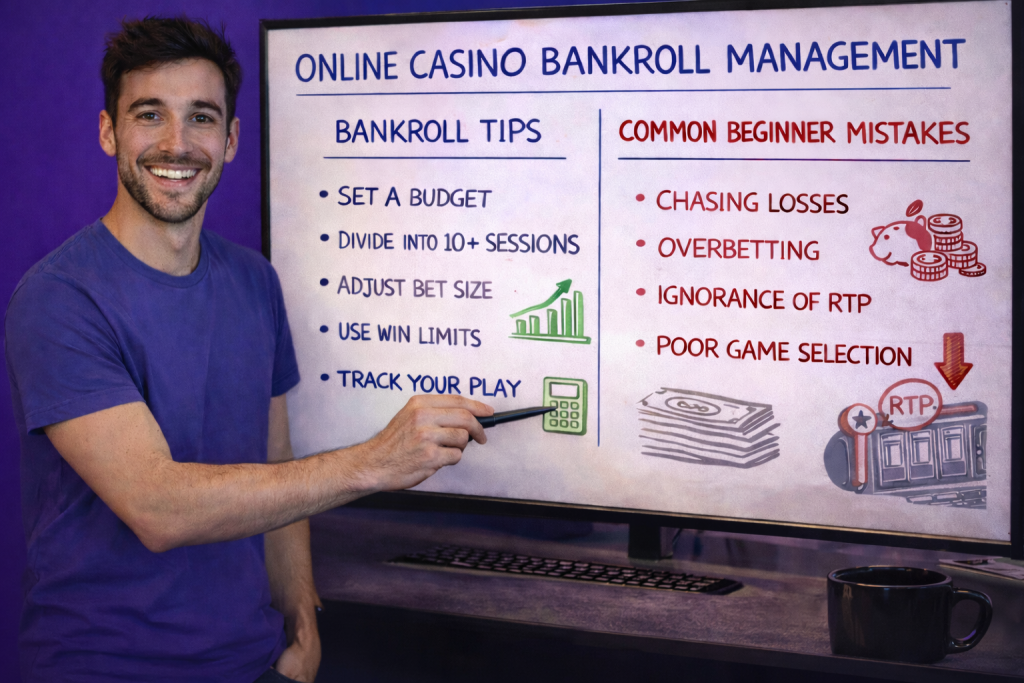
- Bet Sizing: A golden rule of gambling is that your individual bet size should never exceed 1% to 2% of your total session bankroll. If you deposit $100, your maximum slot spin should be $1.00 (or ideally $0.50). If you bet $5.00 a spin on a $100 bankroll, the natural mathematical variance (cold streaks) of the Random Number Generator will bankrupt you in minutes. You must give yourself enough “runway” to survive the dead spins.
- Chasing Losses: This is the most dangerous psychological loop in all of gambling. You lose $100, so you deposit $200 and double your bet size to “win it back quickly.” You lose that, so you deposit $500 in a state of panic. The casino’s mathematics do not care that you are down. The odds do not magically improve just because you are losing. You are simply compounding your negative expected value.
The Auditor’s Solution: Before you open a casino app, decide exactly how much you are willing to spend that day. Let’s say it is $50. Deposit the $50, and instantly go to your account settings and set a “Daily Deposit Limit” of $50. When that money is gone, your session is over. Close the browser, turn off your phone, and walk away.
4. Playing High-Volatility Games with a Small Bankroll
Beginners often browse the casino lobby, see a flashy, heavy-metal themed game like San Quentin or a Megaways slot advertising a “150,000x Max Win,” and immediately jump in. What they do not understand is the concept of Volatility (also known as Variance).
Volatility dictates how a game pays out, not just how much.
- Low Volatility Slots: These games (like NetEnt’s Starburst or Blood Suckers) pay out very frequently, but the individual wins are usually quite small. They are mathematically designed to keep your bankroll highly stable, providing long, entertaining sessions without massive swings in either direction.
- High Volatility Slots: These games (like Hacksaw Gaming’s Wanted Dead or a Wild or Pragmatic Play’s Gates of Olympus) act as brutal bankroll vacuum cleaners in the base game. They are mathematically designed to give you long, agonizing streaks of dead spins where you win absolutely nothing. The machine intentionally hoards the cash so it can occasionally pay out a massive, explosive multiplier during a very rare bonus round.
If you are a beginner with a $50 deposit and you play a maximum 5/5 volatility Megaways slot, there is a very high statistical probability that you will lose your entire deposit in fifteen minutes without ever seeing a bonus feature. You are buying a highly expensive lottery ticket.
The Auditor’s Solution: Match the game’s math model to your bankroll size. If you have a small budget and want to play for two hours, you must stick to low-to-medium volatility slots or classic table games. Leave the extreme volatility games to the high-rollers who have the massive 1,000-spin bankrolls required to survive the long, brutal droughts.
5. Misunderstanding the Gambler’s Fallacy
The Gambler’s Fallacy is a cognitive bias that has destroyed more bankrolls than any other psychological trap in human history. It is the false, irrational belief that if a specific event happens more frequently than normal in the past, it is statistically less likely to happen in the future (or vice versa).
The classic beginner example happens at the Roulette table. A beginner looks at the digital history board and sees that the ball has landed on “Black” eight times in a row. They think, “Red is absolutely due to hit! It has to balance out!” They place a massive, oversized bet on Red to capitalize on this “guarantee.” The ball lands on Black for the ninth time, and they lose their money.
The Auditor’s Reality Check: Online casino games operate on complex, certified Random Number Generators (RNG). Every single spin of a slot machine, every roll of the digital roulette wheel, and every shuffle of the blackjack deck is a completely Independent Trial.
The RNG has absolutely no memory. It does not know that Black just hit eight times. It does not care that a slot machine hasn’t paid a bonus round in 400 spins. The mathematical probability of the roulette ball landing on Red is exactly 48.6% (on a single-zero European wheel), regardless of what happened on the previous spin, or the previous one thousand spins. A slot machine is never “due” for a payout, and it is never running “hot” or “cold.” Those are human constructs applied to random math.
The Auditor’s Solution: Accept the mathematics. Never increase your bet size because you feel a win is “overdue.” Base your betting strategy entirely on your current bankroll size, not on the imaginary patterns you think you see on the screen.
6. Delaying the KYC (Account Verification) Process
“Know Your Customer” (KYC) is the mandatory identity verification process enforced by all legitimate global licensing authorities (like the UKGC, the Malta Gaming Authority, and the Curaçao LOK framework). Casinos are legally mandated by international law to verify your identity, age, and address to prevent money laundering, terrorist financing, fraud, and underage gambling.
A massive mistake beginners make is ignoring the verification tab when they first register. They deposit their money, play their favorite games, and win $1,000. They click “Withdraw,” expecting the money instantly, and suddenly their account is frozen. The casino demands a high-resolution copy of their passport, a selfie holding the ID, and a recent utility bill.
This leads to the dreaded “Pending Withdrawal Trap.”
Because the player hasn’t prepared their documents, the verification process takes 48 to 72 hours to complete. During those three days, the $1,000 is sitting in a “pending” state in the casino cashier. Many casinos intentionally leave a “Reverse Withdrawal” button sitting right next to the pending money. Frustrated and impatient, the beginner cancels the withdrawal, brings the money back to the slot machines to play “just a few more spins while they wait,” and ultimately loses the entire $1,000 before the compliance team even looks at their passport.
The Auditor’s Solution: Treat KYC as step one of your casino journey. The very moment you register a new casino account, navigate to the document upload section. Take clear, well-lit photos of your ID and a recent bank statement or utility bill, and upload them immediately. Force the casino to verify your account before you make your first real-money deposit. When you do finally win, your withdrawal will be processed instantly with no delays and no temptation to reverse it.
7. Playing Terrible Table Game Side Bets
If beginners decide to step away from the flashing lights of the slot machines and try digital table games, they often gravitate toward Blackjack or Baccarat. These are actually fantastic choices for a beginner, as they possess some of the lowest mathematical house edges in the entire casino (Blackjack played with a perfect basic strategy chart has a house edge of roughly 0.5%).
However, the casino is fully aware of this low margin. To increase their profit margins on these table games, they surround the main betting area with glowing, enticing Side Bets.
Beginners sit at a digital Blackjack table and see side bets like “Perfect Pairs” or “21+3.” They place their $5 main bet and casually toss a $1 chip onto the Perfect Pairs circle because it promises a massive 25-to-1 payout if they happen to get dealt two identical cards.
The Auditor’s Mathematical Truth: Side bets are notoriously predatory math traps. While the main game of Blackjack offers a 99.5% RTP, the “Perfect Pairs” side bet often carries an abysmal RTP of around 89% to 93% (meaning a massive house edge of 7% to 11%). You are voluntarily taking the best game in the casino and making a terrible mathematical wager that will slowly and methodically drain your bankroll on every single hand you play.
The Auditor’s Solution: Completely ignore the side bets. Treat them as if they do not exist on the felt. If you are playing Blackjack, print out a Basic Strategy chart, stick exclusively to the main hand, and grind out the lowest house edge possible.
8. Using the Wrong Payment Methods for Bonuses
Not all payment methods are created equal in the eyes of an online casino operator. Beginners will frequently spend hours finding the perfect casino, set up a new account, excitedly select the welcome bonus, and make their first deposit using a popular e-wallet like Skrill or Neteller.
The deposit goes through instantly, but the massive welcome bonus never appears in their account. The beginner emails customer support, only to be told that they have completely forfeited the promotion.
Why does this happen? Almost every major online casino has a hidden rule buried deep in their terms and conditions explicitly stating: “Deposits made via Skrill, Neteller, Paysafecard, or certain cryptocurrencies are strictly excluded from the Welcome Bonus.”
The Industry Secret: Casinos restrict these specific e-wallets for two very concrete business reasons. Historically, Skrill and Neteller were heavily abused by organized “matched betting” syndicates who created thousands of fake accounts to illegally farm casino bonuses. Secondly, the merchant processing fees charged by these e-wallets are significantly higher than traditional bank cards. The casino simply refuses to pay those high transaction fees while simultaneously handing you free promotional money.
The Auditor’s Solution: Always make your very first deposit at a new online casino using a standard Visa/Mastercard debit card, a direct Open Banking transfer (like Trustly or Interac), or the specific cryptocurrency actively being promoted by the site. Once you have successfully claimed and cleared the welcome bonus, you can safely switch your banking method back to your preferred e-wallet for day-to-day transactions.
9. Playing at Unlicensed or Offshore Scam Casinos
In a desperate search for the biggest possible bonuses, or perhaps looking for a way to bypass national self-exclusion schemes (like GAMSTOP in the UK or Spelpaus in Sweden), beginners often fall into the darkest, most dangerous trap on the internet: the completely unregulated offshore scam casino.
These websites are engineered to look incredibly professional. They steal high-quality graphics, feature games that look absolutely identical to famous titles from Pragmatic Play or Evolution, and offer absurdly large bonuses like “500% Match + No KYC Required.”
The Reality of the Scam:
If a casino does not hold a verifiable license from a recognized, government-backed authority (such as the MGA, UKGC, GRA, or the new Curaçao LOK framework), they answer to absolutely no one. You have zero legal protection.
- Pirated Software: Scam casinos do not host real games. They host stolen, pirated, clone versions of popular slot games running on their own private servers. They manipulate the source code to artificially lower the RTP from 96% down to 20% or even 0%, meaning it is mathematically impossible for you to ever win over a session.
- Total Non-Payment: If you somehow manage to get lucky and request a withdrawal, they simply will not pay you. They will ignore your emails, permanently block your IP address, delete your account, and steal your original deposit. You have no regulatory body to complain to and zero legal recourse to get your money back.
The Auditor’s Solution: Never, under any circumstances, deposit money into a casino without mathematically verifying their regulatory license. Scroll to the absolute bottom footer of the website. Do not just look at the logo; physically click the licensing seal. If it is a real license, it will open a dynamic, cryptographically secure hyperlink to the official government registry proving the casino is legally active. If the seal is just a static JPEG image that does nothing when clicked, close the website immediately.
10. Trying to Beat the Casino with “Betting Systems”
The internet is flooded with self-proclaimed “casino gurus” selling guaranteed mathematical systems designed to beat digital Roulette, Baccarat, or Blackjack tables. The most famous and historically destructive of these is the Martingale System.
Beginners learn the Martingale and genuinely believe they have discovered an infinite money glitch. The system dictates that you place an even-money bet (like Red on Roulette). If you lose, you double your bet on the next spin. If you lose again, you double it again. The logic dictates that eventually, mathematically, you have to win. When you finally do, the doubled bet will recover all previous losses and yield a profit equal to your original starting unit.
The Auditor’s Mathematical Demolition: The Martingale system is a catastrophic financial trap that will inevitably result in the total, instantaneous destruction of your bankroll. It fails catastrophically for two absolute reasons:
- Exponential Growth: If you start with a $5 bet and hit a terrible streak of just 8 losses in a row (which happens frequently in statistics), your 9th bet requires you to wager $1,280 just to win back your original $5 profit. You are risking over a thousand dollars to win five. Most beginners do not have the liquid bankroll to sustain this terrifying exponential math.
- Hard Table Limits: Even if you are a multi-millionaire with infinite funds, the casino protects itself. Every single table game in the world enforces a strict “Maximum Bet Limit.” You will quickly hit the ceiling of the table limit (e.g., $500), making it physically impossible to place the next required doubled bet. At this exact moment, your massive loss is permanently locked in.
The Auditor’s Solution: Accept the cold, hard truth: there is no mathematical betting progression system that can overcome a negative expectation game (a game with a built-in house edge). Betting systems do not change the odds of the game; they only manipulate the volatility of your bankroll. Play table games for entertainment, apply basic strategy to minimize the edge, but never believe a doubling system will guarantee a profit.
11. Playing Emotional, Stressed, or Intoxicated (The Tilt)
Gambling is an inherently emotional activity. The massive adrenaline rush of a near-miss, the incredible dopamine hit of a 1,000x multiplier, and the sheer, agonizing frustration of a long losing streak all deeply affect your brain chemistry.
When a beginner drinks alcohol, plays while highly stressed from work, or gambles immediately after a personal argument, their prefrontal cortex (the part of the brain directly responsible for logical decision-making, impulse control, and risk assessment) is heavily suppressed. This leads to a dangerous psychological state known in the poker world as “Tilt.”
When a player is on tilt, all rational bankroll management instantly goes out the window. They raise their bet sizes recklessly out of anger, they cancel pending withdrawals to get more funds, they aggressively chase their losses, and they load up maximum volatility games out of pure frustration, hoping for a miracle. The casino’s algorithms are specifically designed to capitalize on players who are in this exact emotional state.
The Auditor’s Solution: Treat online gambling with the exact same respect you would treat operating heavy machinery. Never gamble when you are intoxicated, depressed, or angry. If you feel your heart rate elevating, your palms sweating, or a sense of desperation after a bad beat, force yourself to physically stand up, close your laptop or lock your phone screen, and walk away from the game for a mandatory minimum of 24 hours.
12. Failing to Utilize Responsible Gambling Tools on Day One
Legitimate, government-licensed online casinos are legally required by their regulators to provide a comprehensive suite of Responsible Gambling (RG) tools within your account settings. A massive, foundational mistake beginners make is viewing these tools as mechanisms “only meant for severe addicts.”
By the time a player realizes they actually need to use the tools, they have usually already lost significantly more money than they could afford.
The Auditor’s Solution: The defining mark of a professional, highly disciplined gambler is the proactive use of RG tools on Day 1. The very moment you open a new casino account, before you even make your first deposit, navigate to the Responsible Gaming tab and instantly activate these three features:
- The Deposit Limit: Set a strict daily, weekly, or monthly deposit limit based exclusively on your disposable entertainment budget. Once you hit this limit, the casino software will physically block your debit card from processing another transaction until the timeframe officially rolls over.
- The Loss Limit: This is a significantly more powerful tool than a standard deposit limit. It specifically tracks your net losses. If you deposit $100 and win $500, but then start losing it all back, a strict loss limit will automatically freeze your gameplay before you give all your winnings back to the house.
- The Reality Check: Turn this feature on to trigger an inescapable pop-up notification every 30 or 60 minutes. It forcefully interrupts your gameplay, breaking the hypnotic, trance-like state induced by slot machines, and explicitly displays exactly how much money you have won or lost during that specific session, forcing you to make a conscious choice to continue.
Conclusion
The online casino is a formidable, highly calculated opponent, backed by multi-million dollar algorithms and uncompromising mathematics. If you walk into this digital environment blind, relying on pure luck and making the common beginner mistakes outlined above, the casino will quickly, quietly, and efficiently drain your bankroll.
However, by rigorously reading the terms and conditions, utilizing strict stop-loss limits, avoiding predatory side bets, verifying your identity proactively, and refusing to play at unregulated sites, you strip away the massive psychological advantages the casino relies upon. You transition from being an easy target into an educated, disciplined player. Treat gambling exclusively as entertainment, respect the mathematics, and always protect your funds above all else.
Frequently Asked Questions (FAQs)
Why did the online casino cancel my withdrawal and confiscate my winnings?
The absolute most common reason for confiscated winnings is a direct violation of the Bonus Terms and Conditions. If you played with active promotional bonus funds, you highly likely exceeded the strict Maximum Bet Limit (which is usually capped at $5 per spin) or you played a specific slot game that was explicitly placed on the casino’s “Restricted Games” list. Casinos utilize highly advanced automated compliance software to instantly flag these rule breaches the moment a withdrawal is requested.
Are online casino slot games rigged to make beginners lose?
No, licensed and regulated online casinos are not rigged. They do not need to cheat because the underlying mathematics of the games guarantee them a long-term profit (known as the House Edge). All games at regulated casinos are rigorously tested by independent auditing laboratories (like eCOGRA or GLI) to ensure the Random Number Generator (RNG) is completely random, unpredictable, and fair. Beginners lose quickly not because of malicious rigging, but because of poor bankroll management and playing high-volatility games.
What is the difference between a Sticky and Non-Sticky casino bonus?
A “Sticky” bonus mathematically locks your real money deposit and the bonus funds together from the very first spin; you cannot withdraw a single dollar until the entire massive wagering requirement is met. Conversely, a “Non-Sticky” (or Parachute) bonus keeps your real money completely separate. You play with your real cash first, and if you hit a massive win early on, you can simply forfeit the attached bonus money and instantly withdraw your cash without completing any wagering requirements.
How do I know if an online casino is actually safe and legitimate?
Never trust a casino based solely on its sleek website design or the massive size of its welcome bonus. You must scroll to the absolute bottom footer of the website and locate their regulatory licensing seal (such as the MGA, UKGC, GRA, or Curaçao LOK). You must physically click on the seal; it must immediately open a dynamic, cryptographically secure link to the official government registry proving the casino holds an active, legally compliant status.
Why does the casino need a copy of my passport and a utility bill?
Legitimate online casinos do not collect this sensitive information to delay your payout or annoy you; they are legally mandated to do so under strict international Anti-Money Laundering (AML) and Know Your Customer (KYC) laws. Government regulators require casinos to cryptographically verify that you are of legal gambling age, that the payment method definitively belongs to you, and that you reside in a permitted geographic jurisdiction before they can legally release any financial funds.
What is mathematically the safest game for a beginner to play?
For beginners looking to preserve their bankroll and minimize the casino’s inherent mathematical advantage, digital Blackjack (played strictly utilizing a perfect Basic Strategy chart) is the safest option, offering an incredibly low house edge of roughly 0.5%. If you prefer the entertainment of slot machines, look exclusively for “Low Volatility” slots with an RTP (Return to Player) of 96% or higher, which provide frequent, smaller payouts designed to keep your balance highly stable.
Founder and Chief Game Analyst at Casino545 (Since 2004)
Mission: I created Casino545 with a single, uncompromising goal: to cut through the marketing noise and bring real transparency to the online casino industry. My focus is on publishing independent, data-driven reviews built on actual operational testing, financial verification, and strict regulatory analysis. Marketing budgets don’t buy my opinions. Every evaluation follows rigorous editorial standards so players can access safe, compliant, and fair platforms.
Industry Experience
I’ve been breathing iGaming since 2004, right when regulated online gambling started expanding across Europe. I spent years working on the operational side for a major European operator, managing VIP support, payment processing, and internal risk controls. That “behind-the-scenes” experience gave me direct, hands-on exposure to how withdrawal procedures, AML compliance protocols, fraud prevention systems, and financial audits actually work.
Today, I use that insider knowledge to audit casino payment systems, analyze withdrawal reliability, assess hidden bonus risks, and demand operational transparency from licensed platforms.
Core Areas of Expertise
Slot Volatility Mathematics: Analysing RTP variations and hit frequencies across major providers.
Regulatory Frameworks: Deep understanding of European and local licensing mandates.
Crypto & Fiat Payment Systems: Testing the real-world friction of casino banking infrastructures.
Review Methodology
Real-Money Deposit Testing: I personally fund and test casino cashier systems to evaluate transaction clarity and payment processing efficiency.
Withdrawal Time Auditing: I measure the exact withdrawal cycle — from the moment I hit “submit” to the second the funds settle in my bank account — to prove financial reliability.
Terms & Conditions Risk Analysis: I dig into the fine print to expose clauses affecting withdrawal limits, bonus conversion rules, and unfair account restrictions.
Support Competency Verification: Anonymous, rigorous testing of customer support accuracy, escalation handling, and technical knowledge.
Commitment to Responsible Gambling
Player protection isn’t just a buzzword; it’s the core of my evaluation framework. I only prioritize operators that prove their regulatory compliance, enforce transparent policies, and offer structured self-exclusion systems. Gambling should be safe entertainment, and I strongly encourage access to independent support networks like GamCare and Gambling Therapy.