By Lars Jensen
If you are playing crypto slots because you like the flashing lights or the sound of coins dropping, you are the perfect customer. Casinos love you. You are paying for entertainment, and the price of admission is your inevitable loss.
But if you are playing to win—or at least to minimize the mathematical tax levied on your wallet—you need to stop looking at the graphics and start looking at the numbers. In the world of blockchain gambling, a slot machine is not a game. It is a complex probability engine governed by three hard-coded metrics: RTP (Return to Player), Volatility (Variance), and Hit Frequency.
As a blockchain tech lead, I do not believe in “lucky streaks.” I believe in variance distribution. In this guide, I will deconstruct the source code of modern crypto slots. I will teach you how to differentiate between a 96% RTP and a 99% RTP, how to spot pirated software that steals your funds, and why “Bonus Buys” are often a mathematical suicide mission.
Table of Contents
The Engine: RNG vs. Provably Fair
Before we discuss strategy, we must define the mechanism. In 2026, crypto slots fall into two technical categories. Understanding the difference is the first step in your OpSec (Operational Security).
1. Server-Side RNG (Traditional Video Slots)
When you play a slot from a major provider like Pragmatic Play, Hacksaw, or NoLimit City, the game does not run on the casino’s server. It runs on the provider’s server. The casino is merely a “frontend” window.
When you press “Spin,” your browser sends a request to Pragmatic’s server. Their certified Random Number Generator (RNG) calculates the result and sends it back. The casino has zero control over this outcome. They cannot “switch a button” to make you lose. They can only choose which RTP version of the game to host (more on this later).
2. Provably Fair Slots (Blockchain Native)
These are the proprietary games built by the crypto casino itself (e.g., “Stake Originals” or “BC Originals”). These operate on the same logic I explained in my Crash Gambling guide.
The Key Difference: You can verify every single spin. The result is pre-determined by a Server Seed and your Client Seed. If you are a skeptical player who trusts nobody, these are the only slots you should play. However, they lack the visual polish and complex bonus mechanics of traditional video slots.
RTP Explained: The Theoretical Lie
RTP stands for Return to Player. It is the percentage of total money wagered that a slot is programmed to pay back to players over a massive sample size (usually 1 billion spins).
If a slot has an RTP of 96%, it means for every $100 wagered, the machine keeps $4 (The House Edge) and returns $96. Simple, right? Wrong.
The “Short-Term” Variance Trap
The biggest mistake players make is assuming RTP applies to their specific session. It does not.
In a session of 1,000 spins, your personal RTP could range from 0% (you lose everything) to 5,000% (you hit a max win). The 96% figure is a long-term mathematical limit. You will never see the true RTP unless you play for 10 years straight.
The Variable RTP Scam
Here is a secret casinos don’t want you to know: Game providers create multiple versions of the same game.
Take the popular slot “Gates of Olympus.” Pragmatic Play offers this game with RTP settings of:
- 96.50% (The “Gold” standard)
- 95.50%
- 94.50%
- 88.00% (The “Predator” setting)
A shady crypto casino will host the 88% version but advertise it as the standard game. You cannot tell the difference visually. The graphics are identical. The only difference is that your money disappears 8% faster. Always check the “Game Info” or “?” file inside the slot interface to find the actual RTP of the specific version you are playing.
Volatility: The Silent Bankroll Killer
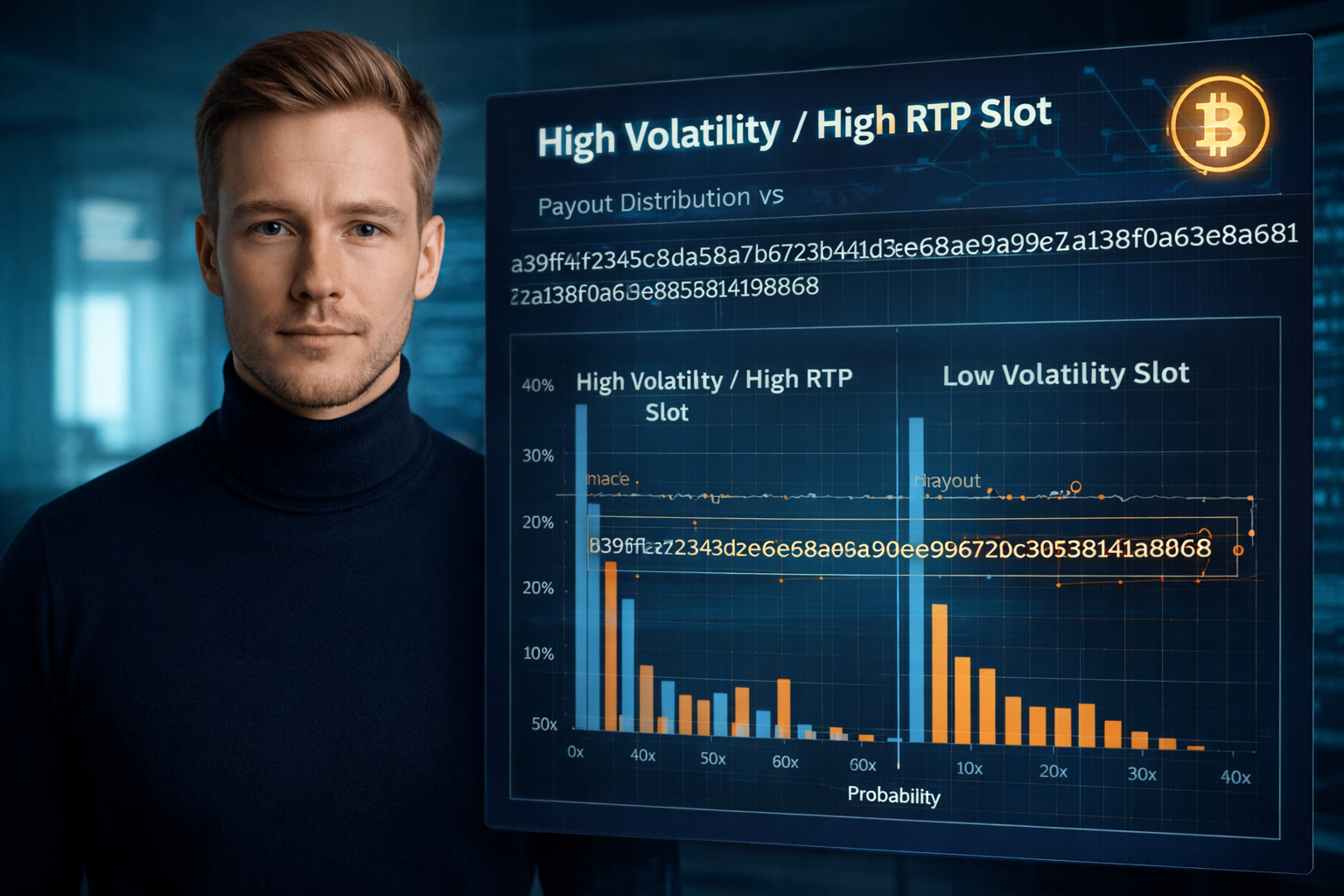
If RTP is the “Price” of the game, Volatility is the “Risk.”
Volatility (or Variance) dictates how the RTP is distributed.
- Low Volatility: You win frequently, but the wins are small (0.5x to 5x your bet). Your graph looks like a gentle slope downwards. You get a lot of “playtime” for your money.
- High Volatility: You endure long streaks of “dead spins” (losing money). But when you win, you win big (100x to 5,000x). Your graph looks like a cliff drop followed by a vertical spike.
The “Max Win” Illusion
Crypto slots in 2026 are obsessed with “Max Wins.” You will see games advertising “50,000x Max Win!”
Warning: To pay for that one massive 50,000x jackpot, the game must take money from millions of other spins. Extremely high volatility slots (like San Quentin or Mental) are essentially lottery tickets. They are designed to drain 99% of players to pay the top 1%.
If you have a small bankroll (under $500), playing high volatility slots is mathematically unwise. You will likely hit “Risk of Ruin” (going to zero) before you trigger the bonus that pays back the RTP.
Security Alert: How to Spot Fake Slots
This is the most technical part of this guide, and the most important for your safety.
Unlicensed “Script” casinos will host pirated versions of popular games. These look exactly like the real thing, but they are not running on the provider’s server. They are running on a private server where the admin controls the win rate.
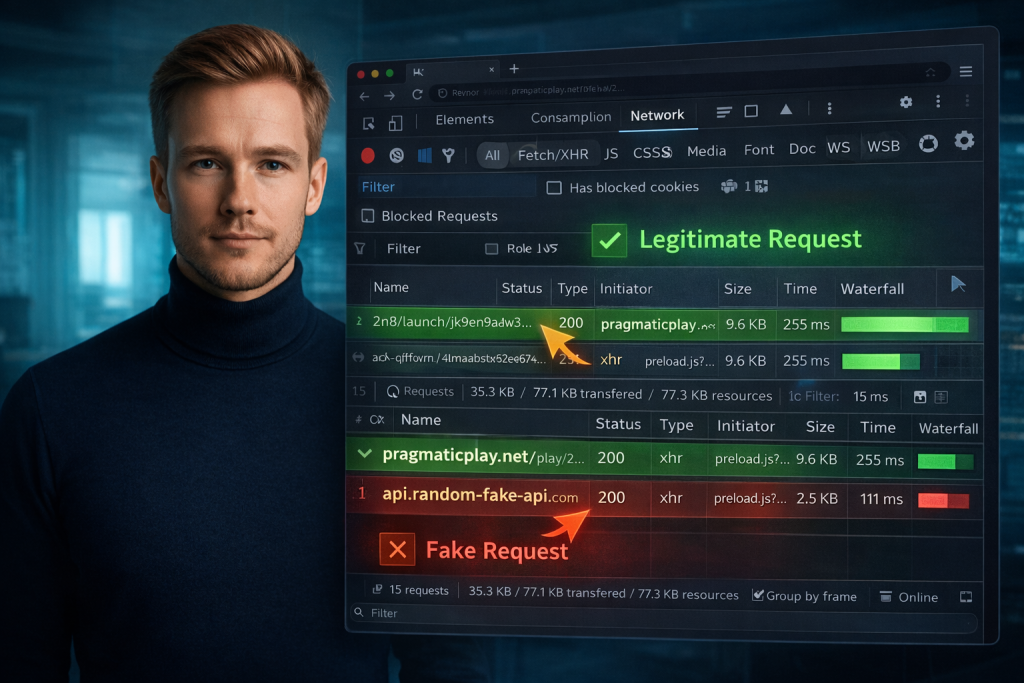
The “Inspect Element” Method
You can verify a slot’s authenticity using your browser’s Developer Tools. Here is the Lars Jensen protocol:
- Open the slot game in your browser (Chrome/Firefox).
- Right-click anywhere on the screen and select Inspect.
- Go to the Network tab.
- Spin the reels once.
- Look at the network requests appearing in the list.
What to look for:
You need to verify the Host URL of the game server.
- Real Pragmatic Play: Requests should go to `*.pragmaticplay.net` or `*.ppgames.net`.
- Real Evolution/NetEnt: Requests should go to `*.evolution.com` or `*.casinofra.com`.
- Real Hacksaw: Requests should go to `*.hacksawgaming.com`.
The Red Flag:
If the game is sending requests to a generic domain like `gserver-api.xyz`, `slots-api.ru`, or the casino’s own domain (e.g., `mycryptocasino.com/api/spin`), IT IS A FAKE SLOT. Close the tab immediately. Your money is gone.
The Math of Bonus Buys
Many modern crypto slots allow you to “Buy the Bonus” for 100x or 200x your bet. This skips the base game and takes you straight to the free spins.
Is it worth it?
From a pure RTP perspective: Yes.
Most developers slightly increase the RTP when you buy the bonus. For example, a game might have a 96.2% base RTP but a 96.4% “Bonus Buy” RTP.
The Trap:
While the RTP is higher, the Volatility skyrockets. When you bet $1, you lose $1 if you miss. When you buy a bonus for $100, you can instantly lose $80 if the bonus pays out poorly (which happens often). Bonus buying is the fastest way to destroy a bankroll. Only attempt this if you have a bankroll of at least 50x the buy-in price.
The “200 Spin” Strategy
Slots are negative expectation games (House Edge > 0). No strategy can guarantee a profit. However, you can use strategy to optimize your probability of hitting a bonus without going bust.
My preferred method for testing a new slot is the 200 Spin Rule:
- Set a Stop Loss: Determine exactly how much you are willing to lose.
- Calculate Bet Size: Your bet size should be your Bankroll / 200. (e.g., $100 Bankroll = $0.50 spins).
- The Logic: Most slots trigger a bonus feature roughly once every 150-200 spins on average. By ensuring you have enough ammo for 200 spins, you statistically maximize your chance of seeing at least one feature.
- The Exit: If you trigger a bonus and win significantly (e.g., 50x your bankroll), STOP. The math dictates that if you keep playing, the variance will swing back down. Lock in the profit.
Top Developers by Mathematical Profile
Not all code is written the same. Here is my breakdown of the top developers based on their mathematical tendencies:
- Pragmatic Play (The All-Rounder): High volatility, massive max wins (5,000x standard), but prone to long “dead” streaks. Best for: High Rollers.
- Hacksaw Gaming (The Extremist): Their games are binary. You either win nothing, or you win 10,000x. Their “DuelReels” mechanic is notoriously volatile. Best for: Streamers and Jackpot Hunters.
- PG Soft (The Mobile King): Medium volatility, extremely high RTP (often 97%+), designed for mobile play. Best for: Grinders and Wager Completion.
- NoLimit City (The Insanity): Complex mechanics (xWays, xNudge) with confusing payout structures but the highest max wins in the industry (up to 300,000x). Best for: Those who understand deep mechanics.
Conclusion
Winning at crypto slots is not about predicting the next spin. It is about understanding the cost of the game.
RTP is your cost. Volatility is your risk. Verification is your safety.
If you refuse to check the RTP in the settings, and you refuse to inspect the network traffic for fake scripts, you are not a gambler—you are a victim. Treat slots like a software audit. Check the specs, verify the host, manage your liquidity, and never trust a machine that hasn’t been audited.
FAQ: Crypto Slots
Do crypto slots pay out more than fiat slots?
Generally, yes. Crypto casinos have lower overhead costs (no payment processing fees, fewer staff), allowing them to offer slots with higher RTP settings (97-99%) compared to land-based casinos (85-90%) or regulated fiat sites (94-96%).
Can I use a VPN to play blocked slots?
Yes, but be careful. While you can access the game, if you win a jackpot, the provider might check your IP during the audit. If they see a VPN IP from a restricted country, they can legally void the win. It is safer to play on “No KYC” crypto casinos that explicitly allow VPN usage.
What is “RTP Range”?
This is a feature that allows casinos to choose the RTP. If a provider lists their game as “RTP Range: 92% – 96%,” it means the casino can select either setting. Always assume the casino has picked the lower one until you verify it.
Are “Provably Fair” slots better than Pragmatic/NetEnt?
For transparency? Yes. For entertainment and win potential? usually No. Provably Fair slots are graphically simple and often lack the “explosive” multiplier mechanics of commercial slots. They are better for steady, low-volatility play.
How do I know if a slot is “Hot” or “Cold”?
You don’t. The “Hot/Cold” fallacy is a cognitive bias. Every spin is an independent event. The RNG does not care that the machine hasn’t paid out in an hour. It has no memory.

Crypto Gambling Expert & Blockchain Tech Lead (Since 2013)
Mission: I trust code, not promises. The crypto gambling space is still the Wild West, and my job at Casino545 is to guide you through it safely. I don’t care about flashy marketing; I verify that “Provably Fair” algorithms are actually fair and that your crypto withdrawals are mathematically protected from technical loopholes and hidden terms.
Industry Experience
I mined my first Bitcoin back in 2013 and have been deeply immersed in blockchain architecture and cyber security ever since. Before joining Casino545, my daily routine involved auditing DeFi smart contracts and stress-testing the payment gateways of newly launched crypto casinos to ensure they were watertight.
That hardcore technical background allows me to spot what regular reviewers completely miss. I can read the hash-strings of a crypto game to verify cryptographic fairness, and I know exactly how to differentiate a legitimate blockchain licensing protocol from a fake trust seal.
Core Areas of Expertise
- Cryptographic Fairness: Decompiling client-seed and server-seed hashes to prove RNG legitimacy.
- Smart Contract Auditing: Finding backdoors or exploitable code in decentralized gambling platforms (Web3).
- Privacy & KYC Protocols: Stress-testing anonymity claims and withdrawal friction in crypto-only environments.
Review Methodology
- The Blockchain Speed Test: I run live deposit and withdrawal cycles using BTC, ETH, and USDT, measuring the exact block confirmation times against the casino’s marketing claims.
- Provably Fair Verification: I manually verify the seeds and hashes on high-volatility games like Crash, Dice, and Plinko to guarantee results are 100% tamper-proof.
- Anonymity Check: I stress-test the KYC process to expose whether a “No-KYC” casino truly respects your privacy, or if they trap your funds behind sudden document requests the moment you win.
- Smart Contract Audits: For decentralized casinos, I dig into the underlying code to ensure there are no malicious withdrawal lockups.
Commitment to Player Security
Crypto gambling offers unmatched financial freedom, but it comes with permanent risks — there are no chargebacks on the blockchain. I advocate heavily for mandatory 2FA (Two-Factor Authentication) architectures and prioritize educating players on how to secure their wallet keys before they ever connect to a gambling dApp.