
By Marco Rossi
Every week, a new player walks into the live casino lobby thinking they are the next Rain Man. They watched a Hollywood movie, memorized a basic Plus-Minus system, and printed out a chart. They sit at a $50 minimum live blackjack table, stare intensely at the screen, and start moving their lips as they count the cards. I used to watch these guys from the pit. Now I watch them bleed their bankrolls dry online. The truth is harsh. The math is unforgiving. If you are trying to count cards in a modern live dealer studio, you are not an advantage player. You are a mark.
In This Article
I am going to break down exactly why your card counting system is failing online. We are going to strip away the myths sold by internet gurus who want you to buy their counting software. We will look at the mechanics of the live dealer shoe, the mathematical brick wall of deck penetration, the speed of the game, and the software the house uses to track your bets. By the end of this guide, you will understand how the casino protects its money, and more importantly, how you can stop handing yours over so easily.
The Illusion: How Card Counting Is Supposed to Work
To understand why counting fails online, you must first understand why it works in a physical casino. Card counting is not about memorizing every single card that has been dealt. It is about tracking the ratio of high cards to low cards remaining in the shoe.
The most common system is the Hi-Lo system. You assign a value to every card you see.
- Low cards (2, 3, 4, 5, 6) are assigned a value of +1.
- Neutral cards (7, 8, 9) are ignored. They are 0.
- High cards (10, Jack, Queen, King, Ace) are assigned a value of -1.
As the dealer pulls cards from the shoe, you keep a “Running Count” in your head. If a lot of low cards come out, your count goes up into the positive numbers (+5, +8, +12). This is the dream scenario. A high positive count means the remaining shoe is packed with Tens and Aces.
Why do you want Tens and Aces? Because they make Blackjacks (which pay 3:2). They also cause the dealer to bust more frequently when they are forced to hit a stiff hand like a 15 or 16. When the count is high, the advantage shifts from the casino to the player. The counter then drastically increases their bet size to capitalize on this mathematical edge.
That is the theory. It is mathematically sound. MIT students proved it. Professional gamblers made millions doing it. But the casinos did not just sit there and take the hit. They adapted. And when the game moved to the internet, they built the ultimate defense.
The Ultimate Countermeasure: Deck Penetration
This is the concept that amateur counters completely ignore. It is the single most important factor in advantage play. Deck Penetration refers to how many cards the dealer deals out of the shoe before shuffling.
In a classic Las Vegas high-roller room, a dealer might use a 6-deck shoe and place the cut card behind the 5th deck. This means 5 out of 6 decks are dealt before a shuffle. That is roughly 83% penetration. With deep penetration, the count becomes incredibly accurate. If you reach the last deck and the running count is +15, you have absolute mathematical certainty that the remaining cards are heavily loaded with face cards.
Now, let’s look at the Live Dealer environment.
Log into any major provider. Evolution. Playtech. Pragmatic. Watch the dealer set up a new shoe. They take 8 decks of cards (416 cards). They shuffle them. Then, they take the yellow cut card and place it exactly in the middle of the shoe. Sometimes they even place it at 40%.
This means they are only dealing 4 decks out of 8. 50% penetration.
This destroys the math. Completely obliterates it. Why? Because of the True Count.
The Death of the True Count
A Running Count of +10 means nothing on its own. You must convert it to a “True Count” to know your actual advantage. You do this by dividing the Running Count by the number of decks remaining in the shoe.
Let’s run the scenario at an online table with 50% penetration.
You sit down. The shoe starts. You count diligently. After two decks are dealt, your Running Count is an impressive +12. You feel the adrenaline. It is time to raise your bet, right?
Wrong. Let’s do the math.
There are 8 decks total. 2 have been dealt. That leaves 6 decks remaining in the shoe.
True Count = Running Count (+12) divided by Remaining Decks (6).
True Count = +2.
A True Count of +2 gives you a microscopic advantage over the house. Maybe half of a percent. You raise your bet, hoping to capitalize. But the dealer hits the yellow cut card almost immediately after. The shoe is over. The cards are swapped. The count resets to zero.
Because they cut the shoe in half, you never reach the deep end of the shoe where the True Count mathematically skyrockets. The volatility remains too high. The remaining cards are still too diluted by the unplayed decks. You will spend hours grinding, raising your bets on weak True Counts, and losing to the natural variance of the game.
The Shuffling Machines: Constant Reset
You might think, “I’ll just find a table that deals deeper.” Good luck. Live casinos are factories. They operate on strict standard operating procedures. The dealers are heavily monitored to ensure they place that cut card exactly where management dictates.
Furthermore, look at the equipment. Many live tables use Automatic Shuffling Machines (ASMs). While the dealer is dealing one 8-deck shoe, the previous 8 decks are in a machine behind them, being perfectly randomized. The moment the cut card comes out, the shoes are swapped. There is zero downtime. You cannot track card clumping. You cannot track dealer shuffle patterns. The randomization is absolute.
Worse, some physical casinos use Continuous Shuffling Machines (CSMs), where discards are fed back into the machine immediately. Live online casinos rarely use CSMs for blackjack because players hate the look of them—they prefer the physical shoe for trust reasons. But by using an 8-deck shoe and cutting it at 50%, the online casinos achieve the exact same mathematical protection as a CSM. They make counting irrelevant.
Speed and Variance: The Silent Killers
Let us pretend for a moment that you found a flaw. Let us say you found a sloppy dealer online who cuts the shoe at 75%. You have a mathematical edge. You are ready to print money.
You still lose. Why? Hands per hour.
Card counting is not a get-rich-quick scheme. It is a grind. A professional card counter in a physical casino expects an edge of about 1% to 1.5%. To realize that tiny statistical edge, they have to play massive volume. They need to play hundreds of hands an hour. If you play head-up against a fast physical dealer, you can see 200 hands an hour.
At a live dealer table online, there are usually 7 seats. Players have 15 seconds to make a decision. Someone always waits until the 14th second. The dealer has to read the screen, pull the cards, and clear the bets. A fast live dealer table might give you 50 hands an hour. A slow one gives you 35.
With an edge of 1%, playing 40 hands an hour, the variance will tear your bankroll apart before the math corrects itself. You could play perfectly for a month and still be down money purely because you cannot generate the necessary volume of hands to let the statistics play out. Your “Long Run” might take three years to achieve at that speed.
The Pit Boss Software: Bet Spread Detection
Here is a secret from the floor. Casinos do not rely on humans to catch card counters anymore. They rely on algorithms. When you play online, every single action is logged. Every bet, every hit, every stand.
To make money counting, you have to spread your bets. You bet the minimum (say, $10) when the count is negative or zero. When the True Count hits +3, you suddenly jump your bet to $100 or $150. This 1-to-10 or 1-to-15 bet spread is how you extract value from the shoe.
The moment you do this online, the software flags your account. The system tracks your bet sizing perfectly against the mathematical composition of the remaining shoe. If your bets correlate directly with the True Count over a few shoes, an alert pops up on a manager’s screen in Malta or Riga. They don’t send a heavy guy to tap you on the shoulder. They simply implement digital countermeasures.
They might restrict your betting limits. They might remove you from VIP promotions. They might just let you keep playing, knowing that the 50% penetration rule means your bet spread will eventually fail and you will give the money back anyway. You are fighting a supercomputer with a piece of paper.
Wonging: The “Bet Behind” Trap
Stanford Wong popularized a strategy called “Back-Counting” or “Wonging.” The idea is you stand behind a table, count the cards without betting, and only sit down and place a bet when the count is highly positive. You avoid all the negative expectation hands.
Online players think they can do this. They open four different live blackjack streams. They don’t take a seat. They just sit in the lobby and count. When Table A gets hot, they jump in.
The casinos saw this coming a decade ago. Here is how they stop it.
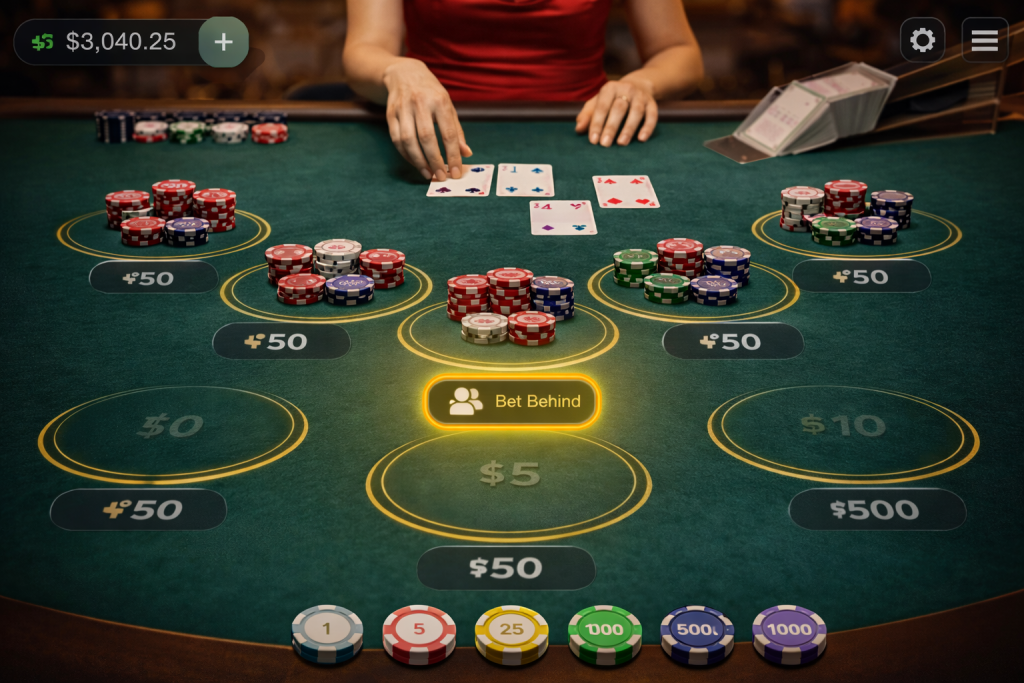
First, tables are usually full. You can’t just take a main seat when you want to. You have to use the “Bet Behind” feature. The problem with Bet Behind is that you have no control over the hand. If the main player is an idiot who splits 10s against a dealer 6, you are forced to ride their terrible decision. Your mathematical edge from the count is destroyed by their bad basic strategy.
Second, many high-stakes exclusive tables simply prohibit mid-shoe entry. If you didn’t bet the first hand after the shuffle, you cannot place a bet until the next shuffle. Wonging is dead online.
The Licensing and Fair Play Reality
When players realize they cannot win by counting, they usually run to the forums and cry that the games are rigged. They claim the cards are marked, or the shoes are stacked by a computer.
This is the cry of a loser. The games are not rigged. If a casino operates under a strict regulator, such as the Malta Gaming Authority, the physical equipment is audited constantly. The cards are standard, physical playing cards. They have RFID chips inside them to read the value to the computer screen, but the order is entirely random based on the physical shuffle.
The casino does not need to cheat you. Cheating is a risk to their license. They beat you legally by manipulating the rules: 8 decks, 50% penetration, slow game speed, and strict table limits. It is a perfectly legal, heavily regulated slaughterhouse.
If You Can’t Count, How Do You Win?
If you have read this far, you might be asking if there is any point in playing live blackjack at all. Yes, there is. But you have to change your definition of “winning.” You are not going to make a living doing this. You are playing for entertainment, and you are playing to minimize the house edge to give yourself the best chance of a lucky winning session.
Your weapon is not counting. Your weapon is Perfect Basic Strategy.
Print out a basic strategy chart specifically for an 8-deck shoe where the dealer stands on soft 17 (the standard online rule). Memorize it. Play it flawlessly. Never take insurance. Never play the side bets (Perfect Pairs, 21+3). Do not deviate because you have a “hunch.”
If you play perfect basic strategy, the house edge is roughly 0.5%. That means for every $100 you wager, you technically only lose 50 cents in the long run. With an edge that low, natural variance will give you winning nights. You will have sessions where you double your bankroll purely by getting good cards. When that happens, have the discipline to cash out.
Conclusion: Stop Chasing Ghosts
The internet is full of hucksters selling courses on how to beat live dealer blackjack with secret counting software. They are selling you a ghost. I have managed the floors. I know the math the house uses to protect the vault. The 50% cut card is a brick wall that no counting system can break through.
Stop trying to outsmart the system. Stop spreading your bets recklessly on a +2 count. Accept the game for what it is: a highly polished, heavily regulated game of chance where the house holds a tiny, unbreakable advantage. Play the math. Play the basic strategy. Have fun. And leave the counting to the movies.
Frequently Asked Questions
Is it illegal to count cards in online blackjack?
It is not illegal. It is not a crime to use your brain to do math. However, the casino is a private business. If their software detects you spreading your bets in a way that correlates with the count, they have the right to restrict your betting limits, ban you from promotions, or close your account entirely based on their terms of service.
Do card counting apps work for live casinos?
No. There are apps where you can click buttons to track the cards instead of doing it in your head. The apps do the math perfectly. The problem is not the math; the problem is the 50% deck penetration. The app will tell you the exact True Count, but the True Count will never get high enough to give you a profitable edge before the dealer shuffles.
What does “burning a card” mean, and does it hurt the count?
Burning a card means the dealer takes the first card from the new shoe and discards it face down without showing it. In physical casinos, this is an anti-cheating measure. Online, some providers do it, some do not. If you are counting, a burned card represents missing information. It slightly hurts the accuracy of your count, but it is a minor issue compared to the shoe penetration.
Why do they use 8 decks instead of 6?
The more decks used in the shoe, the higher the house edge, and the less sensitive the True Count becomes. An 8-deck shoe dilutes the concentration of high cards faster than a 6-deck shoe. It is purely a defensive mechanism by the casino providers to increase their profit margin.
Should I ever take Insurance if I am not counting?
Never. The Insurance bet pays 2:1, but the actual odds of the dealer having a Blackjack when showing an Ace are worse than that. It is a sucker bet designed to prey on players who are afraid of losing their strong hands. A card counter will only take Insurance when the True Count is exceptionally high (usually +3 or higher). Since you cannot reach that count online, you must always decline Insurance.
Does the “Bet Behind” feature change the odds?
The math of the cards remains the same, but your fate is tied to the decisions of the main seat player. If you bet behind a player who plays perfect Basic Strategy, you enjoy the standard 0.5% house edge. If you bet behind a player who hits a hard 17 or splits tens, your house edge skyrockets. You are gambling on their competence.

Head of Live Casino & Table Strategy (Former Pro Dealer)
Mission: I don’t just play the game; I used to run it. My mission at Casino545 is to bridge the gap between the physical casino floor and your screen. I leverage a decade of experience as a professional croupier to help players spot fair tables, master mathematical strategies, and avoid the casino myths that drain bankrolls.
Industry Experience
My career began in 2012 on the prestigious casino floors of Venice and Monte Carlo. For five years, I worked as a professional dealer specializing in Blackjack, Roulette, and Baccarat. Dealing cards to high rollers taught me every trick of the trade — from card counting countermeasures to the strict physical regulations that govern fair play.
In 2017, I transitioned to the online sector to consult for major Live Dealer studios. That insider perspective allows me to evaluate what casual players completely miss: video streaming latency, dealer micro-expressions, and whether a digital shoe shuffle is truly random or algorithmically biased.
Core Areas of Expertise
- Live Dealer Mechanics: Analyzing shoe penetration, shuffle protocols, and physical equipment integrity.
- Mathematical Table Strategy: Deconstructing Blackjack basic strategy and Roulette probability models.
- High-Roller VIP Protocols: Evaluating table limits, VIP treatment, and private salon fairness.
Review Methodology
- The Dealer Audit: We rigorously test live dealers for professionalism, procedural mistakes, and interaction. A competent dealer makes the game; a sloppy one ruins your edge.
- Stream Latency Stress-Testing: We verify if the 4K video feed is truly “live” or artificially delayed, which is a critical factor for real-time betting strategies.
- Strategy Verification: I personally test betting systems (like the Martingale or Fibonacci) with real money to demonstrate mathematically what actually works and what guarantees ruin.
- Table Limits Analysis: We map out the best live lobbies, catering to both low-stakes grinders and VIP high rollers looking for maximum limits.
Commitment to Responsible Gambling
Live casino games are engineered to be immersive and fast-paced. As someone who has watched players chase losses from the other side of the table, I am a fierce advocate for setting strict session limits. We only recommend live casinos that enforce mandatory “reality checks” and offer immediate cooling-off tools to keep your bankroll safe.