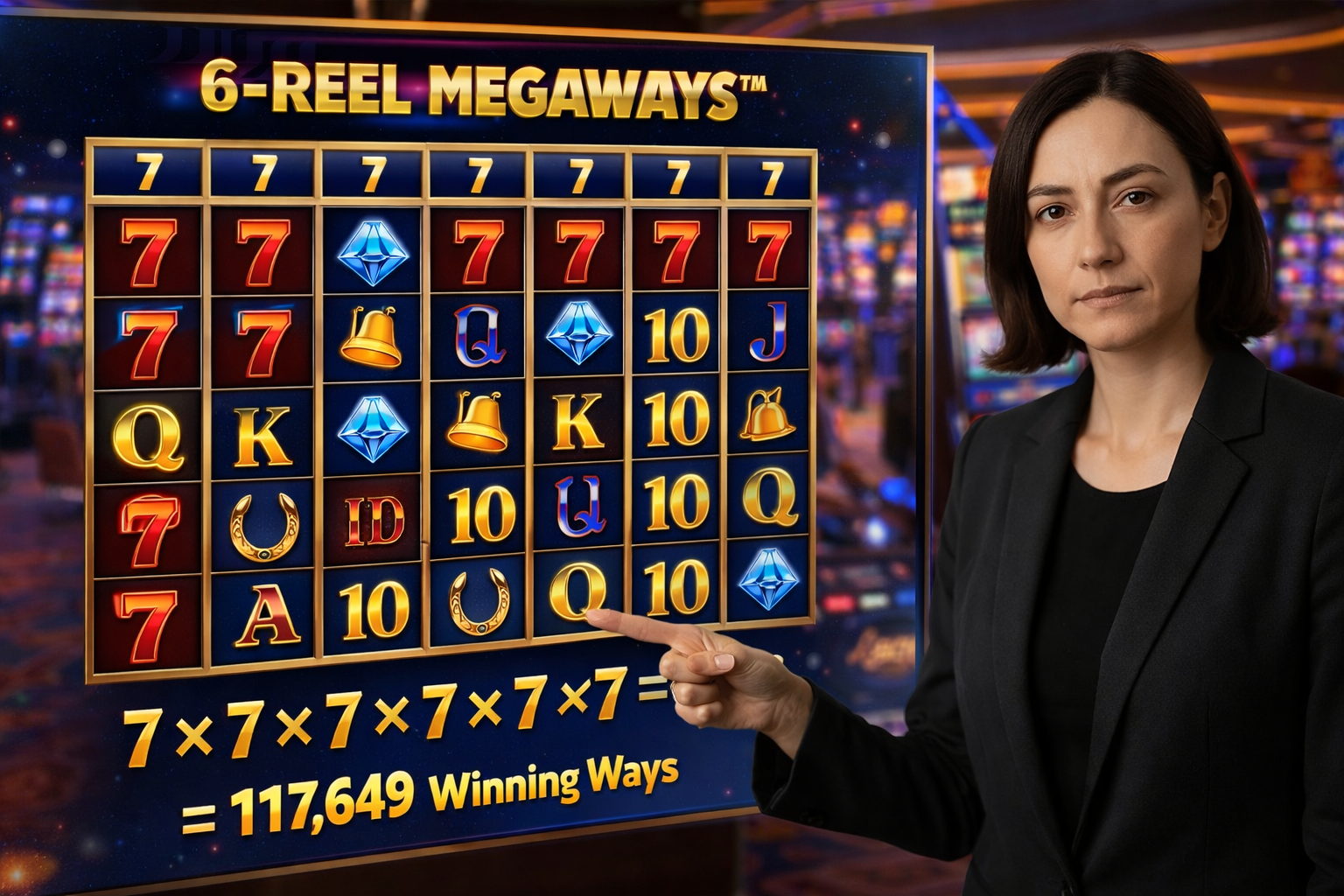
In 2016, a small Australian studio called Big Time Gaming (BTG) released a slot called Bonanza. It did not look like a normal slot machine. The reels were uneven. The symbols were different sizes. And above the grid, a number kept changing: “117,649 Ways.”
To the casual player, this was chaos. To a game mathematician, it was a revolution. The “Megaways™” engine fundamentally changed how we calculate volatility. It moved the industry away from “Fixed Paylines” (where you bet on a specific line) to “Dynamic Permutations” (where the grid itself shifts every spin).
Today, everyone leases this engine. Pragmatic Play, Blueprint, Red Tiger, NetEnt—they all have a Megaways license. But do you understand what you are playing? Do you understand that the number “117,649” is a theoretical ceiling, not a standard setting? In this deep analysis, I will strip down the engine. We will look at the multiplication of reels, the impact of “Cascades” on RTP, and why the “Unlimited Multiplier” is the most dangerous mathematical variable in modern gaming.
Table of Contents
The Core Equation: How “Ways” Are Calculated
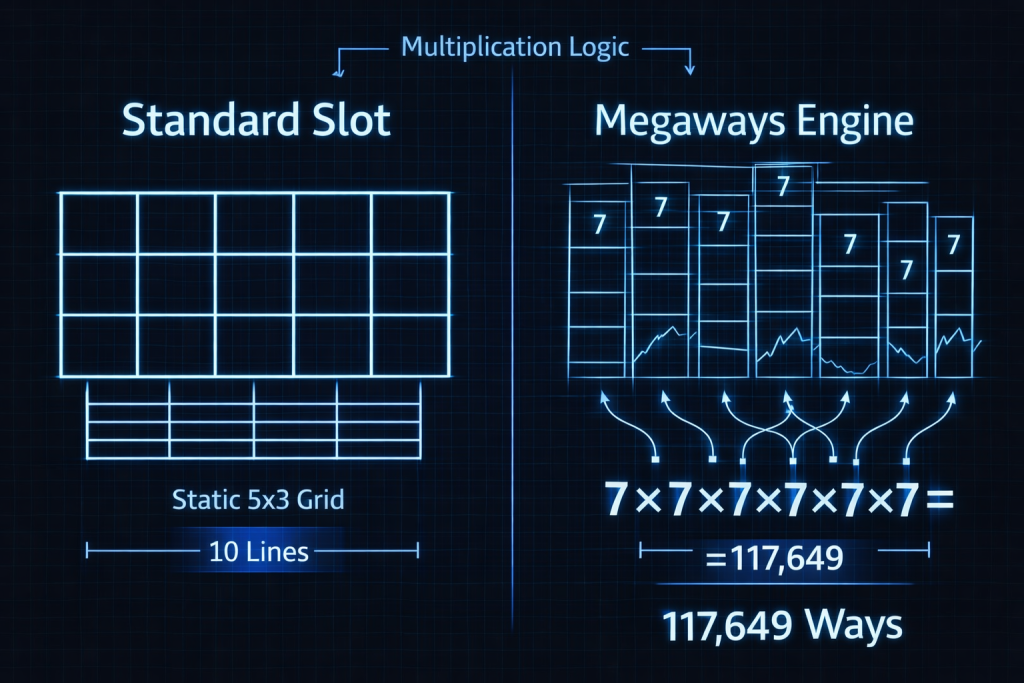
To understand the risk, you must understand the grid. A standard slot has a fixed grid, usually 5×3 (5 reels, 3 rows).
Standard Math: 5 reels. Fixed rows. 10, 20, or 50 paylines.
Megaways uses a “Dynamic Row Modifier.” On any given spin, each reel can display between 2 and 7 symbols. The number of symbols is determined by the Random Number Generator (RNG) at the moment of the spin.
The Multiplication Factor
The “Ways to Win” are calculated by multiplying the number of symbols on each reel across the grid.
Let’s look at the “Max Megaways” scenario (the 117,649 figure):
- Reel 1: 7 Symbols
- Reel 2: 7 Symbols
- Reel 3: 7 Symbols
- Reel 4: 7 Symbols
- Reel 5: 7 Symbols
- Reel 6: 7 Symbols
The Math: $7 \times 7 \times 7 \times 7 \times 7 \times 7 = 117,649$.
This is the marketing hook. But let’s look at the “Minimum Megaways” scenario (the reality of most dead spins):
- Reel 1: 2 Symbols
- Reel 2: 2 Symbols
- Reel 3: 2 Symbols
- Reel 4: 2 Symbols
- Reel 5: 2 Symbols
- Reel 6: 2 Symbols
The Math: $2 \times 2 \times 2 \times 2 \times 2 \times 2 = 64$ Ways.
This is the secret of the volatility. The game swings between 64 ways and 117,649 ways. The vast majority of your spins will hover in the 324 to 2,000 range. You are paying a premium bet for the possibility of the 117,649 grid, but statistically, you will see it less than 1% of the time.
The “Cascading” Mechanic: RTP Injection
Almost all Megaways slots use “Cascading Reels” (also called Avalanches or Tumbles). When you form a winning combination, the winning symbols explode. New symbols drop down to fill the gaps.
Mathematically, this effectively increases the RTP of a single spin.
The Cost Efficiency:
You bet $1.00.
Spin 1: Win $0.50. (Symbols explode).
Cascade 1: Win $2.00. (Symbols explode).
Cascade 2: Win $5.00. (Loss).
Total Return: $7.50.
You received three “Outcomes” for the price of one wager. This lowers the “Velocity of Loss” slightly, as the animations and cascades take time. It extends your “Time on Device.” However, the developer compensates for this “Free Action” by lowering the value of individual symbols.
In a standard 10-line slot, 5 Aces might pay 50x or 100x. In a Megaways slot, 6 Aces might pay only 2x or 50x. The value is not in the symbol; it is in the volume of symbols.
The “Unlimited Win Multiplier”: Exponential Variance
This is where bankrolls are either made or destroyed. In the Bonus Round of most Megaways titles (like Bonanza or Extra Chilli), every Cascade increases the Global Multiplier by 1x. It does not reset between spins.
The Linear Progression:
Spin 1: 1x Multiplier.
Spin 2 (after 3 cascades): 4x Multiplier.
Spin 5 (after 10 total cascades): 11x Multiplier.
If you hit a significant combination (e.g., 6 Premium Symbols) while the multiplier is at 15x or 20x, the payout becomes exponential.
The Math of the “Dead Bonus”:
However, the inverse is also true. You can trigger 12 Free Spins. You can spin 12 times and get zero cascades. Your multiplier stays at 1x. You exit the bonus with a 5x total win.
Because the “Ceiling” (Max Win) is so high (often 20,000x or 50,000x), the “Floor” (Min Win) must be incredibly low to balance the math model. Megaways bonuses are notorious for being “All or Nothing.”
The “Top Tracker” Variable
Many Megaways games (like Bonanza) feature a “Cart” or “Top Tracker” above reels 2, 3, 4, and 5. This adds an extra symbol to those reels.
From a probability standpoint, the Tracker is crucial because it often contains the Wilds. Since it is a single row moving horizontally, it acts as a “Bridge.”
If you have matching symbols on Reel 1, 2, and 3, but nothing on Reel 4… the Top Tracker is your only hope to connect to Reel 5 and 6. Mathematically, the Tracker increases the “Hit Frequency” of 6-of-a-kind wins by providing a secondary route for connectivity.
Game Clones: Same Engine, Different Skins?
Since BTG licensed the engine, the market is flooded. But are they all the same math?
No. Let’s compare:
1. Bonanza (Big Time Gaming)
- Volatility: High.
- RTP: 96.00%.
- Mechanic: Standard Megaways. No Feature Buy.
- Analysis: The purest form. Brutal base game, high potential bonus.
2. White Rabbit (Big Time Gaming)
- Volatility: Very High.
- RTP: 97.77% (with Feature Buy).
- Mechanic: “Expanding Reels.” The reels physically grow during the bonus.
- Analysis: The highest RTP Megaways slot. The “Expanding Reel” mechanic reduces variance slightly by permanently increasing the ways for the duration of the bonus.
3. Madame Destiny Megaways (Pragmatic Play)
- Volatility: Extreme.
- RTP: Variable (96.56% down to 94%).
- Mechanic: “Multiplier Wilds.” Wilds multiply each other.
- Analysis: A “Gambler’s” slot. The addition of multiplier wilds on top of the progressive multiplier creates a “Double Exponential” curve. The dead spins are frequent, but the max win cap is hit more often.
The “Feature Buy” Dilemma in Megaways
I previously wrote about Bonus Buys, but in Megaways, the math is specific.
When you buy a Megaways bonus (usually for 100x), you are skipping the “Base Game Grind.” In the base game, the RTP is often heavily weighted toward low-paying symbol connections (Ace, King, Queen) to keep you afloat.
In the Bonus Buy, you are paying strictly for the volatility of the multiplier.
The Strategy:
If you buy a bonus on a slot like Extra Chilli, you are offered a “Gamble Wheel” to increase your spins from 8 to 24.
Mathematically, you must gamble.
Why? Because with only 8 spins, the probability of building a high multiplier (15x+) is statistically low. You need Volume (Spins) to generate Cascades.
However, the Gamble Wheel has a 50/50 chance of losing everything. This is the ultimate “Risk of Ruin.” But if you want to realize the 50,000x potential, 8 spins is rarely enough. The math demands you take the risk on the wheel.
Tracking the License: Who Actually Makes the Game?
It is important to note who “Built” the math.
- Blueprint Gaming: (e.g., Genie Jackpots Megaways). Known for “Busy” math. Lots of modifiers, mystery symbols, and base game features. Higher Hit Frequency, slightly lower top-end volatility.
- Pragmatic Play: (e.g., The Dog House Megaways). “Sticky” math. They prefer Sticky Wilds over Unlimited Multipliers. This changes the distribution curve. It is less about a long string of cascades and more about landing a specific setup of Wilds on Reels 2, 3, 4.
- Red Tiger: (e.g., Gonzo’s Quest Megaways). “Balanced” math. Often lower RTP (due to Daily Jackpots attached), but smoother gameplay.
Conclusion: Respect the 117,649
Megaways is the most successful slot mechanic of the last decade for a reason. It creates an illusion of “Massive Possibility” on every spin.
But as an analyst, I see the truth. The 117,649 number is a “Max Cap.” It is not the norm. The game is a beast of variance designed to drain bankrolls quickly with complex animations and “near miss” grids.
If you play Megaways, you need a bankroll of at least 300 bets. You need patience. And you need to understand that 90% of your session will be watching 2s and 3s drop, waiting for that one moment when the 7s align and the multiplier climbs. It is a game for the patient, not the desperate.
Frequently Asked Questions
Is it possible to get more than 117,649 ways?
Yes. Some newer games like Holy Diver or White Rabbit use mechanics that can expand the ways up to 586,971 or even higher. However, the standard license is capped at 117,649 (7^6).
Why do Megaways slots feel so volatile?
Because the “Symbol Value” is very low. In a normal slot, 5-of-a-kind pays well. In Megaways, 6-of-a-kind pays very little because the game expects you to hit many ways at once. If you don’t get the cascades, the base payouts are insufficient to sustain your balance.
Do all Megaways slots have an Unlimited Multiplier?
No. Games like The Dog House Megaways use Sticky Wilds with fixed multipliers (2x or 3x) instead of a progressive global multiplier. This offers a different type of volatility where the potential is capped but more predictable.
What is the best RTP Megaways slot?
Historically, White Rabbit by Big Time Gaming offers the highest RTP at 97.77% (if you use the Feature Drop). Most standard Megaways slots hover around 96.00% to 96.50%.
Does the number of ways affect the RTP?
Technically, no. The RTP is calculated over billions of spins encompassing all possible grid configurations. However, a spin with 117,649 ways has a much higher probability of a large win than a spin with 324 ways.
What are “Mystery Symbols” in Megaways?
These are “Transformation” symbols. The RNG selects a symbol ID (e.g., A King) and all Mystery Symbols on the grid turn into that symbol. Mathematically, this is a “Variance Smoother.” It helps create connections across the dynamic reels where normally there would be none.

Senior Slots Analyst & Game Math Expert (Since 2015)
Mission: Flashy graphics don’t pay out; math does. I joined Casino545 to deconstruct online slots and bonuses, revealing the true mathematical value (RTP) behind the marketing hype. My absolute priority is to ensure our readers understand the exact odds and mechanics before they ever press “spin”.
Industry Experience
With a background in Applied Mathematics, I entered the iGaming technical sector in 2015. Instead of marketing or support, I started “under the hood” as a Quality Assurance (QA) Tester for a major European game studio.
Testing slot mechanics, verifying volatility curves, and auditing Random Number Generators (RNG) for true randomness taught me how to read between the lines. I know exactly how to spot manipulated RTP figures and separate fair entertainment from predatory mathematical design.
Core Areas of Expertise
- RTP & Volatility Mathematics: Decompiling provider algorithms to verify actual hit frequencies.
- Bonus Valuation: Calculating the true monetary value of promotions against hidden wagering requirements.
- Game Studio QA: Identifying deceptive mechanics and unverified RNG software.
Review Methodology
- The 1,000 Spin Test: I don’t just read the manual; I run extensive real-money spin sessions to verify if the live volatility matches the developer’s technical sheet.
- Bonus Math Auditing: I calculate the true cost of a bonus. If a 50x wagering requirement makes winning statistically improbable, I flag it immediately.
- Dynamic RTP Tracking: I actively check if casinos are quietly lowering default RTP settings on popular games to protect their own margins.
Commitment to Responsible Gambling
Gambling must be a transparent transaction based on facts, never false hope. I advocate fiercely for clear Terms & Conditions and support industry initiatives that force operators to display live, unaltered RTP figures visibly on every single game interface.