
I am Carlos Costa Silva, and as we head into the final stretch of Q1, the iGaming industry is heavily mobilizing for its next major wave of software releases. If you have been following my independent audits since I originally founded this platform back in 2004, you already know my exact methodology. I do not pay attention to flashy studio press releases, I ignore the sponsored streaming hype, and I certainly do not care about the multi-million dollar marketing budgets these developers deploy. My objective is singular and uncompromising: to cut entirely through the industry noise and mathematically analyze what these upcoming March 2026 slot releases actually mean for your personal fiat bankroll. Today, we are witnessing a continued, highly concerning trend across the global market regarding hidden Return to Player (RTP) variations, punishing extreme volatility models, and predatory terms buried deep within bonus mechanics. In this comprehensive, data-driven guide, I am breaking down the most anticipated fiat-only casino slot releases for March 2026, putting their underlying math models under a microscope, and preparing you for the financial reality of what to expect when these titles hit the real-money casino lobbies.
In this article
The State of iGaming in Q1 2026: Why Independent Testing is Non-Negotiable
The landscape of regulated online gambling has shifted dramatically over the last few years, and what we are witnessing in March 2026 is the direct culmination of aggressive game development strategies clashing with tightening regulatory frameworks across Europe. During my years working on the operational side for major European operators—where I managed VIP support floors, processed traditional fiat payments, and monitored internal risk and fraud controls—I learned to look at a software provider’s game roadmap fundamentally differently than your typical casino affiliate marketer.
I do not look at the graphics, the character design, or the background music. I look at the math, the server hosting the game round, and the default RTP settings actively chosen by the casino operator.
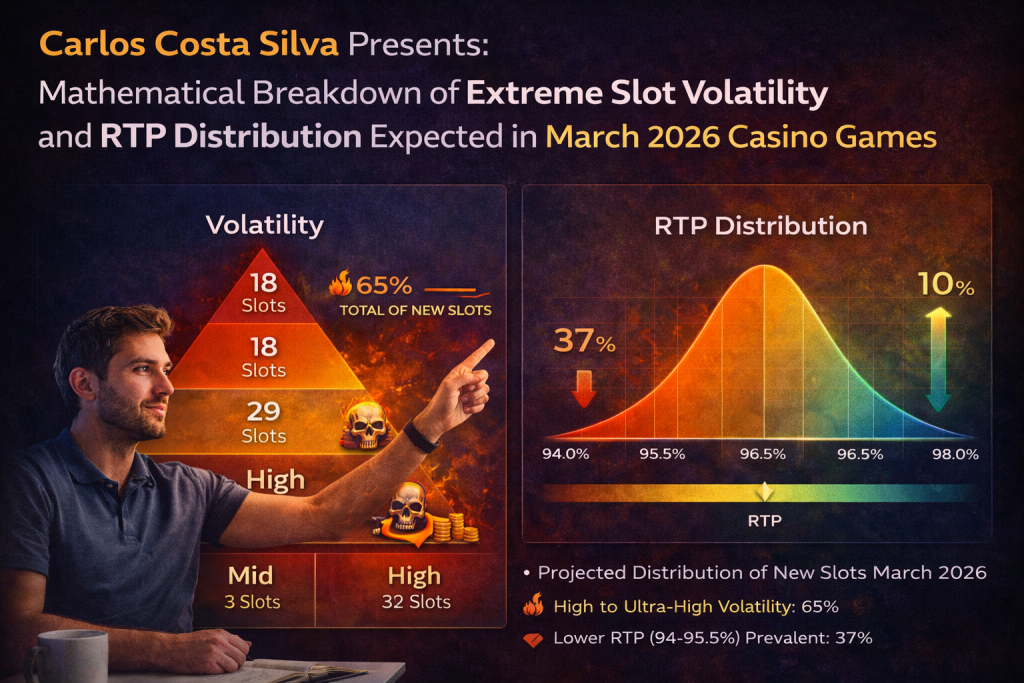
Right now, the industry is entirely obsessed with ultra-high volatility titles. Providers are pushing maximum win caps to 25,000x, 50,000x, and even 100,000x your base stake. But as I consistently remind my readers, a higher maximum win potential mathematically dictates a brutal, unforgiving base game experience. To fund those massive, highly publicized multipliers that look great on YouTube, the mathematical framework requires that the hit frequency of medium-sized, sustaining wins must drop drastically. This month, we are seeing a veritable flood of these high-risk games hitting the market, targeting players who do not understand the underlying variance.
Furthermore, the RTP squeeze is in full effect across all regulated markets. Almost all major software providers now mandate variable RTP ranges. A game releasing this March might be proudly advertised by the development studio with a 96.5% RTP, but individual casino operators are given the backend tools to host the 94.5%, 92%, or even 89% versions. My primary focus this month is identifying exactly which fiat platforms are choosing the player-friendly math models and which are quietly squeezing their user base to inflate their quarterly profit margins.
Operational transparency is absolutely non-negotiable for me. If a casino hides the active RTP deep within the game’s help files rather than displaying it clearly in the main lobby, they immediately fail my audit. Players deserve to know the exact mathematical disadvantage they are facing before they deposit a single Euro from their bank account.
The Heavy Hitters: March 2026 Slot Release Roadmap
Based on my direct analysis of the upcoming provider roadmaps and internal industry memos, here are the major slot releases scheduled for March 2026. You will notice a heavy lean toward fishing-themed slots and dark, gritty themes this month. Instead of praising their visual effects or audio design, I am going to break down the underlying mathematics, the core mechanics, and the potential financial risks for your real-money fiat deposits.
1. Big Bass Race Day Repeat (Pragmatic Play)
Pragmatic Play continues to heavily milk its incredibly successful Big Bass franchise, this time taking the familiar fisherman character back to the racetrack. While the theme might seem slightly disjointed compared to previous aquatic iterations, the underlying math and mechanics are exactly what we need to evaluate.
Like its immediate predecessors, this game utilizes a standard 5×3 layout with 10 fixed paylines. It is classified as highly volatile, with the mathematical framework focused almost entirely on collecting cash values and building progressive multipliers during the Free Spins round. The advertised maximum win sits around the 5,000x mark. In the base game, you are essentially just spinning to land three scatters. The base game line hits are generally too small to sustain your bankroll over a long session, which is a classic hallmark of the Big Bass series.
Pragmatic Play is notorious in the industry for providing operators with incredibly wide RTP bands. The premier version of this game will sit at a respectable 96.51%. However, my ongoing internal audits of European operators show a massive, industry-wide trend toward selecting the 94.5% or even 93% settings for Big Bass titles. Because the brand name is so immensely popular, operators know players will flock to the game regardless of the underlying math. You are quite literally paying a premium for the brand name.
Because the base game offers very little in terms of substantial line hits, your entire bankroll is essentially a waiting room for the bonus scatter symbols. Pragmatic employs tease spins heavily—where two scatters land, and the third reel slows down dramatically with intense audio cues. These are meticulously designed by behavioral psychologists to spike your dopamine levels, but mathematically, the actual bonus trigger frequency remains stubbornly low.
2. Catfish Hunters (Nolimit City)
Nolimit City has built a formidable, often highly controversial reputation on extreme volatility, dark themes, and highly complex mechanics. Their March release brings a gritty, high-stakes twist to the normally lighthearted fishing slot genre, and the math model is absolutely ruthless.
Games in this specific Nolimit City tier are mathematically punishing in the base game. The hit frequency usually sits well below 22%. This means you are statistically guaranteed to encounter incredibly long stretches of completely dead spins. The RTP is distributed so heavily toward the massive maximum win that the standard base game payouts are negligible. You are taking on immense financial risk for the statistical anomaly of a massive payout.
Nolimit City games almost always feature multi-tiered bonus buys, sometimes costing up to 2,000x your base stake for the highest tier bonus. From a strict risk analysis perspective, executing these feature buys without rigid, professional-level bankroll management is financial suicide. The variance is so astronomically high that a massive feature buy can easily return a fraction of your stake. The emotional tilt that directly follows such a devastating loss is exactly what rogue operators bank on.
The potential payouts are structurally massive, but the reality of the math model dictates that only a tiny fraction of a percent of the player base will ever see a return on their investment here. Approach with extreme caution, play at absolute minimum stakes, and never chase your losses on a Nolimit title.
3. Rabid Randy Gone Fishing (NetEnt)
NetEnt, now fully integrated into the Evolution Gaming corporate umbrella, is releasing a fishing twist on their unhinged hunter character. Set on a larger 5×4 grid with 25 paylines, this game shifts the focus slightly away from purely raw volatility and introduces more sustained progressive elements.
The core gameplay heavily relies on a specific wild symbol landing on the first reel, which triggers a sequence of walking re-spins and instant cash prizes. Because it features these walking wilds, the base game hit frequency is noticeably higher than the Pragmatic or Nolimit releases. You will see more action on screen, though the individual payout values are heavily scaled down to mathematically compensate for the frequency.
The game features five localized progressive jackpots. As an experienced data analyst, I must deliver a harsh truth regarding this setup: whenever a game includes local or network progressives, a significant portion of the stated RTP (usually between 1.5% and 4%) is completely siphoned off the top to feed those jackpot pools. Your day-to-day base game RTP is artificially lowered to fund a massive prize that you are mathematically unlikely to ever hit.
This is a solid option for players who prefer longer session times and more frequent, albeit smaller, base game interactions. However, do not play this game if you are actively trying to clear a casino welcome bonus, as the inherently lower base RTP will mathematically grind out your bonus funds before you ever finish the wagering requirements.
The Volatility Tax: Analyzing 100,000x Max Wins
As an independent analyst, I spend a significant portion of my time completely reverse-engineering slot volatility mathematics. The marketing machinery surrounding the March 2026 releases is intensely focused on maximum win potential. Press releases constantly scream about 50,000x and 100,000x multipliers. But we need to have a serious, data-driven conversation about the actual math hiding behind these astronomical numbers.
When a studio states that a new game has a 96% RTP and a 100,000x max win, you must deeply understand how that 96% return is distributed over the game’s total lifespan. RTP is not calculated over your Friday night 500-spin session; it is calculated over billions of simulated spins during the software’s regulatory certification process.
If a mathematically significant chunk of that 96% return is heavily allocated to the incredibly rare 100,000x payout, the day-to-day, session-to-session RTP for the average player drops drastically.
This is what I refer to as the Volatility Tax. Players are unknowingly paying a steep premium—manifesting in the form of endless dead spins and rapid balance depletion—for the mere statistical possibility of a life-changing win. The math is designed to drain you slowly while keeping you engaged with the promise of a massive multiplier.
During my operational years managing risk and VIP behavior, I analyzed backend player data extensively. The average session length on an ultra-high volatility slot is significantly shorter than on a low-volatility classic slot. Players make a €100 fiat deposit, hit the spin button at €1 a spin, and the math model grinds their balance down to zero exponentially faster than they anticipated. This is precisely why I demand operational transparency. If an operator is aggressively pushing these high-variance games to vulnerable players via email marketing without adequate responsible gambling tools in place, they are failing their regulatory mandates, and I will blacklist them without hesitation.
My Real-Money Fiat Audit Methodology for March Releases
At Casino545, I absolutely refuse to rely on demo mode testing or free-play tokens provided by the studios or affiliate managers. A demo version operates in a completely sterile environment. It does not reflect the real-world friction of casino banking infrastructures, withdrawal delays, or KYC bottlenecks. To bring actual, verifiable transparency to my readers, I subject these newly integrated games to my rigorous review methodology using my own fiat money.
Here is exactly how I will be auditing the platforms hosting the March 2026 slot releases over the coming weeks.
First, I conduct strict fiat real-money deposit testing. I personally fund accounts across multiple newly licensed casinos offering these specific games. I only use traditional fiat methods: Visa, Mastercard, SEPA Bank Wire, Trustly, Skrill, and Neteller. I systematically evaluate transaction clarity, hidden deposit fees, currency conversion markups, and the precise speed at which the funds are actively credited to the gaming balance.
Second, I engage in live gameplay and data tracking. I will run a minimum of 3,000-spin sessions on the new titles with real money. I meticulously track the actual base game hit frequency against the provider’s stated metrics in their certification files. Most importantly, I open the game settings and verify the in-game RTP files against the casino’s lobby claims to ensure they haven’t silently switched to a lower payout tier mid-month.
Finally, I execute my fiat withdrawal time auditing, which is the true test of any casino. If I hit a profitable session or trigger a solid bonus round, I immediately initiate a withdrawal. I measure the exact withdrawal cycle—from the precise second I click submit in the cashier to the moment the fiat funds settle in my actual bank account. Marketing teams love to plaster instant withdrawals on their homepages, but my audits frequently reveal 48-to-72 hour pending periods intentionally designed to frustrate players into canceling their cashouts and losing the funds back to the house.
The Reality of Fiat Payment Processing in 2026
Because my focus is heavily on regulated, compliant platforms, we must discuss fiat payment processing in depth. When you win on a new March 2026 release, the game itself does not pay you—the casino’s finance department does. And this is where the industry is currently experiencing the most operational friction.
During my time on the operational side, I managed payment processing queues. I know exactly how rogue operators use compliance as a weapon to delay your payouts.
The primary issue is the verification loop. Legitimate operators enforce strict Anti-Money Laundering (AML) and Know Your Customer (KYC) protocols. However, predatory operators will wait until you request a withdrawal from your big win to ask for a utility bill. You send it. 48 hours later, they reject it because all four corners are not perfectly visible. You send it again. 48 hours later, they ask for a notarized bank statement. This is a deliberate stall tactic. My reviews outline exactly which operators process KYC documents within two hours, and which ones systematically drag it out for a week.
We must also look at e-wallet versus bank transfer realities. In 2026, if you are using Skrill or Neteller, your withdrawal (once approved by the casino) should be practically instantaneous. Bank transfers, however, are still subject to legacy banking hours and SEPA processing times in Europe. I heavily penalize casinos that claim a standard bank transfer takes five to seven business days. In the modern European banking era, a SEPA transfer should clear within 24 to 48 hours maximum.
Finally, there are Source of Wealth (SoW) triggers. With tightening financial regulations, hitting a massive 5,000x max win on a new slot with a €2 bet might instantly trigger an automated Source of Wealth check. The casino will legally freeze your funds until you can prove where your initial deposit came from via payslips or tax returns. While this is legally mandated, how the casino communicates this to the player separates the reputable sites from the scams. I demand clear, transparent communication from operators during these mandatory regulatory checks.
Regulatory Frameworks: The Malta Gaming Authority Shield
As the slot math models become more volatile and maximum exposures increase, the regulatory framework protecting your fiat funds is your only true safety net. A deep, analytical understanding of European and local licensing mandates is crucial for protecting your bankroll when testing out the March 2026 releases.
When evaluating which casinos are best suited to play these new games, I look strictly at their active licensing. For European players, platforms operating directly under the Malta Gaming Authority provide a significantly higher baseline of player protection, formal dispute resolution, and operational oversight compared to unregulated or weakly regulated offshore entities.
The MGA mandates the strict segregation of player funds. This means your deposited fiat money, and the winnings you generate from these new slot games, are legally required to be held in a completely separate, ring-fenced bank account from the casino’s day-to-day operational funds. If the operator mismanages their marketing budget and files for bankruptcy, your money is legally protected and can be returned to you. Unregulated casinos do not offer this protection; if they go under, your balance vanishes with them. Never compromise on licensing just to play a new slot release a day early.
Reading the Fine Print: T&C Risk Analysis
Whenever highly anticipated slots drop, casino marketing departments flood the internet with promotional offers: free spins, reload bonuses, and massive deposit matches. This is where my specific terms and conditions risk analysis comes into play. I dig deep into the microscopic fine print to expose clauses explicitly affecting your withdrawal limits, bonus conversion rules, and unfair account restrictions.
If you are planning to use a bonus to test out the new March releases, the first thing you must watch out for are predatory game exclusion lists. Casinos frequently and quietly update their terms to exclude new, high-volatility, or high-RTP games from bonus wagering entirely. If you claim a €100 bonus to play the new releases, you might find that the game contributes 0% to your wagering requirements. Even worse, some predatory terms state that merely opening an excluded game while a bonus is active will void your entire balance and confiscate your winnings.
You must also avoid the bonus buy trap. A standard, industry-wide clause dictates a maximum bet (usually €5 or equivalent) while playing with active bonus funds. However, operators intentionally bury feature buy restrictions in the rules. Buying a bonus feature for €20 on a new slot while a bonus is active is treated mathematically as a single €20 bet. This will instantly trigger an automated breach of terms, resulting in the complete confiscation of your deposit, your bonus, and your winnings. I see players fall for this trap daily.
Finally, look out for artificial win caps on free spins. Beware of new casinos offering 500 free spins on a new game, only to cap the maximum withdrawable winnings from those spins at a meager €10 or €20. It is a predatory marketing tactic designed solely to harvest your personal data without offering any real financial value or entertainment.
Support Competency Verification
When new slot software is deployed to live servers, technical glitches are inevitable. Game rounds can freeze mid-spin, bonus buys can crash the client, and payout mechanics can miscalculate due to server latency. This is precisely why anonymous, rigorous testing of a casino’s customer support accuracy, escalation handling, and technical knowledge is a massive pillar of my methodology.
If a highly volatile game crashes on your browser right in the middle of a €50 bonus round, the casino’s live support team is your only lifeline.
During my operational days managing VIP support floors, I personally trained agents on how to immediately query game logs directly from the provider’s server via the backend. A competent support agent in 2026 should be able to instantly verify your game round ID, check the external server status, and manually refund the bet to your fiat balance if the session definitively failed.
Unfortunately, my recent audits show a terrifying trend: operators are outsourcing their frontline support to automated AI bots or untrained offshore agents who simply copy-paste generic responses. When evaluating the best fiat platforms to play the March 2026 releases, I heavily penalize casinos that fail my technical support escalation tests. When real fiat currency is on the line, you deserve competent, immediate, and human assistance.
Commitment to Responsible Gambling
Player protection isn’t just a corporate buzzword I use; it is the absolute core of my evaluation framework at Casino545. The slot games releasing in March 2026 are masterclasses in psychological design. They are engineered by brilliant mathematicians and audio-visual experts to be incredibly engaging. Their extreme volatility math models, combined with near-miss mechanics, can rapidly lead to chasing losses.
I only prioritize and recommend operators that prove their regulatory compliance, enforce completely transparent policies, and offer easily accessible, structured self-exclusion systems.
A legitimate, well-regulated casino will allow you to set daily deposit limits, net loss limits, and strict session time limits seamlessly from your player dashboard the moment you register. If an operator forces you to send an email to support or wait 24 hours just to set a basic deposit limit, they are intentionally creating behavioral friction to keep you gambling. I flag this immediately and publicly in my audits.
Gambling should only ever be safe entertainment. It is absolutely not a way to make an income. The mathematical framework of every single game releasing this March is inherently built in favor of the house. I strongly encourage my readers to utilize independent support networks like GamCare and Gambling Therapy if you ever feel that your gaming habits are causing financial or emotional stress. Use the account tools provided, stay highly informed about the math, and never deposit fiat money you cannot comfortably afford to lose.
Conclusion
The March 2026 slot releases bring a wave of heavily marketed mechanics, stunning visual design, and massive advertised payout potential. However, as an independent analyst, my duty is to anchor your expectations in the mathematical reality beneath the surface. The math models are becoming significantly more volatile, the RTP ranges are being squeezed tighter by operators, and compliance departments are utilizing restrictive clauses to delay legitimate fiat withdrawals.
By relying on actual operational testing, verifiable financial auditing, and strict regulatory analysis, I will continue to bring you the unvarnished, data-driven truth about the online casino industry. Do not let the massive marketing budgets of these game studios blind you to the math. Check the RTP files, understand the concept of the volatility tax, thoroughly test the fiat withdrawal speeds with small deposits first, and always prioritize platforms that value operational transparency and stringent player protection. Stay smart, protect your bankroll, play safe, and I will see you in the data.
Frequently Asked Questions
Are the new slot games releasing in March 2026 guaranteed to pay out more money?
Absolutely not. Slot machines utilize certified random number generators to ensure every single spin is entirely independent and random. While the new releases advertise massive maximum win caps, this does not mean they pay out more frequently. In reality, games with extremely high maximum wins usually have a significantly lower hit frequency in the base game to statistically compensate for the rare possibility of a massive payout.
How can I verify the exact RTP of a newly released slot game?
The active return to player percentage must be clearly listed within the game’s internal help file or paytable. Once you launch the game, click on the information or settings gear icon, and scroll through the specific rules text. If a casino operator hides the RTP, removes it from the help file, or forces you to contact support to find it, I highly recommend withdrawing your funds and finding a more transparent platform immediately.
Why do so many casinos ban new slot releases from their bonus wagering requirements?
Casinos frequently restrict high volatility games or newly released slots from their active bonus wagering requirements to mathematically protect their own profit margins. Games that offer feature buys, progressive multipliers, or massive variance can rapidly clear a wagering requirement or generate huge liabilities from bonus funds. Operators place these games on strict exclusion lists buried deep in their terms and conditions to mitigate their own financial risk.
What should I do if a new slot game completely freezes during a bonus round?
Take a screenshot of the frozen game screen immediately, making sure to clearly capture your local time, your current active balance, and the game interface. Do not immediately clear your cache. Contact the casino’s live customer support and provide them with the exact time of the incident and the screenshot. A competent support team will query the software provider’s game logs and either successfully restore the round upon reloading or manually refund your bet based on the server’s backend data.
Why do my fiat withdrawals take so long after winning on a new game?
Withdrawal delays on fiat networks are rarely due to the banking system itself; they are almost always caused by the casino’s internal risk controls and finance departments. Legitimate operators must conduct anti-money laundering checks and verify your identity before releasing funds. However, rogue operators exploit these compliance protocols, utilizing pending periods to intentionally delay the process, hoping you will reverse the withdrawal and gamble the winnings away.

Founder and Chief Game Analyst at Casino545 (Since 2004)
Mission: I created Casino545 with a single, uncompromising goal: to cut through the marketing noise and bring real transparency to the online casino industry. My focus is on publishing independent, data-driven reviews built on actual operational testing, financial verification, and strict regulatory analysis. Marketing budgets don’t buy my opinions. Every evaluation follows rigorous editorial standards so players can access safe, compliant, and fair platforms.
Industry Experience
I’ve been breathing iGaming since 2004, right when regulated online gambling started expanding across Europe. I spent years working on the operational side for a major European operator, managing VIP support, payment processing, and internal risk controls. That “behind-the-scenes” experience gave me direct, hands-on exposure to how withdrawal procedures, AML compliance protocols, fraud prevention systems, and financial audits actually work.
Today, I use that insider knowledge to audit casino payment systems, analyze withdrawal reliability, assess hidden bonus risks, and demand operational transparency from licensed platforms.
Core Areas of Expertise
Slot Volatility Mathematics: Analysing RTP variations and hit frequencies across major providers.
Regulatory Frameworks: Deep understanding of European and local licensing mandates.
Crypto & Fiat Payment Systems: Testing the real-world friction of casino banking infrastructures.
Review Methodology
Real-Money Deposit Testing: I personally fund and test casino cashier systems to evaluate transaction clarity and payment processing efficiency.
Withdrawal Time Auditing: I measure the exact withdrawal cycle — from the moment I hit “submit” to the second the funds settle in my bank account — to prove financial reliability.
Terms & Conditions Risk Analysis: I dig into the fine print to expose clauses affecting withdrawal limits, bonus conversion rules, and unfair account restrictions.
Support Competency Verification: Anonymous, rigorous testing of customer support accuracy, escalation handling, and technical knowledge.
Commitment to Responsible Gambling
Player protection isn’t just a buzzword; it’s the core of my evaluation framework. I only prioritize operators that prove their regulatory compliance, enforce transparent policies, and offer structured self-exclusion systems. Gambling should be safe entertainment, and I strongly encourage access to independent support networks like GamCare and Gambling Therapy.