By Lars Jensen
In 2024, a major crypto casino database leak exposed the passports, driver’s licenses, and selfie verifications of over 200,000 users. These weren’t criminals; they were regular players who trusted a “licensed” operator with their most sensitive data. The dark web did not care about the license. The hackers sold that data for pennies on the dollar.
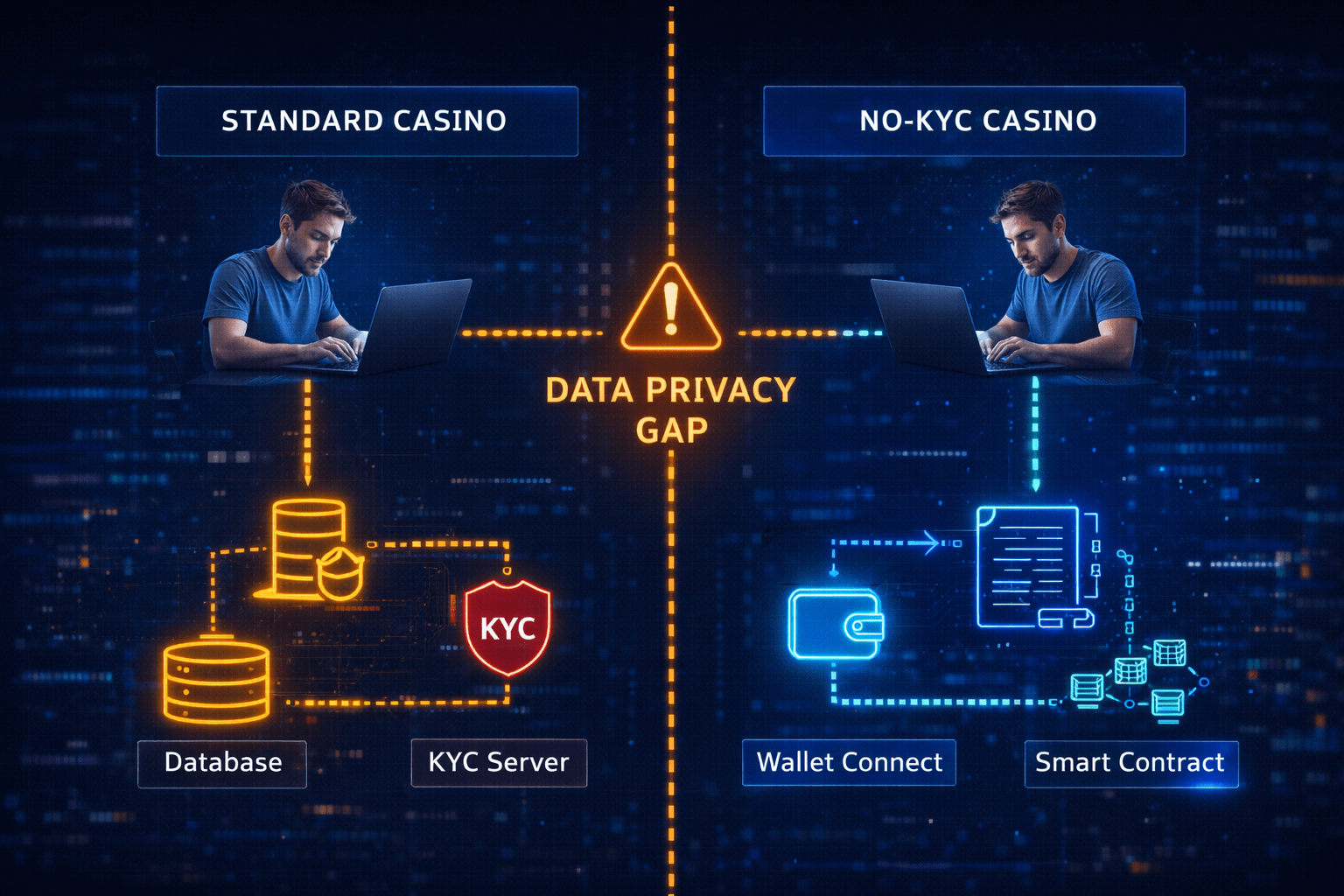
In 2026, handing over your government ID to a gambling site is not just an inconvenience—it is a critical security failure. The rise of “No KYC” (Know Your Customer) casinos is not about evading the law; it is about data sovereignty. It is about the fundamental right to spend your digital assets without creating a permanent record accessible to thieves, tax dragnets, and surveillance firms.
However, the term “No KYC” has become a marketing trap. Scammers use it to lure in unsuspecting players, only to freeze funds later and demand documentation. As a blockchain security lead, I have analyzed the Terms of Service and backend code of the top anonymous platforms. This guide explains how true No KYC casinos operate, the rise of Telegram gambling bots, and how to distinguish between a privacy haven and a honeypot.
In This Article
- Defining “No KYC”: Pure vs. Hybrid
- The Rise of Telegram Casinos
- The Invisible ID: Device Fingerprinting
- The “Soft KYC” Trap: When Anonymity Ends
- OpSec Strategy for Anonymous Play
- Sweepstakes vs. DeFi: Know the Difference
- The Regulatory Risks in 2026
- Conclusion
- FAQ: No KYC Gambling
Defining “No KYC”: Pure vs. Hybrid
Not all anonymous casinos are created equal. In the current market, platforms fall into three distinct categories. Understanding the difference will save you from a frozen account.
1. The “Pure” DeFi Casino (Web3)
This is the gold standard. These platforms do not have a “Sign Up” button. They have a “Connect Wallet” button. You interact directly with a smart contract using MetaMask, Phantom, or a hardware wallet.
Because the funds are managed by code, there is no centralized admin to demand your passport. The payout is automated. If you win, the smart contract sends the tokens to your wallet address. There is no database storing your name because the casino doesn’t know your name. Examples include decentralized platforms on Solana and Arbitrum.
2. The “Crypto-First” Gray Market Casino
These sites look like traditional Web 2.0 casinos but operate with a “Don’t Ask, Don’t Tell” policy. You sign up with an email address and a password. You deposit crypto. You play.
They do not ask for ID upon registration. However, they retain the right to ask for it if their fraud detection system is triggered. This is the most common type of “No KYC” site. It is convenient, but it requires trust. You are trusting them to keep their word.
3. The “Fake” No KYC Casino
These sites advertise anonymity to get your deposit. But the moment you try to withdraw, a popup appears: “To process your withdrawal, please complete Level 1 Verification.” This is a bait-and-switch scam. They hold your funds hostage until you dox yourself. Avoid these at all costs by checking player forums before depositing.
The Rise of Telegram Casinos
The biggest shift in 2025 and 2026 has been the migration of gambling from websites to Telegram Bots. Telegram casinos leverage the messaging app’s API to create a seamless, app-like experience without a browser.
Why They Are Booming
- Integrated Wallets: Telegram’s “TON Space” wallet allows for instant, one-click deposits within the chat interface.
- Bypassing Censorship: Governments can block a website domain (e.g., casino.com), but they cannot easily block a specific Telegram bot without banning the entire Telegram app. This makes these casinos incredibly resilient to geo-blocking.
- Speed: The interface is text and button-based, which loads instantly even on slow mobile connections, unlike graphics-heavy web casinos.
The Security Trade-Off
While convenient, Telegram casinos are opaque. You cannot easily inspect the SSL certificate or the backend code of a Telegram bot. You are interacting with a black box. If the bot developer decides to delete the bot, your balance disappears with it. Only play on Telegram casinos that have a verified reputation and an associated web platform that acts as a backup access point.
The Invisible ID: Device Fingerprinting
You might ask: “If I don’t give them my ID, how do they know if I’m multi-accounting?”
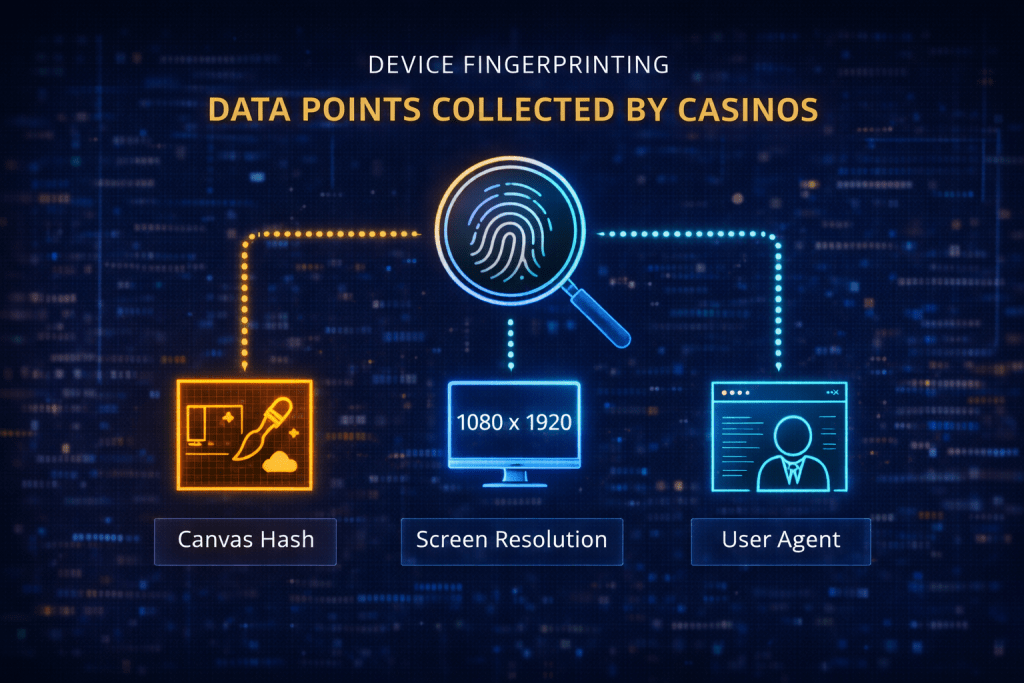
The answer is Browser Fingerprinting. Even without a login, modern websites collect up to 50 data points from your browser to create a unique “ID” for your device. This includes:
- Canvas Fingerprinting: The site renders a hidden 3D image in your browser. The exact way your graphics card draws that image is unique to your hardware setup.
- Audio Context: The way your sound card processes audio signals.
- Screen Resolution & Fonts: The specific list of fonts installed on your laptop.
- Battery Status API: Even your battery level can be a tracking metric.
If you create ten different accounts from the same laptop, the casino knows it is the same person, even if you use ten different emails. They will ban all accounts and confiscate the funds. To defeat this, you need distinct browser profiles (like Multilogin or Incogniton) or a fresh virtual machine for each identity—though for most players, simply sticking to one account is the safer play.
The “Soft KYC” Trap: When Anonymity Ends
Most “No KYC” casinos have a clause in their Terms of Service called the Risk-Based Approach. This is the legal loophole that allows them to remain licensed (usually in Curacao or Anjouan) while offering anonymous play.
They will not ask for ID for a $500 withdrawal. But they will ask for ID if:
- The Threshold is Breached: You withdraw more than $2,000 in a single day or $10,000 in a month.
- Suspicious Betting Patterns: You are betting on both sides of a Roulette wheel to clear a bonus (Bonus Abuse).
- IP Mismatch: You registered with a German IP address but are playing from a US IP address.
The “Soft KYC” trap is dangerous because it hits you when you are winning. To avoid this, keep your withdrawals small and regular. Do not let a balance build up to five figures. Withdraw $1,500 every few days rather than $20,000 at once.
OpSec Strategy for Anonymous Play
If you are serious about keeping your identity off the grid, you need a rigorous Operational Security (OpSec) protocol. A “No KYC” casino is useless if you leak your IP address or pay with a KYC’d wallet.
1. The VPN Protocol
Never access a crypto casino without a VPN. However, standard VPNs are often flagged. Casino security systems recognize the IP addresses of popular VPNs (like NordVPN or ExpressVPN) and may block them.
The Solution: Use a **Dedicated IP** or a **Residential Proxy**. A Residential Proxy routes your traffic through a real home internet connection (often peer-to-peer), making you look like a regular user rather than someone hiding behind a server farm.
2. The Wallet Hygiene
Do not send funds directly from Coinbase, Binance, or Kraken to a No KYC casino. These exchanges use Chainalysis to track outgoing funds. If they see you sending money to a known gambling entity, they will freeze your exchange account.
The Workflow:
Exchange -> Private Wallet (Exodus/Metamask) -> Casino.
The Return:
Casino -> Private Wallet -> Exchange.
By adding the private wallet as a buffer, you break the direct link. For maximum privacy, swap your Bitcoin for Monero (XMR) before depositing, as discussed in my previous guide.
3. The Email Alias
Do not use your primary Gmail (john.doe@gmail.com). Use an encrypted email service like **ProtonMail** or **Tutanota**. Even better, use an email alias service like **SimpleLogin**. This creates a fake email address that forwards to your real inbox. If the casino sells your email to a spam list, you can simply delete the alias without affecting your main account.
Sweepstakes vs. DeFi: Know the Difference
In the United States, a new trend called “Sweepstakes Casinos” (like Stake.us) is gaining traction. These legally operate without traditional gambling licenses by using a dual-currency system (“Gold Coins” and “Sweepstakes Cash”).
Do not confuse these with No KYC casinos.
Sweepstakes casinos are High KYC. Because they operate under strict US sweepstakes laws, they require more identity verification than a standard casino. You must submit a driver’s license and often a facial scan just to redeem a $20 prize. If you are looking for anonymity, Sweepstakes casinos are the opposite of what you want.
The Regulatory Risks in 2026
We must address the elephant in the room: Regulation. In 2026, the European Union (via MiCA regulations) and the US Treasury are cracking down on “Unhosted Wallets” and non-compliant offshore platforms.
The risk for the player is not necessarily legal prosecution (gambling itself is rarely the crime), but Financial Censorship. Regulators are pressuring ISPs to block access to these domains and pressuring stablecoin issuers (like Tether/USDT and Circle/USDC) to blacklist addresses associated with gambling.
This is why holding your funds in a smart contract is safer than holding them in a casino account. If Tether blacklists the casino’s hot wallet, everyone’s funds are frozen. If you hold your funds in your own wallet and only deposit what you are about to bet, you minimize your exposure to this systemic risk.
Conclusion
The era of the “Wild West” internet is closing, but the era of the “Privacy First” internet is just beginning. No KYC casinos are a vital tool for preserving digital freedom, but they require a higher level of user responsibility.
You are your own bank. You are your own compliance officer. If you lose your password, there is no support agent to reset it. If you send funds to the wrong address, there is no refund. But the trade-off is worth it: You get instant payouts, zero paperwork, and the peace of mind that your passport scan isn’t floating around on a hacker forum. Trust the code, verify the reputation, and keep your private keys private.
FAQ: No KYC Gambling
Are No KYC casinos legal?
The casinos themselves usually operate from jurisdictions like Costa Rica or Panama where they are legal entities. For you as a player, it depends on your local laws. In most countries, it is not illegal to play, but circumventing geo-blocks to access restricted sites may violate the site’s Terms of Service, leading to forfeiture of winnings.
Can I withdraw millions without KYC?
Generally, no. Even the most lenient crypto casinos have a limit. Usually, withdrawals under $2,000 to $5,000 are automated. If you hit a $1 million jackpot, expect a manual review. In a true DeFi casino, the smart contract will pay you regardless of the amount, but liquidity in the pool might be the bottleneck.
What is the best crypto for anonymity?
Monero (XMR) is the only truly anonymous coin. Litecoin (LTC) with MWEB is a close second. Bitcoin (BTC) and Ethereum (ETH) are pseudonymous, meaning they are traceable if your identity is linked to the wallet address.
Do No KYC casinos have worse odds?
Not necessarily. Many use the same game providers (Pragmatic Play, Evolution, Hacksaw) as licensed casinos. The “Return to Player” (RTP) is set by the game provider, not the casino. However, checking the RTP in the game settings is crucial, as some providers allow casinos to choose between range settings (e.g., 94% vs 96%).
How do I know if a No KYC site is a scam?
Check the domain age. Check Reddit and BitcoinTalk forums for recent withdrawal proofs. Look for a valid license seal (even if it’s Curacao). Most importantly, test with a small amount first. Never deposit your entire bankroll on day one.

Crypto Gambling Expert & Blockchain Tech Lead (Since 2013)
Mission: I trust code, not promises. The crypto gambling space is still the Wild West, and my job at Casino545 is to guide you through it safely. I don’t care about flashy marketing; I verify that “Provably Fair” algorithms are actually fair and that your crypto withdrawals are mathematically protected from technical loopholes and hidden terms.
Industry Experience
I mined my first Bitcoin back in 2013 and have been deeply immersed in blockchain architecture and cyber security ever since. Before joining Casino545, my daily routine involved auditing DeFi smart contracts and stress-testing the payment gateways of newly launched crypto casinos to ensure they were watertight.
That hardcore technical background allows me to spot what regular reviewers completely miss. I can read the hash-strings of a crypto game to verify cryptographic fairness, and I know exactly how to differentiate a legitimate blockchain licensing protocol from a fake trust seal.
Core Areas of Expertise
- Cryptographic Fairness: Decompiling client-seed and server-seed hashes to prove RNG legitimacy.
- Smart Contract Auditing: Finding backdoors or exploitable code in decentralized gambling platforms (Web3).
- Privacy & KYC Protocols: Stress-testing anonymity claims and withdrawal friction in crypto-only environments.
Review Methodology
- The Blockchain Speed Test: I run live deposit and withdrawal cycles using BTC, ETH, and USDT, measuring the exact block confirmation times against the casino’s marketing claims.
- Provably Fair Verification: I manually verify the seeds and hashes on high-volatility games like Crash, Dice, and Plinko to guarantee results are 100% tamper-proof.
- Anonymity Check: I stress-test the KYC process to expose whether a “No-KYC” casino truly respects your privacy, or if they trap your funds behind sudden document requests the moment you win.
- Smart Contract Audits: For decentralized casinos, I dig into the underlying code to ensure there are no malicious withdrawal lockups.
Commitment to Player Security
Crypto gambling offers unmatched financial freedom, but it comes with permanent risks — there are no chargebacks on the blockchain. I advocate heavily for mandatory 2FA (Two-Factor Authentication) architectures and prioritize educating players on how to secure their wallet keys before they ever connect to a gambling dApp.