
Most “casino reviews” you read are paid advertisements. They tell you the welcome bonus is big. They tell you the graphics are nice. They do not tell you if the operator has the liquidity to pay a €50,000 jackpot. They do not tell you if the Random Number Generator (RNG) is hosted on a pirated server in a basement in St. Petersburg.
At Casino545, we do not write “reviews.” We perform audits. An audit is an operational stress test. We look for cracks in the financial foundation, loopholes in the Terms & Conditions, and anomalies in the mathematical return.
In 2026, the online gambling landscape is a minefield. Sophisticated “White Label” scams can clone a legitimate casino in minutes. To survive, you must stop thinking like a player and start thinking like an auditor. This article documents our internal Standard Operating Procedure (SOP) for auditing an online casino. It is 2,000 words of “Insider” data designed to keep your bankroll safe.
Audit Log: Jump to Section
- 1. License Verification: The Dynamic Seal Test
- 2. RNG Integrity: The Mathematics of Fairness
- 3. Liquidity Stress Test: Can They Pay?
- 4. The Auditors: eCOGRA vs. iTechLabs vs. GLI
- 5. Auditing the Live Studio: Wheels & Cards
- 6. Crypto & “Provably Fair” Algorithms
- 7. Terms & Conditions Forensic Scan
- 8. Tool: The Casino Safety Scorecard
- 9. Frequently Asked Questions
1. License Verification: The Dynamic Seal Test
A static image of a license means nothing. Photoshop exists. To verify a license, we must validate the digital handshake between the casino and the regulator. If this step fails, the audit ends immediately.
The Dynamic Seal Protocol
Regulators like the Malta Gaming Authority (MGA) and the UK Gambling Commission (UKGC) use “Dynamic Seals.” These are not images; they are live scripts.
The Procedure:
- Scroll to the footer of the casino homepage.
- Locate the regulator’s logo (e.g., the MGA coat of arms).
- Click it. This is the most important click you will make.
- Analyze the redirect URL.
The Pass Criteria:
The link must open a new window on the official regulator’s domain (e.g., https://authorisations.mga.org.mt/...). The status must read DYNAMIC or ACTIVE in green text. It must list the specific URL you are currently visiting under “Approved Domains.”
The Fail Criteria (Scam Alert):
* The link opens a static page on the casino’s own website (e.g., `casino-name.com/license`).
* The link goes to a “Validation Service” that is not the official regulator.
* The license status is SUSPENDED or CANCELLED.
The “Clone” Attack
Scammers will buy a domain like `bet365-premium.com` and copy the design of the real Bet365. They will even link to the real Bet365 license. However, when you check the license registry, `bet365-premium.com` will not be listed in the “Approved URLs” section. Always match the URL in your browser bar to the URL on the license certificate.
2. RNG Integrity: The Mathematics of Fairness
The heart of any online casino is the Random Number Generator (RNG). It is the black box that decides if you win or lose. But how do we know it isn’t rigged?
PRNG vs. TRNG
Most online slots use Pseudo-Random Number Generators (PRNG). These are algorithms (like the Mersenne Twister) that produce a sequence of numbers that appears random. They require a “Seed” value to start.
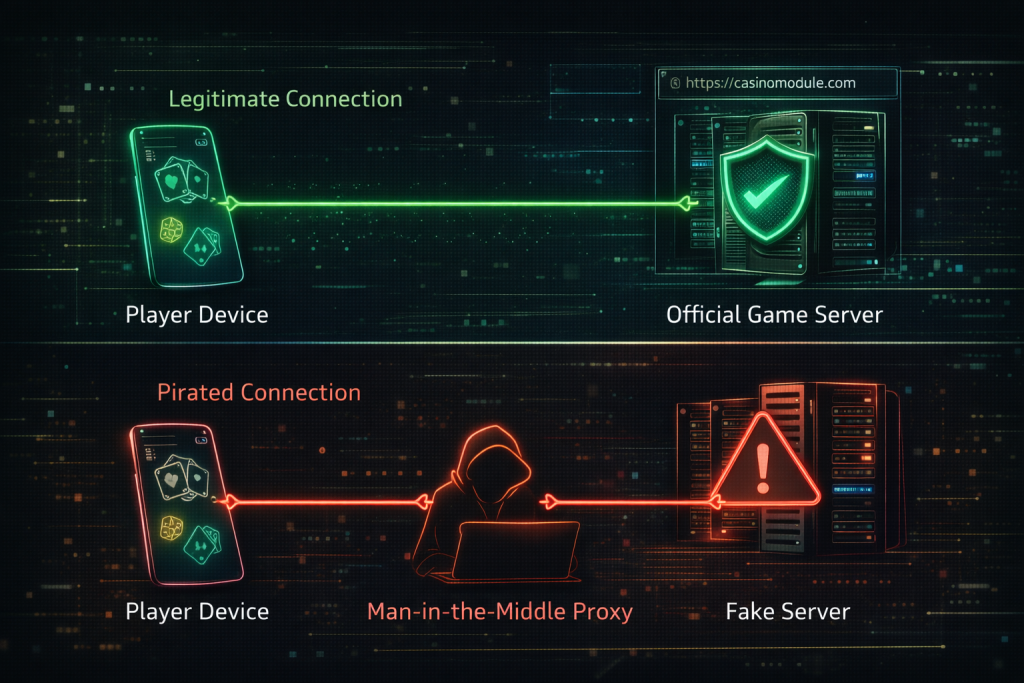
The Rigging Risk: If a casino knows the seed and the algorithm, they can predict the next spin. This is why legitimate casinos do not host the RNG. The RNG is hosted on the game provider’s server (e.g., NetEnt, Play’n GO).
The Server-Side Audit (Do It Yourself)
You can verify this connection yourself using your browser. This is the same “Inspect Element” audit I perform on every review.
1. Open a game (e.g., Book of Dead).
2. Right-click and select “Inspect” to open Developer Tools.
3. Click the “Network” tab.
4. Spin the reels.
5. Look at the “Request URL” column.
Legitimate: The game communicates with `*.playngonetwork.com` (for Play’n GO) or `*.casinomodule.com` (for NetEnt).
Pirated: The game communicates with `xyz-slots-api.net` or a raw IP address. If you see this, the game is a “nulled” copy, and the RTP can be set to 0%.
3. Liquidity Stress Test: Can They Pay?
A casino can be honest but insolvent. If they do not have the cash on hand, they will use “Stalling Tactics” to delay your withdrawal, hoping you reverse it and lose it back.
The “Segregated Funds” Requirement
Tier-1 licenses (MGA, UKGC, Ontario AGCO) require Player Fund Segregation. This means your deposit is kept in a separate bank account from the casino’s operational money (used for salaries, marketing, etc.).
How we audit this: We check the T&Cs for the “Insolvency Protection Level.”
* High Protection: Funds are held in an independent trust. If the casino goes bust, you get paid.
* Medium Protection: Funds are separate but part of the company assets. You are a creditor if they go bust.
* No Protection: Funds are mixed. If they go bust, your money is gone.
The Monthly Withdrawal Limit Ratio
We calculate a ratio: Max Monthly Withdrawal / Max Possible Jackpot.
Example of a Failure:
A casino offers a slot with a €200,000 jackpot but has a €5,000 monthly withdrawal limit. The ratio is 0.025. It would take 40 months (3.3 years) to get your money. We blacklist casinos with this predatory ratio unless they have a specific clause stating “Progressive Jackpots are paid in full.”
4. The Auditors: eCOGRA vs. iTechLabs vs. GLI
You will see these logos in the footer. They are the external police force. Here is what they actually do.
| Agency | Specialty | What to Look For |
|---|---|---|
| eCOGRA | Player Disputes & RTP Reports | The “Safe & Fair” Seal. Click it to see the “Percentage Payout Review” for the last month. |
| iTechLabs | RNG Code Testing | Focuses on Poker and Slots algorithms. Ensures card shuffling is statistically random. |
| GLI | Land-Based & Online Parity | The strictest technical standards. Common in US states (NJ, PA) and highly regulated EU markets. |
5. Auditing the Live Studio: Wheels & Cards
Live Casino introduces a physical element. How do we audit a human dealer?
The OCR (Optical Character Recognition) Audit
In Evolution or Playtech studios, every card has a barcode. As the card leaves the shoe, it passes a scanner. This data is fed to the Game Control Unit (GCU).
The “Ghost Card” Check: If the video freezes but the game history shows a result, rely on the audit log. The GCU records the digital scan of the card. This is the legal result. The video is just for entertainment. If the dealer scans a “King” but the video shows a “Queen” (extremely rare), the digital scan usually overrides, but this is grounds for a refund.
Wheel Balancing
Roulette wheels are mechanical. Over time, they can develop a “bias” due to wear and tear. Auditors perform “Leveling Checks” weekly. They spin the wheel thousands of times to ensure no “Zone” is hit more often than statistically probable (1/37).
6. Crypto & “Provably Fair” Algorithms
Crypto casinos (Stake, Roobet, BC.Game) use a different audit method called Provably Fair. This is superior to traditional auditing because you can verify every single bet.
How It Works
- Server Seed: The casino generates a random string and hashes it (hides it) before you bet.
- Client Seed: You (the player) provide a random seed (or the browser generates one).
- The Result: The result is calculated using `Hash(Server Seed + Client Seed)`.
- The Reveal: After the bet, the casino reveals the unhashed Server Seed. You can run the calculation yourself to prove they didn’t change the outcome after you bet.
The Audit Step: If a crypto casino does not offer a “Verify” button for every hand history, it is not Provably Fair. Avoid it.
7. Terms & Conditions Forensic Scan
The most dangerous part of a casino is not the software; it is the legal contract. We scan for these three “Killer Clauses”:
1. The “Irregular Play” Trap
“The Casino reserves the right to withhold winnings if irregular play is detected.”
The Danger: This is often undefined. It can mean “betting 30% of your balance in one go” or “moving from high variance slots to low variance slots.” Safe casinos define exactly what constitutes irregular play (e.g., “Bets over €5”).
2. The “Dormancy” Fee
“If an account is inactive for 3 months, a €10/month fee is charged.”
The Danger: This is predatory. Standard dormancy is 12 months. If a casino tries to bleed your balance after 90 days, they are struggling for cash flow.
3. The “Max Win” on Real Money
“Maximum withdrawal from any play is €10,000.”
The Danger: Never accept a cap on wins generated from your own cash deposit. Win caps should only apply to “No Deposit Bonuses.” If I deposit €100 and win €50,000, I should be able to withdraw €50,000. Period.
8. Tool: The Casino Safety Scorecard
Use this interactive checklist to grade any casino you are considering. If the score is below 80, do not deposit.
🛡️ Operational Safety Audit
1. License Link is Dynamic (MGA/UKGC)
2. SSL Certificate is OV or EV (Not just DV)
3. eCOGRA/iTechLabs Logo is Clickable
4. Game Server Check (Inspect Element) Passed
5. No “Max Win Cap” on Real Money
6. Withdrawal Limit > €20,000/MonthCalculate Safety Score
Score: 0/100
9. Frequently Asked Questions
How often should a casino be audited?
Regulators like the MGA require an external audit (by eCOGRA or similar) annually. However, internal compliance teams should audit liquidity and T&Cs monthly. If a casino hasn’t updated its “Payout Percentage” report in 6 months, it’s a red flag.
Can I audit a casino myself?
Yes. You can perform the “License Check” and “Server Check” (using Inspect Element) yourself. These two steps catch 90% of scams. The “Safety Scorecard” above is designed exactly for this personal auditing process.
What is the difference between eCOGRA and iTechLabs?
Both are accredited testing agencies. eCOGRA is more player-focused and handles dispute resolution (ADR services). iTechLabs is more focused on the technical certification of the RNG code and mathematics.
Do new casinos have less liquidity?
Generally, yes. A brand new casino has not built up a treasury reserve. This is why we recommend checking if they are part of a larger “Group” (e.g., L&L Europe, N1 Interactive) which shares liquidity across brands. Standalone new casinos are high risk for large withdrawals.
Is it safe to play at a casino without a license?
No. Never. Without a license, you are handing your money to a stranger on the internet with no legal contract. If they steal it, you have zero recourse. No regulator can help you recover funds from an unlicensed site.
What does “RTP” actually mean in an audit?
RTP (Return to Player) is a statistical average. A 96% RTP means that over 1 billion spins, the machine will return 96% of the money in prizes. It does not guarantee you will win back €96 of your €100 deposit today. Volatility determines your short-term experience; RTP determines the long-term math.
How do I know if a “Streamer” is playing on a rigged server?
Many “Fake Money” streamers play on “Demo Mode” servers that are rigged to hit more often to create excitement. If a streamer cannot show their “Deposit History” or “Withdrawal History,” assume they are playing on a dev server, not the live server you play on.
What is an “ISO 27001” certification?
ISO 27001 is the gold standard for Information Security. If a casino (or their platform provider) has this, it means their staff has strict protocols for handling your data (passwords, passport scans). It prevents internal data theft.
Why do casinos ask for “Source of Wealth” (SOW)?
This is a mandatory audit step enforced by Anti-Money Laundering (AML) laws. If you deposit large sums (e.g., over €2,000), the casino must ask where the money came from to ensure they are not processing dirty money. It is annoying, but it is actually a sign of a compliant, safe casino.
Can a casino refuse to pay out a Progressive Jackpot?
Legally, no. Progressive Jackpots are usually pooled across the entire network (e.g., all casinos hosting Mega Moolah). The provider (Microgaming), not the casino, holds the funds. If a casino refuses to pay, they are stealing money that isn’t even theirs. This results in immediate license revocation.

Founder and Chief Game Analyst at Casino545 (Since 2004)
Mission: I created Casino545 with a single, uncompromising goal: to cut through the marketing noise and bring real transparency to the online casino industry. My focus is on publishing independent, data-driven reviews built on actual operational testing, financial verification, and strict regulatory analysis. Marketing budgets don’t buy my opinions. Every evaluation follows rigorous editorial standards so players can access safe, compliant, and fair platforms.
Industry Experience
I’ve been breathing iGaming since 2004, right when regulated online gambling started expanding across Europe. I spent years working on the operational side for a major European operator, managing VIP support, payment processing, and internal risk controls. That “behind-the-scenes” experience gave me direct, hands-on exposure to how withdrawal procedures, AML compliance protocols, fraud prevention systems, and financial audits actually work.
Today, I use that insider knowledge to audit casino payment systems, analyze withdrawal reliability, assess hidden bonus risks, and demand operational transparency from licensed platforms.
Core Areas of Expertise
Slot Volatility Mathematics: Analysing RTP variations and hit frequencies across major providers.
Regulatory Frameworks: Deep understanding of European and local licensing mandates.
Crypto & Fiat Payment Systems: Testing the real-world friction of casino banking infrastructures.
Review Methodology
Real-Money Deposit Testing: I personally fund and test casino cashier systems to evaluate transaction clarity and payment processing efficiency.
Withdrawal Time Auditing: I measure the exact withdrawal cycle — from the moment I hit “submit” to the second the funds settle in my bank account — to prove financial reliability.
Terms & Conditions Risk Analysis: I dig into the fine print to expose clauses affecting withdrawal limits, bonus conversion rules, and unfair account restrictions.
Support Competency Verification: Anonymous, rigorous testing of customer support accuracy, escalation handling, and technical knowledge.
Commitment to Responsible Gambling
Player protection isn’t just a buzzword; it’s the core of my evaluation framework. I only prioritize operators that prove their regulatory compliance, enforce transparent policies, and offer structured self-exclusion systems. Gambling should be safe entertainment, and I strongly encourage access to independent support networks like GamCare and Gambling Therapy.