
I have audited the server code for some of the world’s largest slot providers. I have seen the “Par Sheets”—the spreadsheet documents that define the mathematics of the game. And I can tell you this: everything you think you see on the screen is an illusion.
The reels spinning? An animation. The “near miss” where the third scatter symbol lands just one spot too low? A pre-calculated visual effect designed to spike your dopamine. The moment you clicked “Spin,” the result was already decided by a server in Malta, Gibraltar, or the Isle of Man. The rest is just theater designed to keep you seated.
Most players operate on superstition. They believe in “hot” and “cold” machines. They believe that changing their bet size confuses the software. In 2026, these myths are not just wrong; they are expensive. To win at slots—or at least, to lose slower—you must stop looking at the graphics and start looking at the math. In this operational deep-dive, I will dismantle the engine of an online slot machine. We will cover the Random Number Generator (RNG), the Virtual Reel Mapping, the concept of Volatility, and the hidden RTP Ranges that casinos use to silently lower your odds.
Tech Specs: Jump to Section
- 1. The RNG Engine: The Millisecond Decision
- 2. Virtual Reel Mapping: The Illusion of Odds
- 3. The Par Sheet: The Blueprint of the Game
- 4. Variable RTP: The 96% vs. 91% Trap
- 5. Volatility vs. Hit Frequency: A Case Study
- 6. Dopamine Engineering: Sound and Speed
- 7. The “Near Miss” Effect: Is It Rigged?
- 8. Tool: Volatility Simulator
- 9. The Math of “Bonus Buys”
- 10. Frequently Asked Questions
1. The RNG Engine: The Millisecond Decision
The brain of the slot is the Pseudo-Random Number Generator (PRNG). It is the absolute authority. It does not “cycle” through wins. It does not care that you lost 50 times in a row. It has no memory of the past and no plan for the future.
The Mersenne Twister Algorithm
Most modern slots use an algorithm known as the Mersenne Twister. This mathematical formula generates a sequence of numbers that is statistically indistinguishable from true randomness. It requires a “Seed” value to start.
The Operational Cycle:
The RNG is constantly generating numbers—thousands per second—even when no one is playing. The server is in a perpetual state of flux.
0.00ms: You stare at the screen. The RNG is churning: 492810, 102938, 559201, 992834…
0.05ms: You decide to click “Spin.”
0.06ms: Your click reaches the server. The RNG locks onto the exact number generated at that microsecond (e.g., 559201).
The Result: The server translates 559201 into a specific outcome: “Reel 1: Cherry, Reel 2: Lemon, Reel 3: Bar.”
If you had clicked “Spin” one millisecond later, you would have grabbed a different number, and perhaps a jackpot. This is why “timing” strategies are futile. No human reaction time can synchronize with a processor running at gigahertz speeds.
True Randomness vs. Pseudo Randomness
Technically, computers cannot be truly random. They follow instructions. However, the PRNGs used in gambling are tested by auditors like eCOGRA to ensure the “Period” (the time before the sequence repeats) is so massive—often $2^{19937}-1$—that it would take billions of years to repeat. For all practical gambling purposes, it is random.
2. Virtual Reel Mapping: The Illusion of Odds
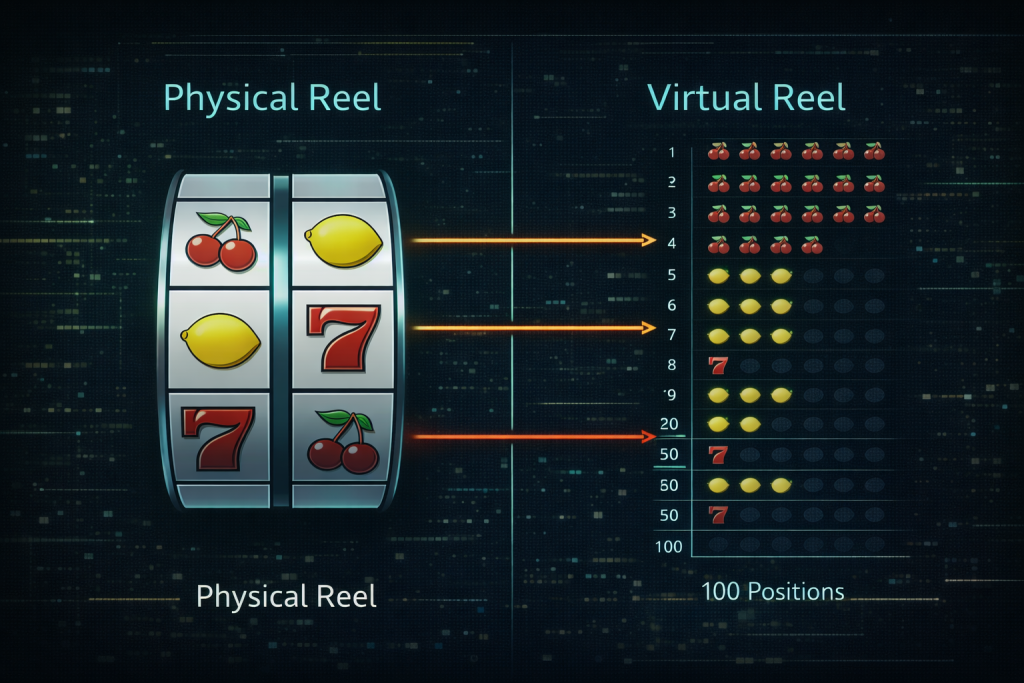
This is the industry’s biggest secret, patented by Inge Telnaes in 1984. In the old days of mechanical slots, a physical reel had 20 symbols. The odds of hitting a specific symbol were 1 in 20. If you had 3 reels, the jackpot odds were $20 \times 20 \times 20 = 8,000$ to 1.
In online slots (Video Slots), the physical reel on the screen is just a display. It does not dictate the odds. Behind the scenes, there is a Virtual Reel with thousands of positions.
The Mapping Table Example:
Let’s imagine a virtual reel with 100 stops.
| Symbol | On Screen Appearance | Virtual Stops (The Real Odds) | Probability |
|---|---|---|---|
| 🍒 Cherry (Low Pay) | Appears 4 times | Mapped to 50 stops | 50% (High) |
| 🍋 Lemon (Medium Pay) | Appears 4 times | Mapped to 20 stops | 20% (Medium) |
| 💎 Diamond (Jackpot) | Appears 1 time | Mapped to 1 stop | 1% (Ultra Low) |
| ⚪ Blank/Ghost | Appears 10 times | Mapped to 29 stops | 29% (Loss) |
You might see one Diamond and one Cherry on the reel strip. Visually, they look equally likely to land. But on the Virtual Reel, the Cherry has a massive “landing zone” (50 spots) and the Diamond has a tiny target (1 spot). This allows the casino to offer massive jackpots (10,000x or more) because the statistical probability of hitting those specific virtual spots across 5 reels is microscopic (e.g., 1 in 50 million).
3. The Par Sheet: The Blueprint of the Game
Every slot has a document called a “Par Sheet” (Probability Accounting Report). This is the bible for the math model, usually hidden from players. It defines:
- RTP (Return to Player): The theoretical payout percentage (e.g., 96.5%).
- Cycle Size: How many spins it takes to theoretically hit every possible combination (often billions).
- Volatility Index (VI): A numerical value representing the “swing” or variance of the bankroll.
- Hit Frequency: The percentage of spins that result in any payout (usually between 20% and 40%).
The Par Sheet is what regulators like the Malta Gaming Authority review. They run millions of simulated spins to ensure the actual results match the Par Sheet’s predictions. If the Par Sheet says the jackpot hits once every 10 million spins, and the simulation hits it once every 100 spins, the game fails certification.
4. Variable RTP: The 96% vs. 91% Trap
In the past, a slot like Book of Dead had a fixed RTP. In 2026, this is no longer true. Game providers now create multiple Par Sheets for the exact same game.
The Operational Reality:
Provider Play’n GO might offer Book of Dead with five different RTP settings:
- 96.21% (The standard “fair” version)
- 94.25% (Common in regulated markets with high taxes)
- 91.25% (Common in shady offshore casinos)
- 87.25% (The “Tourist Trap” setting)
- 84.25% (Pure theft)
The casino operator chooses which version to host. They can choose the 91% version to increase their profit margins. The game looks identical. The graphics are the same. The bonus rounds are the same. But your bankroll will drain 50% faster.
How to Check: Always open the “?” or “Help” file inside the game window. Scroll to the very bottom or look for “Game Rules.” The provider is legally required to display the RTP of the current session. If you cannot find the RTP number, close the game immediately. You are likely playing a low-RTP version.
5. Volatility vs. Hit Frequency: A Case Study
Players often confuse Volatility with Hit Frequency. They are related, but they measure different things.
Hit Frequency is how often you get a winning spin. A game with a 40% hit frequency pays out almost every other spin. However, these wins might be less than your bet (e.g., bet €1, win €0.50). This is a “False Win.”
Volatility (Variance) is the risk/reward ratio. It measures the size of the wins and the gap between them.
Case Study: Starburst vs. Dead or Alive 2
Slot A: Starburst (NetEnt) – Low Volatility
The Experience: You bet €1. You win €0.50, then €1.20, then lose, then win €0.80. Your balance moves slowly: €100 -> €98 -> €102 -> €95.
The Math: The payouts are concentrated in the base game. The max win is low (500x). It is designed to keep you playing for a long time without winning big or losing big.
Slot B: Dead or Alive 2 (NetEnt) – Extreme Volatility
The Experience: You bet €1. You lose. You lose. You lose. You lose for 50 spins. Balance: €50. Suddenly, you hit the bonus. You win €2,000 (2000x).
The Math: The RTP is concentrated in the Bonus Round. The base game pays almost nothing. You are paying for “tickets” to the lottery bonus round.
Operational Advice: If you have a small bankroll (€50), playing High Volatility slots is suicide. You will statistically hit zero before you trigger the massive volatility spike required to make a profit.
6. Dopamine Engineering: Sound and Speed
Slots are not just math; they are psychology. Developers hire sound engineers and behavioral psychologists to maximize “Time on Device.”
- The “Ding” of a Loss: In older slots, silence meant a loss. In modern slots, even a loss is accompanied by encouraging sounds.
- LDWs (Losses Disguised as Wins): You bet €2. The screen flashes, bells ring, and coins explode. You won €0.50. Operational reality: You lost €1.50. But your brain registered a “Win” due to the audio-visual cues. This keeps dopamine high despite financial loss.
- Spin Speed: The “Turbo Spin” feature removes the reel animation, reducing the spin time from 4 seconds to 0.5 seconds. This allows you to play 8x more hands per hour, increasing the casino’s hourly revenue by 800%.
7. The “Near Miss” Effect: Is It Rigged?
You need three Scatters to trigger the Free Spins. You get the first two on Reel 1 and Reel 2. The music intensifies. Reel 3 spins longer than usual. It slows down… stops… and the third Scatter lands just one position below the payline.
You scream: “I was so close!”
The Math: You were not close.
The RNG determined you lost the millisecond you clicked spin. The result was “Loss.” However, the software has a secondary algorithm called the “Near Miss” or “Teaser” script. When the RNG generates a loss that is almost a win, the game loads a specific visual sequence to show the symbols just missing.
Why? Research shows that “Near Misses” activate the same reward centers in the brain as actual wins. They encourage you to spin “just one more time” because you feel like the machine is “warming up.” It is a psychological illusion. The machine is never warming up.
8. Tool: Volatility Simulator
Understand the difference between Low and High Variance before you risk real money. Use this simulator to see how 100 spins play out differently.
🎰 Slot Volatility Simulator (100 Spins)
See how your balance survives (or dies) based on variance.Simulate Low Volatility
(Starburst Style)Simulate High Volatility
(Book of Dead Style)
Waiting for spin…
Start Balance: €100
9. The Math of “Bonus Buys”
A feature dominating the 2026 landscape is the “Bonus Buy” (or “Feature Buy”). This allows you to pay a premium—usually 100x to 2000x your stake—to bypass the base game and trigger the Free Spins immediately. Regulators like the UKGC have banned this mechanism, but it thrives in international (MGA/Curacao) markets.
The Operational Trade-Off:
When you buy a bonus for €100, you are essentially making a massive bet with extremely high variance.
Pros: The RTP of the Bonus Buy is often statistically higher than the base game (e.g., 96.8% vs 96.2%). This is because you are bypassing the low-paying base game spins.
Cons: The Risk of Ruin is exponential. If you have €200, you can spin 200 times at €1. Or you can buy 2 bonuses. The 200 spins give you 200 chances to trigger a feature naturally. The 2 buys give you 2 chances. If both buys pay out 20x (which is operationally common), you are bankrupt in 2 minutes. Bonus Buys are designed for streamers and high-rollers, not for casual players looking for playtime.
The “Max Win” Myth: Many players buy bonuses hoping to hit the “Max Win” (e.g., 50,000x). The odds of hitting the Max Win are usually 1 in 15 million. Buying the bonus increases your frequency of entering the round, but it does not change the astronomical odds of the perfect seed required for the Max Win.
10. Frequently Asked Questions
Do slots pay out more at night?
No. The RNG does not know the time of day. It is purely mathematical. The only reason jackpots often drop at night is that more people are playing, so the RNG cycles are moving faster. The probability per spin remains identical.
Can the casino change the RTP?
Yes, but not instantly. They must request a server configuration change from the game provider (e.g., NetEnt). They cannot toggle a switch to make you lose because they see you winning. That is a myth. Any change in RTP must be reflected in the “Help” file.
What is a “Cold” slot?
A “Cold” slot is a statistical fallacy (The Gambler’s Fallacy). Just because a slot hasn’t paid in 1,000 spins does not mean it is “due” to pay. Past spins do not influence future spins. The odds are reset every millisecond.
Is it better to bet Max Bet?
In modern video slots, no. The RTP is usually the same whether you bet €0.20 or €100. The only exception is some older progressive jackpot slots where a higher bet qualifies you for the “Mega” jackpot tier. Always read the paytable to confirm.
How do I know the RTP of a slot?
Click the “?” or “i” icon inside the game window. Scroll to the bottom of the rules. The provider is legally required (in regulated markets) to display the theoretical RTP. If it is missing, treat the game as suspect.
Do “Quick Spin” or “Slam Stop” affect the result?
No. Clicking the “Stop” button to stop the reels early is purely visual. The result was determined the moment you clicked “Spin.” Stopping the reels just ends the animation faster; it does not change the outcome.
Are “Branded” slots (like Game of Thrones) worse?
Operationally, yes. Branded slots have to pay royalties to the franchise owners (HBO, etc.). To cover these costs, they often have slightly lower RTPs (e.g., 95% instead of 96.5%) or higher volatility to compensate. You are paying for the brand.

Fondator și Analist Principal de Jocuri la Casino545 (Din 2004)
Misiune: Am creat Casino545 cu un singur obiectiv fără compromis: să elimin zgomotul de marketing și să aduc transparență reală în industria cazinourilor online. Mă concentrez pe publicarea de recenzii independente, bazate pe date, construite pe testări operaționale reale, verificare financiară și analiză strictă a cadrului de reglementare. Bugetele de marketing nu îmi cumpără opiniile. Fiecare evaluare urmează standarde editoriale riguroase pentru ca jucătorii să poată accesa platforme sigure, conforme și corecte.
Experiență în Industrie
Trăiesc și respir iGaming din 2004, exact când jocurile de noroc online reglementate au început să se extindă în Europa. Am lucrat ani de zile pe partea operațională a unui operator european major, gestionând suport VIP, procesarea plăților și controale interne de risc. Această experiență „din culise” mi-a oferit expunere practică directă asupra modului în care funcționează procedurile de retragere, protocoalele AML, sistemele de prevenire a fraudei și auditurile financiare.
Astăzi folosesc aceste cunoștințe interne pentru a audita sistemele de plată ale cazinourilor, a analiza fiabilitatea retragerilor, a evalua riscurile ascunse ale bonusurilor și a solicita transparență operațională din partea platformelor licențiate.
Domenii Cheie de Expertiză
- Matematica Volatilității Sloturilor: Analiza variațiilor RTP și a frecvenței câștigurilor la furnizori majori.
- Cadre de Reglementare: Înțelegere profundă a cerințelor de licențiere europene și locale.
- Sisteme de Plată Crypto și Fiat: Testarea fricțiunii reale din infrastructura bancară a cazinourilor.
Metodologie de Recenzie
- Testare Depozit cu Bani Reali: Finanțez și testez personal sistemele de casierie pentru a evalua claritatea tranzacțiilor și eficiența procesării plăților.
- Audit al Timpului de Retragere: Măsor ciclul exact de retragere — din momentul în care apăs „trimite” până când fondurile ajung în contul meu bancar.
- Analiză de Risc a Termenilor și Condițiilor: Analizez detaliile pentru a expune clauze care afectează limitele de retragere, conversia bonusurilor și restricțiile nedrepte de cont.
- Verificarea Competenței Suportului: Testare anonimă și riguroasă a acurateței suportului, gestionării escaladărilor și cunoștințelor tehnice.
Angajament pentru Joc Responsabil
Protecția jucătorilor nu este doar un cuvânt la modă; este nucleul cadrului meu de evaluare. Prioritizez doar operatorii care demonstrează conformitate reglementară, aplică politici transparente și oferă sisteme structurate de autoexcludere. Jocurile de noroc ar trebui să fie divertisment sigur, iar eu încurajez ferm accesul la rețele independente de suport precum GamCare și Gambling Therapy.