In the casino ecosystem, there is a predator that disguises itself as a friend. It does not look dangerous. It is bright, colorful, and often themed after your favorite TV show or movie. It invites you to sit down with a promise that fits comfortably in your pocket: “1¢ Per Line.”
This is the Penny Slot. And as a senior game mathematician, I am here to tell you that it is, statistically speaking, the most expensive machine on the floor.
As we move into 2026, the landscape of “Low Limit” gaming has shifted aggressively. Inflation has touched everything, including the “Cost to Cover” on a standard reel. Players flock to penny slots believing they are the safe harbor for a small bankroll. They believe that betting small means losing small. The math proves otherwise.
In this extensive analysis, I will deconstruct the financial mechanics of the modern penny slot. I will show you the “Hold Percentage” data that casinos hide, the volatility traps of the “Max Bet” button, and why playing a $1 machine might actually save you money in the long run. We are going to look at the numbers, not the flashing lights.
Table of Contents
The Denomination Myth: The Penny That Costs a Dollar
The first trick of the penny slot is linguistic. It is called a “Penny Slot” because the denomination is $0.01. However, the bet is almost never one penny.
Modern video slots operate on a system of “Lines” and “Credits.” To activate the game, you must usually cover 50 lines. Often, there is a “Feature Bet” or “Ante” that adds another 25 credits.
The Calculation:
50 Lines × 1 Credit per Line = 50 Credits.
Feature Cost = 25 Credits.
Total Minimum Bet = 75 Credits.
At a penny denomination, that spin costs $0.75.
If you want to have a decent chance at a win, you often need to bet 2x or 3x the minimum. Suddenly, you are betting $2.25 per spin on a “Penny Slot.” This is the same cost as a “Max Bet” on a classic three-reel Quarter machine ($0.25 × 3 = $0.75), yet players perceive the penny slot as cheaper. It is a psychological slight of hand.
The “Hold Percentage” Reality: Paying for the Privilege
In casino analytics, we don’t just look at RTP (Return to Player); we look at the “Hold.” The Hold is the percentage of chips the casino keeps.
There is a universal rule in slot floor configuration: The lower the denomination, the higher the Hold.
Casinos have fixed operating costs. They need to pay for electricity, staff, and the floor space the machine occupies. It costs the same amount of money to maintain a Penny Slot as it does a $5 High Limit Slot. To make the Penny Slot profitable, the math must be tighter.
The 2026 RTP Spectrum
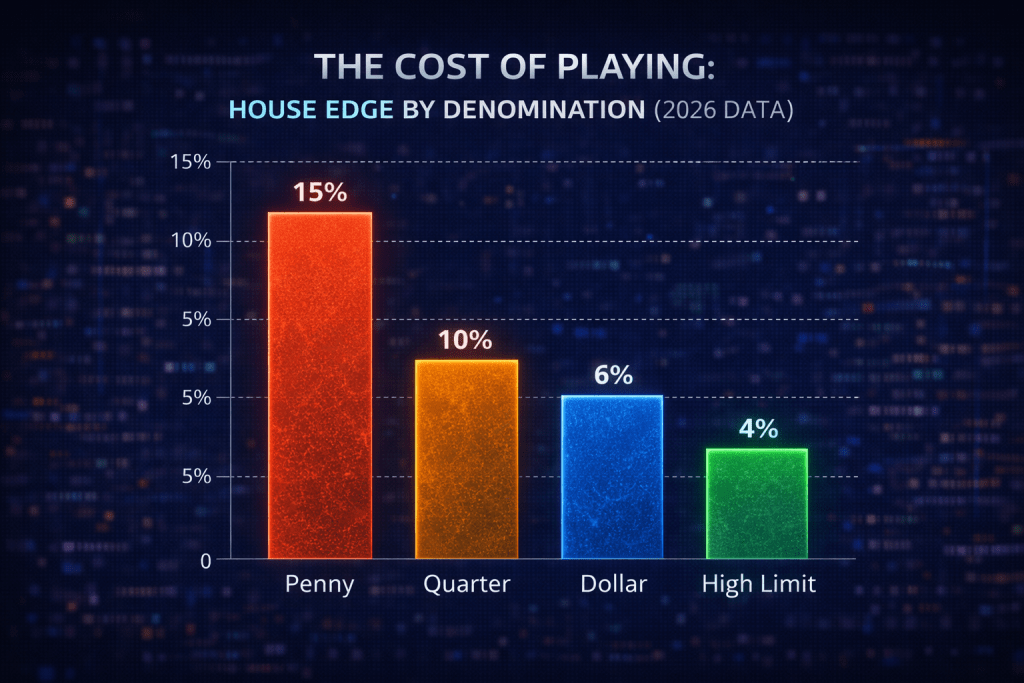
Based on the latest regulatory reports from jurisdictions like Nevada and New Jersey, here is the breakdown of actual payback percentages in 2026:
- $5.00 Slots (High Limit): Average RTP 96% – 98%. (House Edge: 2-4%).
- $1.00 Slots: Average RTP 94% – 96%. (House Edge: 4-6%).
- $0.25 Slots: Average RTP 92% – 94%. (House Edge: 6-8%).
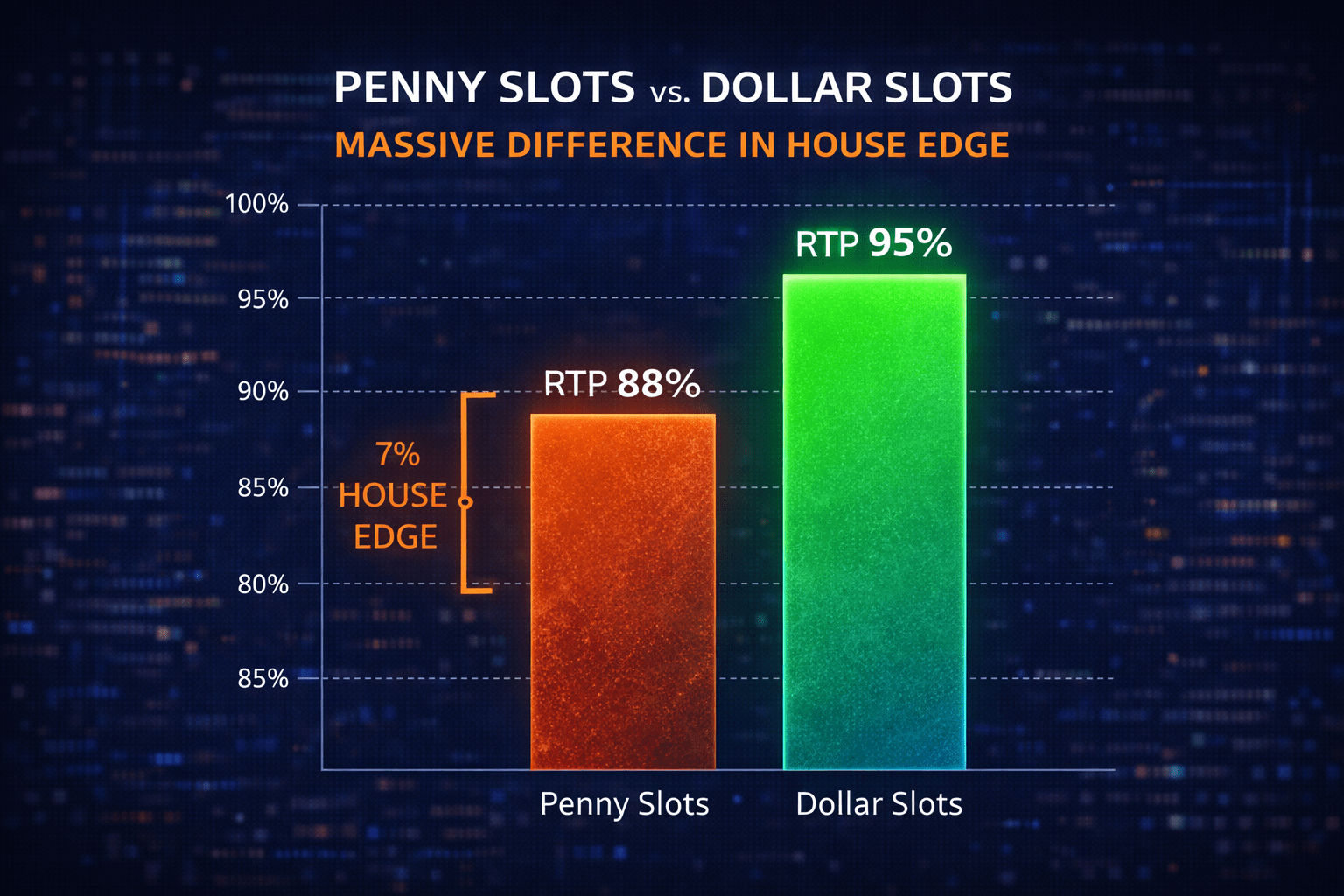
- $0.01 Slots (Penny): Average RTP 84% – 88%. (House Edge: 12-16%).
Look at those numbers closely. The House Edge on a penny slot is often triple or quadruple the edge on a dollar slot.
The Cost Per Hour Formula:
Let’s assume you bet $1.00 per spin on both machines, playing 600 spins per hour.
Scenario A: Dollar Slot ($1 Denom, 1 Line)
Total Wager: $600.
House Edge: 5%.
Theoretical Loss: $30 per hour.
Scenario B: Penny Slot ($0.01 Denom, 100 Lines)
Total Wager: $600.
House Edge: 15%.
Theoretical Loss: $90 per hour.
You are betting the exact same amount of money ($1 per spin), but the Penny Slot is draining your bankroll three times faster. This is why I call penny slots the “Tax on the Risk-Averse.”
The Volatility Trap: Why You Never Win “Small”
You might argue, “But Elena, I get more entertainment on the penny slot because I win more often!”
This is where we must discuss Hit Frequency vs. Payback Percentage. Penny slots are designed with a very high Hit Frequency (often 40-50%). You will see “WIN!” flash on the screen constantly.
But let’s look at the math of those wins.
The “False Win” Phenomenon:
You bet $1.00 (100 credits).
The machine bells ring. You won!
The payout is 40 credits ($0.40).
Did you win? No. You lost $0.60. But your brain released dopamine because of the lights and sounds. Penny slots are masters of the False Win. They bleed your balance slowly while convincing you that you are “staying even.”
The Jackpot Contribution
Furthermore, most penny slots are linked to Progressive Jackpots (Mini, Minor, Major, Grand).
To fund a $100,000 Grand Jackpot, the game must take a slice of every bet. In many penny slots, 5% to 7% of the total RTP is locked in the Progressive.
If the game has an 88% RTP, and 7% is for the Jackpot, the “Base Game RTP” is only 81%. Unless you hit the Grand (a 1 in 50 million event), you are playing on a machine with abysmal returns. You are essentially buying a lottery ticket with every spin, but paying a slot machine price for it.
The “Max Bet” Requirement: The 2026 Lockout
In 2026, game developers have become more aggressive with “Qualifying Bets.”
Read the digital glass (the Help screen) carefully. On many modern penny slots, specifically those with “Hold and Spin” mechanics (like Lightning Link or Dragon Link clones), you are not eligible for the Grand Jackpot unless you bet above a certain threshold.
I have seen machines where the minimum bet is $0.50, but the “Jackpot Qualifier” bet is $3.00.
If you are betting $0.50, you are contributing to the jackpot pool with every spin, but you are mathematically barred from winning it. You are subsidizing the high rollers. This is the worst possible strategy. If you cannot afford the qualifying bet, you must not play that machine. You are paying for a feature you have disabled.
Online Penny Slots: A Different Mathematical Universe
There is a critical distinction to be made between “Land-Based” penny slots (Vegas, Macau, Local Pub) and “Online” penny slots.
Online casinos do not have the same overheads (no floor space, no AC, no staff). Therefore, they can afford to run penny-denomination games at much higher RTPs.
The Online Advantage:
A game like Play’n GO’s Book of Dead allows you to play 1 line at $0.01.
The RTP is typically 96.21% (if checking the default setting).
This is a massive difference from the 88% in a land-based casino.
However, the danger online is Speed.
In a physical casino, a fast player spins 10 times a minute. Online, with “Quick Spin” enabled, you can spin 50 times a minute.
The Speed Multiplier:
Land Based ($0.50 bet × 10 spins/min × 60 min) = $300 Turnover.
Online ($0.50 bet × 50 spins/min × 60 min) = $1,500 Turnover.
Even with a better RTP online (96% vs 88%), the sheer volume of play can result in larger losses if you do not control your pace. The math of “Expected Loss” is Volume × House Edge. If you increase the Volume by 500%, you negate the benefit of the lower House Edge.
Bankroll Management for the “Low Roller”
If you are playing penny slots, you likely have a limited bankroll. Let’s calculate what you actually need to survive the variance.
Many players bring $20 to the casino. In 2026, $20 is not a bankroll; it is a donation.
If you are betting $0.80 per spin, $20 is 25 spins.
At a speed of 10 spins per minute, that is 2.5 minutes of play.
The 1000-Spin Rule
To have a statistical probability of hitting a bonus round (which usually hits once every 150-200 spins), you need staying power.
I recommend a bankroll of at least 100x to 200x your bet size for a casual session.
- Bet Size: $0.50
- Required Bankroll: $50 – $100
If you only have $20, you should not be betting $0.50. You should be finding a machine that allows $0.10 or $0.20 bets. If you over-bet your bankroll on a penny slot, you are relying entirely on luck to save you in the first 5 minutes. The math suggests you will bust.
The Psychology of “The Grind”
Why do we play penny slots if the math is so bad? Because they are designed to be “Time on Device” machines.
A $5 slot is volatile. You win big or lose fast. A penny slot is a “Grind.” It is designed to extract your money slowly, over 3 or 4 hours. The developers use complex math models to ensure you stay in the “Zone.”
They use “Near Misses” (seeing 4 out of 5 bonus symbols). They use “Level Up” mechanics where you collect coins or unlock map areas. These features are not random; they are retention hooks. They are mathematically calibrated to keep you playing exactly until your money runs out.
In 2026, we see more “Perceived Skill” elements—like picking chests or shooting targets. Do not be fooled. The result is RNG. The “choice” is an illusion. Whether you pick the left chest or the right chest, the math model had already decided you were winning $2.00.
Strategic Adjustments for 2026
So, how do you play penny slots without getting slaughtered by the 12% House Edge?
- Check the RTP (Online Only): If playing online, check the “Help” file. If the RTP is below 94%, close the tab. There is no excuse for playing 88% RTP online in 2026.
- Avoid Branded Slots: Slots based on movies (Game of Thrones, Jurassic Park, etc.) have higher licensing fees. The casino pays for those fees by lowering the RTP. Play the generic “Ancient Egypt” or “Fruit” themes for better odds.
- Bet the Minimum to Qualify: Check the paytable. If betting 1 credit per line qualifies you for all bonuses, do not bet 5 credits per line unless the payout scales disproportionately (which it rarely does). Flat betting the minimum extends your playtime.
- The “Hit and Run”: If you hit a bonus round and win 50x or 100x your stake, leave. The math of a penny slot is designed to claw that money back immediately. The longer you stay, the closer you get to the theoretical RTP (Loss). Lock in the win.
Conclusion: The Price of Entertainment
I am not telling you to never play penny slots. They are fun. They are immersive. They offer a low barrier to entry.
But you must respect the math. Do not view them as a “cheap” way to gamble. View them as a premium entertainment product with a high hourly cost. The penny slot is the casino’s most profitable asset for a reason.
In 2026, the smart player knows that the denomination on the machine is irrelevant. It is the Bet Size, the Volatility, and the RTP that matter. If you walk in with $50, betting $2.00 on a penny slot, you are not a “low roller.” You are a high roller with bad math skills. Adjust your bets, understand the hold, and enjoy the show—but keep your wallet guarded.
Frequently Asked Questions
Are penny slots really random?
Yes. They use the same Random Number Generator (RNG) technology as $100 slots. The results are not rigged; they are just weighted. The probability of losing is hard-coded into the reel strips, but the specific outcome of every spin is independent and random.
Is it better to play max bet on penny slots?
Only if the progressive jackpot requires it. If the game has a “Must Hit By” progressive or a Grand Jackpot that unlocks only at Max Bet, then yes, you must bet max to have the highest theoretical return. If there is no jackpot qualifier, betting max just increases your volatility without improving your odds.
Do penny slots have tighter payouts on weekends?
No. This is a myth. Changing the RTP of a slot machine is a complex process that often requires regulatory approval and a technician to physically access the machine (or a server update that takes time). Casinos do not flip a switch for the weekend.
What is the “Volatility Index” of a penny slot?
Penny slots generally have High Volatility. Because the base bets are low, the game must withhold frequent small payouts to fund the occasional massive 10,000x wins. This means you will experience long streaks of “dead spins” compared to older, low-volatility mechanical reel games.
Why are newer penny slots so complicated?
Complexity hides the loss. When a machine has 50 lines, 243 ways to win, and three different bonus wheels, it is very difficult for a player to calculate their “True Odds.” The confusion keeps the player engaged, as they are constantly trying to figure out “how close” they were to a win.

Senior Slots Analyst & Game Math Expert (Since 2015)
Mission: Flashy graphics don’t pay out; math does. I joined Casino545 to deconstruct online slots and bonuses, revealing the true mathematical value (RTP) behind the marketing hype. My absolute priority is to ensure our readers understand the exact odds and mechanics before they ever press “spin”.
Industry Experience
With a background in Applied Mathematics, I entered the iGaming technical sector in 2015. Instead of marketing or support, I started “under the hood” as a Quality Assurance (QA) Tester for a major European game studio.
Testing slot mechanics, verifying volatility curves, and auditing Random Number Generators (RNG) for true randomness taught me how to read between the lines. I know exactly how to spot manipulated RTP figures and separate fair entertainment from predatory mathematical design.
Core Areas of Expertise
- RTP & Volatility Mathematics: Decompiling provider algorithms to verify actual hit frequencies.
- Bonus Valuation: Calculating the true monetary value of promotions against hidden wagering requirements.
- Game Studio QA: Identifying deceptive mechanics and unverified RNG software.
Review Methodology
- The 1,000 Spin Test: I don’t just read the manual; I run extensive real-money spin sessions to verify if the live volatility matches the developer’s technical sheet.
- Bonus Math Auditing: I calculate the true cost of a bonus. If a 50x wagering requirement makes winning statistically improbable, I flag it immediately.
- Dynamic RTP Tracking: I actively check if casinos are quietly lowering default RTP settings on popular games to protect their own margins.
Commitment to Responsible Gambling
Gambling must be a transparent transaction based on facts, never false hope. I advocate fiercely for clear Terms & Conditions and support industry initiatives that force operators to display live, unaltered RTP figures visibly on every single game interface.