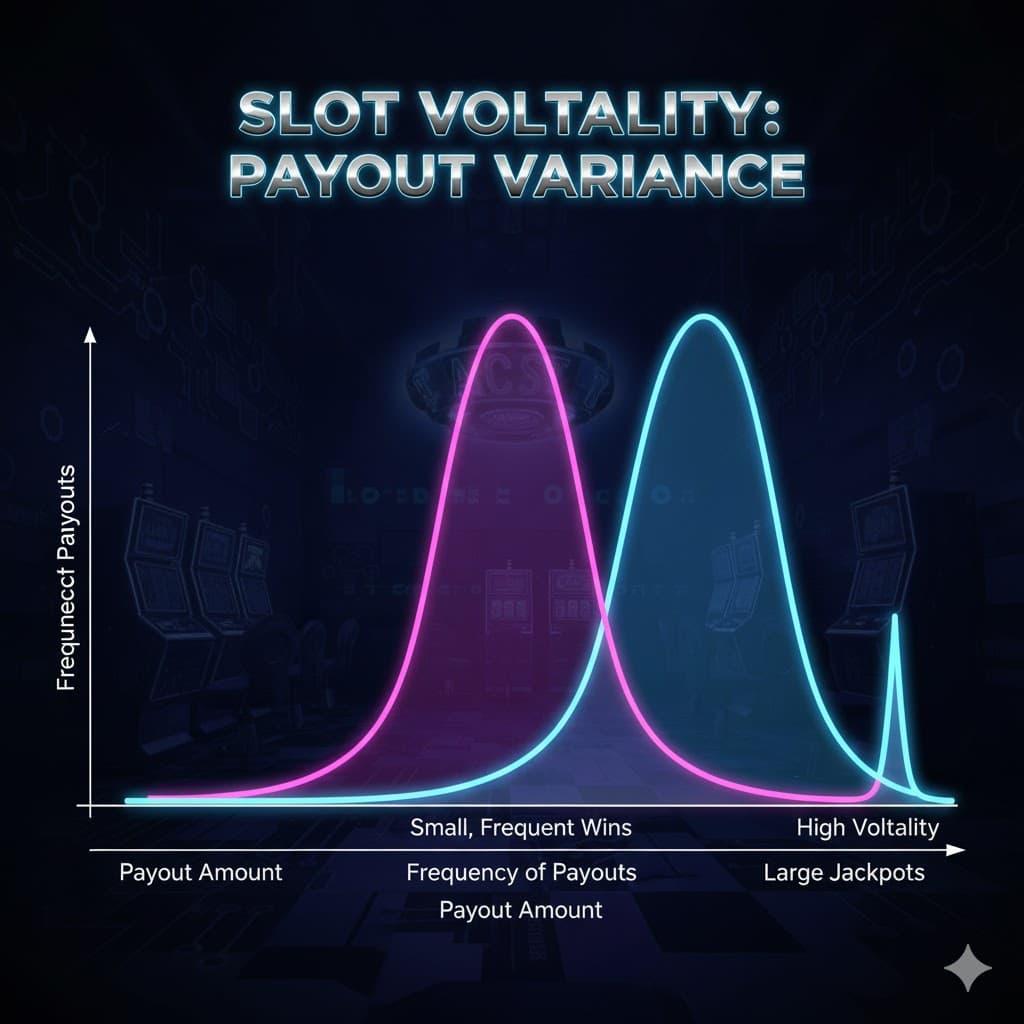
Casinos sell the dream of the “big win.” Developers market it as “High Volatility.” But as a mathematician, I look at the PAR sheets. I look at the variance. The numbers tell a different story than the marketing banners.
Volatility is not a buzzword. It is a statistical measurement of risk. It dictates your bankroll survival rate. It determines if you will play for ten minutes or ten hours. Most players ignore this. They look at the Return to Player (RTP) and assume a 96% payback means safety. This is a mathematical error.
In this analysis, I will deconstruct the mechanics of high volatility slots. We will look at the standard deviation, the relationship between hit frequency and payout size, and why “High Risk” does not always equal “High Reward.” We deal in facts here. Not false hope.
Defining Volatility: It Is Just Variance
In probability theory, volatility is synonymous with variance or standard deviation. In the context of a slot machine, it measures how far the results deviate from the expected average.
Imagine a slot with an RTP of 100% (a theoretical impossibility in online casinos, but useful for this example). You bet $1.00.
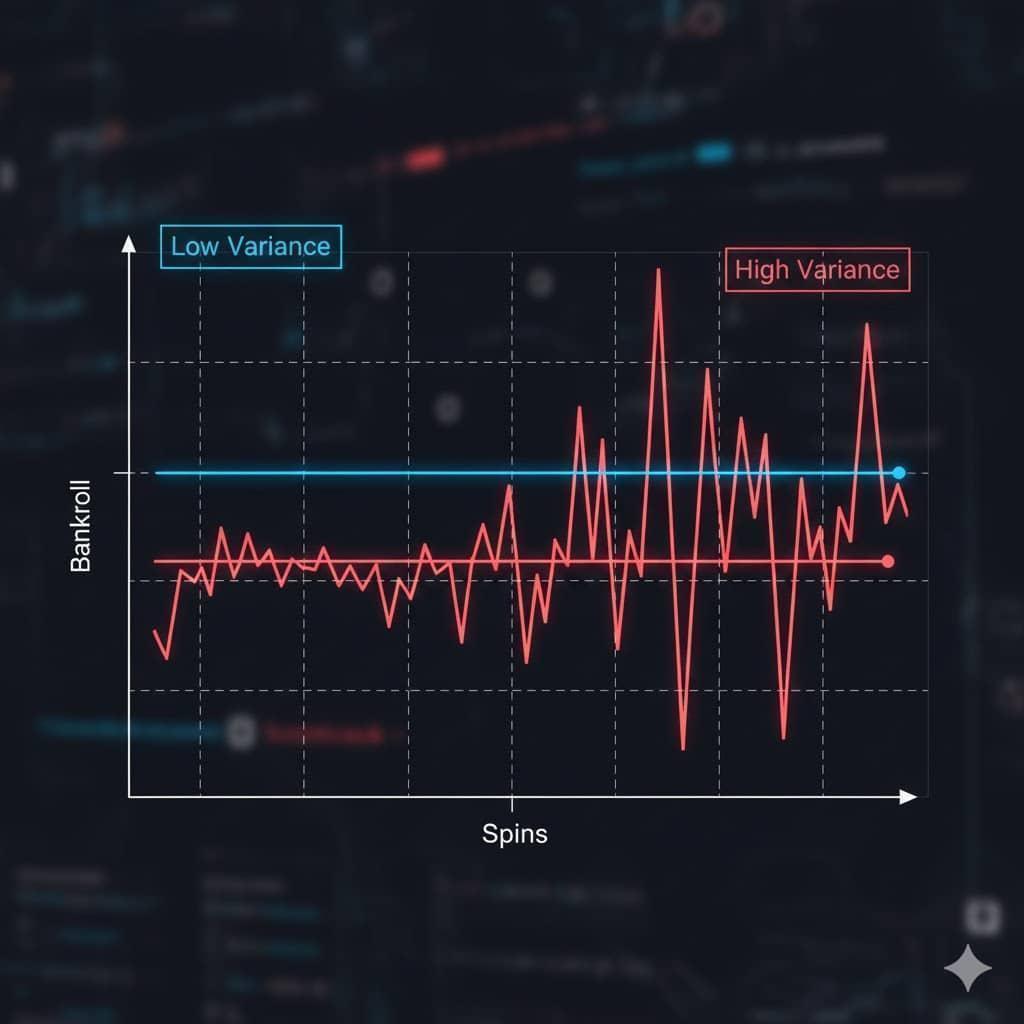
- Low Volatility: You bet $1.00. You win $0.90 or $1.10 almost every spin. The deviation from the mean is small. Your line on the graph is flat.
- High Volatility: You bet $1.00. You lose $1.00 for 99 spins. On the 100th spin, you win $100. The average is the same. The experience is violent.
High volatility slots are programmed with a massive standard deviation. The “Empty Spins” are the price you pay for the outliers. The math demands a long string of losses to compensate for the massive payout potential of 10,000x or 50,000x your stake.
The Volatility Index (VI) Explained
Game studios do not just guess volatility. They calculate a Volatility Index (VI). This is often a value based on the Confidence Interval of the simulation.
When I analyze a game like Book of Dead or Money Train, I look at the distribution of wins. In high VI games, a significant portion of the total RTP is locked behind “rare events.” These are usually bonus rounds or specific symbol combinations.
For example, in a standard low variance game, 40% of the RTP might come from the base game wins of 1x to 5x. In a high variance game, base game wins might only contribute 15% to the RTP. The remaining return is hidden in a 1-in-200 spin probability event. You are paying for spins that mathematically cannot return value until that specific event triggers.
The Relationship Between Hit Frequency and Volatility
There is a strong negative correlation between volatility and Hit Frequency (HF). Hit Frequency is the percentage of spins that result in any payout (even if it is less than the bet size).
Low Volatility: HF is often 30% to 40%. You get positive reinforcement constantly. The machine keeps you engaged with small bells and whistles.
High Volatility: HF can drop to 10% to 20%. This means 80% to 90% of your spins are dead. This is the “Dry Spell.” Mathematically, this is where most bankrolls die.
The “False Win” Phenomenon
High volatility slots often use “False Wins” to mask the low Hit Frequency. You bet $2.00. The screen flashes, sounds play, and coins fly. You won $0.50.
To your brain, this registers as a win. To your bankroll, this is a $1.50 loss. High volatility math relies on these false wins to keep the Hit Frequency technically higher without actually giving away the RTP reserved for the top prizes.
Bankroll Mechanics: The Probability of Ruin
Why do I constantly warn about bet sizing on high volatility games? It is because of the “Risk of Ruin” formula.
Because the variance is high, the swing downward is steeper. If you bring 50 bets to a low volatility game, you have a high probability of playing for an hour. If you bring 50 bets to a high volatility game, your probability of hitting zero before triggering a bonus is statistically probable.
The Math of Survival: To survive the standard deviation of a high volatility slot, you need a bankroll of at least 200x to 300x your average bet. Anything less is gambling on luck, not playing the probabilities.
Why RTP is Misleading in High Variance Games
RTP is a long-term theoretical calculation. “Long-term” in slot simulation means billions of spins.
If a high volatility slot has a 96.5% RTP, that number is irrelevant to your session of 500 spins. Due to the high variance, your personal RTP for that session could be 40% or 400%. The RTP stabilizes only over an infinite horizon. Do not trust the RTP tag on a high variance machine to save you in the short term. It won’t.
Top High Volatility Slots: A Mathematical Look
We see many “Extreme” slots entering the market. Here is how the numbers stack up on the most popular ones.
Money Train Series (Relax Gaming)
This is the benchmark for high variance. The RTP is decent (around 96.4%), but the distribution is heavily weighted toward the Money Cart bonus. The base game is essentially a waiting room. The variance here is extreme; you are buying tickets for a lottery that draws every few hundred spins.
Dead or Alive 2 (NetEnt)
A classic. The 111,111x max win is the outlier that drives the math. To fund a max win of that magnitude, millions of spins must result in zero returns. It is efficient math, but brutal for the casual player.
San Quentin xWays (Nolimit City)
Nolimit City pushes the volatility index to the limit. With 150,000x potential, the standard deviation is off the charts. The “buy feature” options exist because the organic hit rate of the top features is statistically minuscule.
Conclusion: Understand the Curve
I do not dislike high volatility slots. I play them. But I play them with the understanding of the distribution curve. I know that the empty spins are a mathematical necessity, not a glitch.
If you choose to play these games, accept the variance. Lower your bet size. Ignore the “near misses.” The math is designed to test your patience. If you cannot handle the swing, stick to the low variance tables. The numbers do not care about your feelings.
Frequently Asked Questions
What is a good Volatility Index for a casual player?
Casual players should look for “Low” or “Medium” volatility. In numerical terms, look for games with a max win of 500x to 1,000x. These games usually distribute RTP more evenly, preserving your bankroll for longer sessions.
Does high volatility mean the game is rigged?
No. It means the payout distribution is skewed. The game is still operating on a Random Number Generator (RNG). It is simply programmed to pay out large amounts infrequently rather than small amounts frequently. Regulators like the Malta Gaming Authority ensure these mechanics are transparent and fair.
How can I tell if a slot is high volatility?
Check the paytable. If the gap between the lowest symbol payout and the highest symbol payout is massive, it is likely high volatility. Also, look at the max win potential. Anything over 10,000x is almost always high variance.
Is the RTP lower on high volatility slots?
Not necessarily. High volatility slots can have high RTP (e.g., 97%) or low RTP. The RTP tells you how much is returned; volatility tells you how it is returned.

Kıdemli Slot Analisti ve Oyun Matematiği Uzmanı (2015’ten beri)
Misyon: Gösterişli grafikler kazandırmaz; matematik kazandırır. Online slotları ve bonusları parçalara ayırarak pazarlama abartısının arkasındaki gerçek matematiksel değeri (RTP) ortaya çıkarmak için Casino545’e katıldım. En yüksek önceliğim, okuyucularımızın “çevir” tuşuna basmadan önce kesin oranları ve oyun mekaniklerini tam olarak anlamasını sağlamaktır.
Sektör Deneyimi
Uygulamalı Matematik geçmişiyle 2015 yılında iGaming’in teknik sektörüne girdim. Pazarlama ya da destek yerine, büyük bir Avrupa oyun stüdyosunda Kalite Güvence (QA) Test Uzmanı olarak “motorun içinde” kariyerime başladım.
Slot mekaniklerini test etmek, volatilite eğrilerini doğrulamak ve Rastgele Sayı Üreteçlerini (RNG) gerçek rastgelelik açısından denetlemek bana satır aralarını okumayı öğretti. Manipüle edilmiş RTP değerlerini tam olarak nasıl tespit edeceğimi ve adil eğlence ile sömürücü matematiksel tasarımı nasıl ayırt edeceğimi biliyorum.
Temel Uzmanlık Alanları
- RTP ve Volatilite Matematiği: Gerçek isabet frekanslarını doğrulamak için sağlayıcı algoritmalarını analiz etmek.
- Bonus Değerleme: Gizli çevrim şartlarına karşı promosyonların gerçek parasal değerini hesaplamak.
- Oyun Stüdyosu QA: Aldatıcı mekanikleri ve doğrulanmamış RNG yazılımlarını tespit etmek.
İnceleme Metodolojisi
- 1.000 Spin Testi: Sadece kılavuzu okumam; geliştiricinin teknik dokümanıyla canlı volatilitenin eşleşip eşleşmediğini doğrulamak için kapsamlı gerçek para spin oturumları yürütürüm.
- Bonus Matematik Denetimi: Bir bonusun gerçek maliyetini hesaplarım. 50x çevrim şartı kazanmayı istatistiksel olarak olasılık dışı hale getiriyorsa bunu hemen işaretlerim.
- Dinamik RTP Takibi: Kumarhanelerin popüler oyunlarda varsayılan RTP ayarlarını kendi marjlarını korumak için gizlice düşürüp düşürmediğini aktif olarak kontrol ederim.
Sorumlu Kumar Taahhüdü
Kumar, sahte umutlara değil gerçeklere dayalı şeffaf bir işlem olmalıdır. Açık ve net Şartlar & Koşullar için güçlü şekilde savunuculuk yapıyor ve operatörlerin her oyun arayüzünde canlı ve değiştirilmemiş RTP değerlerini görünür şekilde göstermesini zorunlu kılan sektör girişimlerini destekliyorum.