By Lars Jensen
Trust the Code, Not the House
In the world of legacy gambling, you trust a regulatory body. In 2026, we trust mathematics. If you are betting on Crypto Crash games without understanding the underlying SHA-256 hash chains, you aren’t investing; you’re donating.
Provably Fair technology isn’t a marketing buzzword. It is a cryptographic standard that allows every player to manually verify the randomness of every single round. The “Crash” mechanic—where a multiplier rises until it collapses—is driven by a precise algorithm, not a whimsical random number generator (RNG) hidden on a black-box server.
As a blockchain lead, I don’t look at the graphics. I look at the hash strings. This guide explains exactly how the algorithm determines when the rocket explodes and how you can audit the casino yourself.
The Core Trinity: Server Seed, Client Seed, and Nonce
Every Provably Fair Crash game operates on three variables. If a casino does not provide access to these three data points, close the tab immediately.
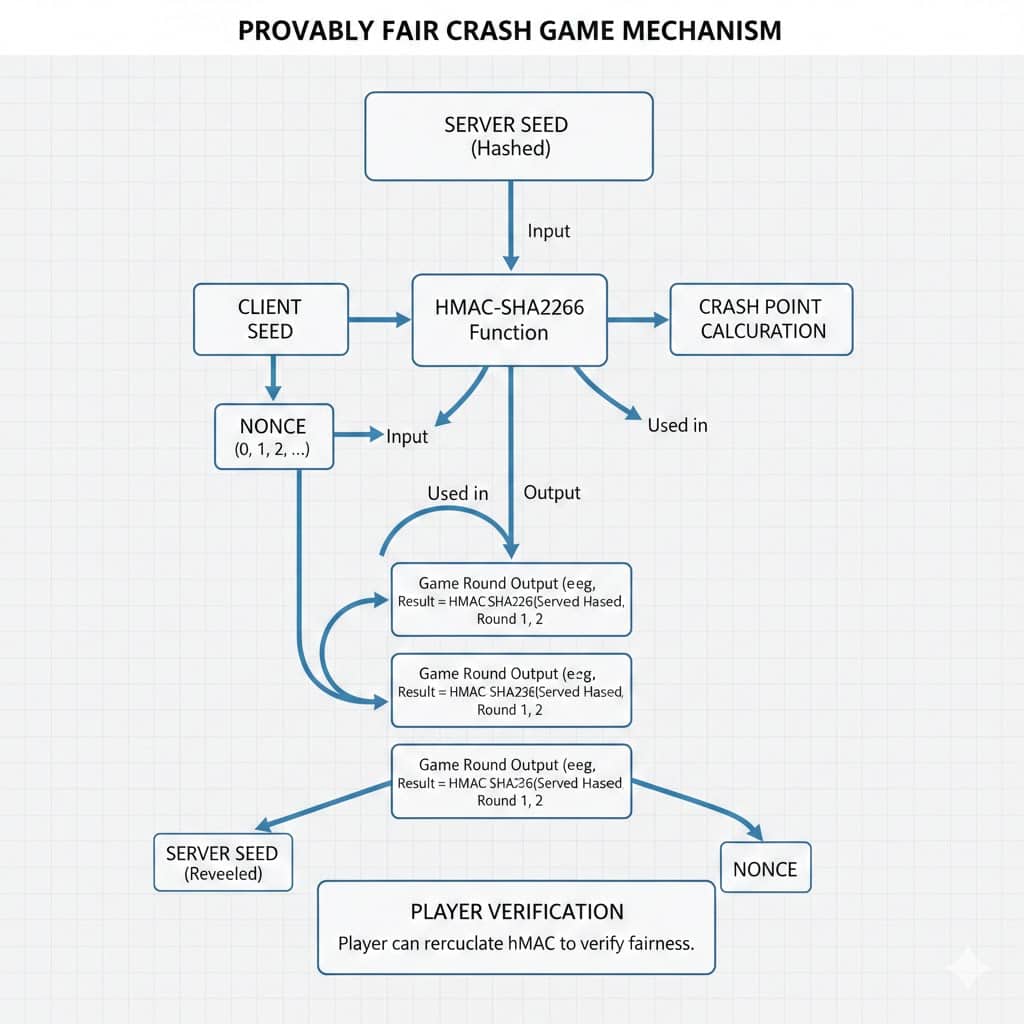
- Server Seed: This is a random string generated by the casino before the round starts. Crucially, the casino provides you with a Hash of this seed beforehand. This locks them in. They cannot change the outcome later without changing the hash (which would prove they cheated).
- Client Seed: This is the variable you control. It is often your browser’s random string, or you can set it manually. The server cannot know this seed until you hit “Bet.” This ensures the server couldn’t have pre-calculated a losing result specifically for you.
- Nonce: A simple counter. For your first bet, the nonce is 0 or 1. For the second, it is 2, and so on. This ensures every round yields a different result even if the seeds stay the same.
The game outcome is generated by combining these three: HMAC_SHA256(ServerSeed, ClientSeed + Nonce).
Deconstructing the Crash Algorithm
Most major crypto casinos in 2026 use a variation of the standard “Crash” formula. While the frontend shows a rocket or a plane, the backend is processing a hexadecimal string.
1. The Hex Generation
The combination of your seeds is hashed into a 64-character hexadecimal string. For example:
b5d4045c3f466fa91fe2cc6abe79232a1a57cdf104f7a26e716e0a1e2789df78
2. The Conversion
The system takes the first 8 characters (or more, depending on the specific casino’s documentation) and converts them into a decimal number. This is your raw “result.”
3. The Formula
To turn that raw number into a Crash Multiplier (e.g., 2.45x), the standard formula used by 90% of provably fair engines is:
Multiplier = (2^52 / (Result + 1)) * (1 - HouseEdge)
If the result calculates to less than the house edge threshold, the game crashes instantly at 1.00x. This is the mathematical “tax” of the system.
How to Manually Verify a Round
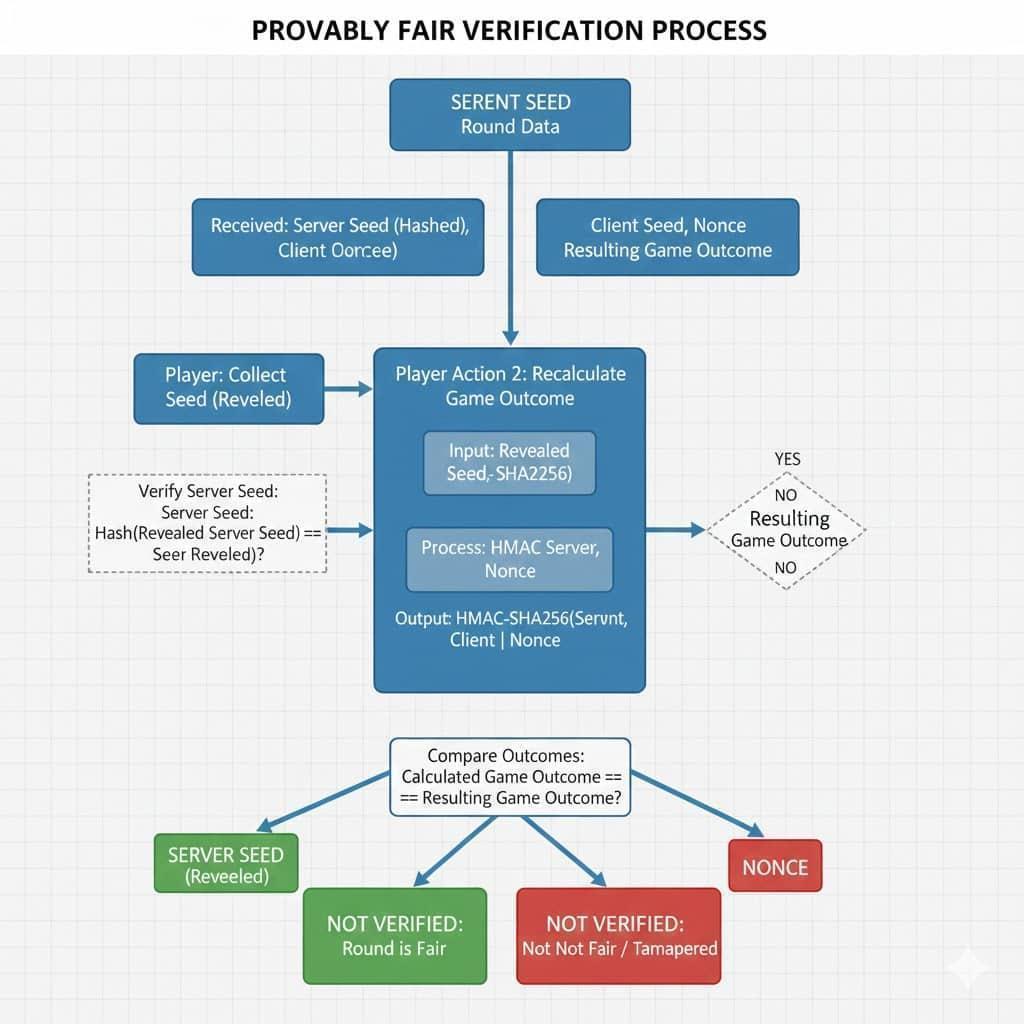
Never take the green “Verified” checkmark at face value. To truly audit a casino, you must use a third-party Python script or an independent online verifier. Here is the workflow for a rigorous security check:
- Copy the Hash: Before betting, copy the “Next Server Seed Hash” displayed in the settings.
- Play the Round: Wait for the crash.
- Get the Unhashed Seed: Once the round is over, the casino must reveal the raw Server Seed that generated that hash.
- Re-Hash It: Run the revealed seed through an SHA-256 calculator. Does it match the hash you copied in Step 1? If yes, the casino didn’t change the seed mid-game.
- Calculate the Result: Input the Server Seed, your Client Seed, and the Nonce into a verifier to ensure the math outputs the exact multiplier the game displayed.
Strategies vs. Mathematical Reality
I see many players in Discord groups selling “prediction bots.” Let’s be clear: You cannot predict a SHA-256 hash. The entire security of the global banking system and Bitcoin itself relies on this fact.
The Martingale Fallacy
Doubling your bet after every loss (Martingale) is mathematically guaranteed to fail eventually due to table limits and bankroll exhaustion. In Crash, a “loss streak” of 10+ rounds of sub-2.00x multipliers is statistically inevitable over a large sample size.
The Anti-Martingale Approach
A more “code-conscious” strategy is the Anti-Martingale, where you increase bets only during winning streaks. This capitalizes on the variance clustering sometimes seen in short-term random distributions, though it does not overcome the house edge (RTP) in the long run.
Red Flags in Crypto Casinos
As we move through 2026, scammers are getting smarter. Avoid any platform that exhibits these traits:
- Hidden Seeds: If you cannot see the hashed server seed before you bet, it is a scam.
- Proprietary “Black Box” Algorithms: If they claim their algorithm is “too complex to share,” they are rigging the RTP.
- Forced Client Seeds: If the casino does not allow you to edit or randomize your own Client Seed, they control the entire equation.
Conclusion: Verification is Power
The beauty of blockchain gambling lies in transparency. You don’t need to trust the casino manager’s good will. You only need to trust the immutability of the hash function. Always keep your Client Seed fresh, audit your high-stakes rounds, and remember: The math doesn’t care if you win or lose, it only cares about the formula.
FAQ: Provably Fair Gambling
Can a casino cheat a Provably Fair game?
Technically, no—provided you verify the seeds. If they change the outcome, the hash won’t match. However, they can cheat by using a “rigged” script if they don’t publish the algorithm, or by not letting you set a Client Seed. Always play on reputable sites that allow full verification.
What is a good Client Seed?
A good Client Seed is one the casino cannot predict. Using a random string generated by your password manager or a phrase known only to you is ideal. Rotating your seed regularly prevents the server from having “too much knowledge” of your future inputs, although mathematically, SHA-256 makes predicting future nonces impossible anyway.
Is the House Edge baked into the algorithm?
Yes. The formula usually includes a divisor (like 0.99 or 0.97) which ensures that over millions of calculations, the multipliers generated will return slightly less than 100% to the player pool. This is the fee for using the service.
Why did the game crash at 1.00x?
This is the “instant bust.” In the algorithm, if the generated raw number is within the specific range designated for the House Edge, the multiplier is rounded down to 1.00x. It is a necessary component to ensure the casino remains solvent.
Can I use AI to predict Crash games?
No. AI analyzes patterns. True cryptographic randomness (or pseudo-randomness derived from high-entropy seeds) has no patterns. Anyone selling you an “AI Crash Predictor” is selling snake oil.

Kripto Kumar Uzmanı & Blockchain Teknoloji Lideri (2013’ten beri)
Misyon: Ben sözlere değil, koda güvenirim. Kripto kumar alanı hâlâ Vahşi Batı gibidir ve Casino545’teki görevim sizi bu alanda güvenli bir şekilde yönlendirmektir. Gösterişli pazarlama umurumda değil; “Provably Fair” algoritmalarının gerçekten adil olup olmadığını doğrular ve kripto para çekimlerinizin teknik açıklar ve gizli şartlardan matematiksel olarak korunduğunu teyit ederim.
Sektör Deneyimi
İlk Bitcoin’imi 2013 yılında kazdım ve o zamandan beri blockchain mimarisi ve siber güvenlik alanında derinlemesine çalışıyorum. Casino545’e katılmadan önce günlük rutinim, DeFi akıllı sözleşmelerini denetlemek ve yeni açılan kripto casinoların ödeme ağ geçitlerini stres testine tabi tutarak sistemlerin tamamen güvenli olduğundan emin olmaktı.
Bu güçlü teknik altyapı, sıradan incelemecilerin tamamen gözden kaçırdığı detayları fark etmemi sağlar. Bir kripto oyununun hash dizilerini okuyarak kriptografik adilliğini doğrulayabilirim ve meşru bir blockchain lisans protokolü ile sahte bir güven mührünü tam olarak ayırt edebilirim.
Temel Uzmanlık Alanları
- Kriptografik Adillik: RNG meşruiyetini kanıtlamak için client-seed ve server-seed hash’lerini analiz etmek.
- Akıllı Sözleşme Denetimi: Merkeziyetsiz kumar platformlarında (Web3) arka kapıları veya istismar edilebilir kodları tespit etmek.
- Gizlilik & KYC Protokolleri: Sadece kriptoya dayalı ortamlarda anonimlik iddialarını ve para çekme süreçlerini stres testine tabi tutmak.
İnceleme Metodolojisi
- Blockchain Hız Testi: BTC, ETH ve USDT kullanarak canlı para yatırma ve çekme döngüleri gerçekleştirir, blok onay sürelerini casinonun pazarlama iddialarıyla karşılaştırarak tam olarak ölçerim.
- Provably Fair Doğrulaması: Crash, Dice ve Plinko gibi yüksek volatiliteye sahip oyunlarda seed ve hash’leri manuel olarak doğrular, sonuçların %100 manipülasyona karşı korumalı olduğunu garanti ederim.
- Anonimlik Kontrolü: “No-KYC” bir casinonun gerçekten gizliliğinize saygı gösterip göstermediğini veya kazandığınız anda ani belge talepleriyle fonlarınızı kilitleyip kilitlemediğini ortaya çıkarmak için KYC sürecini test ederim.
- Akıllı Sözleşme Denetimleri: Merkeziyetsiz casinolar için, kötü niyetli para çekme kilitleri olmadığından emin olmak adına temel kodu incelerim.
Oyuncu Güvenliğine Bağlılık
Kripto kumar benzersiz finansal özgürlük sunar, ancak kalıcı riskler taşır — blockchain üzerinde geri ödeme (chargeback) yoktur. Zorunlu 2FA (İki Faktörlü Kimlik Doğrulama) mimarilerini güçlü şekilde savunur ve oyuncuların bir kumar dApp’ine bağlanmadan önce cüzdan anahtarlarını nasıl güvence altına alacaklarını öğrenmelerini önceliklendiririm.