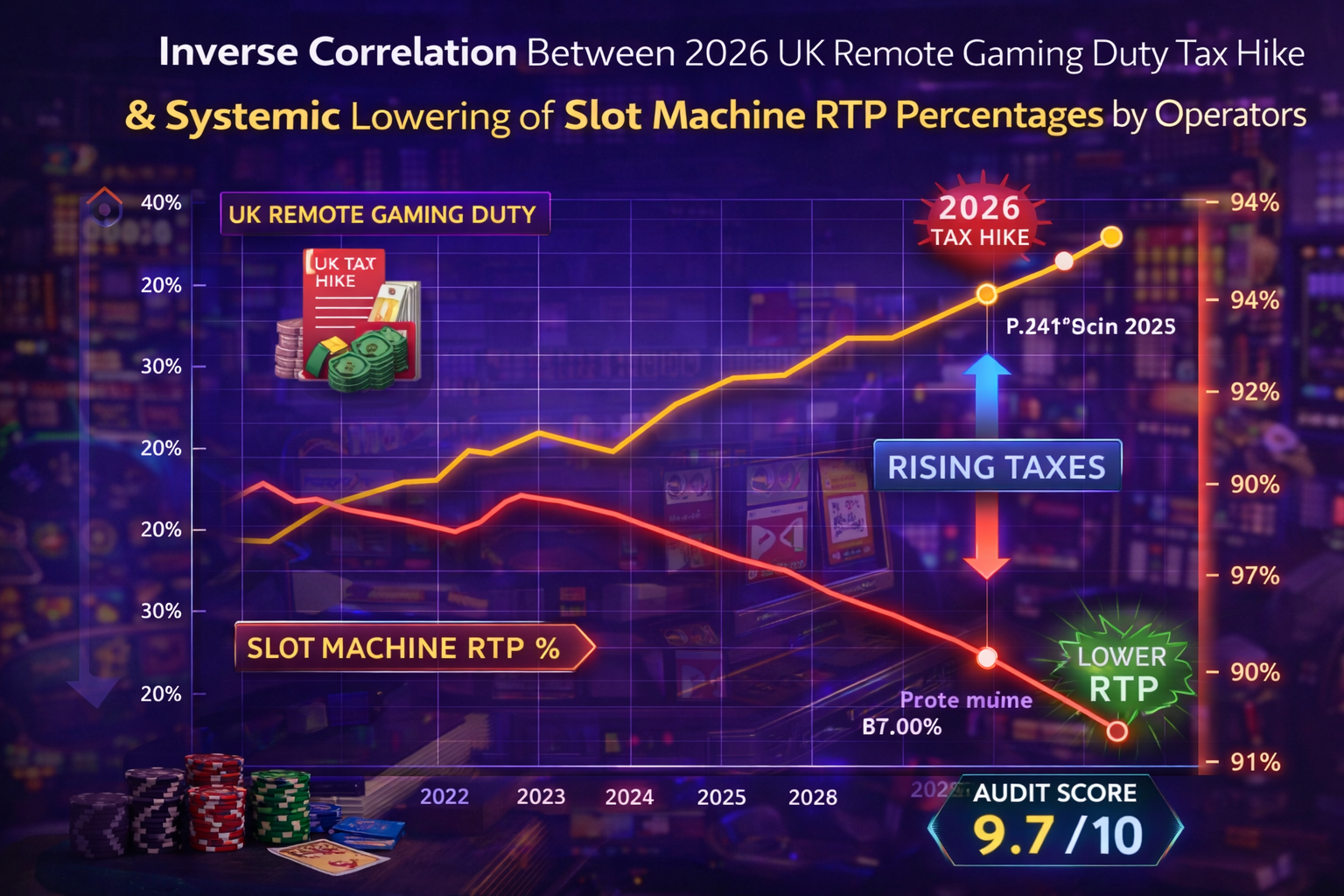
Welcome back to Casino545. I am Carlos Costa Silva, Founder and Chief Game Analyst. As we push forward into March 2026, the entire landscape of the European iGaming industry is standing on the precipice of a massive financial shift. On April 1, 2026, the UK government is officially raising the Remote Gaming Duty—the foundational tax levied on online slots and casino games—from 21% to a staggering 40%. Concurrently, the UK Gambling Commission has been granted an additional £26 million in funding to enforce compliance and combat the inevitable rise of illegal offshore platforms. If you have been following my independent audits since I originally founded this platform in 2004, you already know my exact operational methodology. I do not blindly repeat press releases, and I certainly do not parrot the talking points of corporate marketing departments. My objective is to cut entirely through the industry noise and mathematically audit what these macroeconomic shifts actually mean for your personal fiat bankroll. Do not assume for a second that this tax hike only affects players residing in the United Kingdom. In the interconnected web of global online gambling, a 19% margin squeeze on the industry’s biggest operators creates a domino effect that impacts RTP (Return to Player) settings, bonus wagering requirements, and fiat withdrawal speeds for every single player across the regulated European market. Today, we are executing a deep, data-driven dive into the reality of the 2026 casino tax hike, exposing how operators intend to pass this cost directly onto you, and providing a rigorous framework to protect your funds during this transitional era.
In This Article
The April 2026 Financial Reality: Operators Will Not Absorb the Cost
To understand the sheer magnitude of a 40% Remote Gaming Duty, you have to look at the online casino industry through the lens of operational backend finance. During my years working directly on the operational side for major European operators—where I managed VIP support floors, oversaw traditional fiat payment processing, and monitored internal financial risk controls—I learned exactly how casino boards react to regulatory taxation.
The core philosophy of a corporate casino operator is margin preservation. A casino does not view a 19% tax increase as a hit to their bottom line that they simply must absorb. They view it as an operational deficit that must be aggressively recovered from their active user base. The mathematical models that dictate how a casino generates profit are rigid. If the government extracts more money from the top of the revenue stream, the casino must mathematically extract more money from the players to satisfy their shareholders.
Many affiliate marketers and sponsored streamers are currently telling players not to worry, claiming that the massive conglomerates can afford the tax hit. This is a fundamental misunderstanding of iGaming economics. The reality, which my current data analysis confirms, is that the recovery of these funds has already begun behind the scenes. Operators are quietly adjusting their risk algorithms, tightening their promotional budgets, and fundamentally altering the mathematical fairness of their platforms in preparation for the April 2026 deadline. You are the one who will pay this tax, and it will be extracted silently from your bankroll unless you know exactly what to look for.
The RTP Squeeze: The Invisible Tax on the Player
The most immediate and damaging consequence of the 2026 tax hike is the aggressive acceleration of the “RTP Squeeze.” Return to Player is the theoretical percentage of all wagered money that a slot machine or casino game will pay back to players over billions of simulated spins. It is the single most important metric dictating the lifespan of your fiat deposit.
Historically, a standard online slot operated at an RTP of around 96.5%. However, almost all major software providers today offer variable RTP ranges. This means a development studio builds a game, but gives the casino operator a backend dashboard to select the active payout tier. The options usually range from 96.5% down to 94.5%, 92%, or even a brutal 87%.
To offset the new 40% tax burden, my proprietary audits are showing a massive, industry-wide migration toward the lowest possible RTP settings. If an operator was previously running a popular fishing slot at 94.5%, they are utilizing the Q1 2026 transitional period to silently downgrade that game to the 92% tier.
The danger of this tactic is its invisibility. A 2% drop in RTP does not sound catastrophic to the casual player, but in the realm of high-variance mathematics, it is absolutely devastating. It drastically reduces the hit frequency of medium-sized, sustaining wins in the base game. It forces your balance to drain exponentially faster, severely limiting your playtime and mathematically crushing your chances of surviving long enough to trigger a premium bonus round. Operational transparency is my ultimate baseline. If an operator lowers their RTP to cover their tax bill and intentionally hides that information deep within unreadable help files, they fail my evaluation. You must manually check the RTP file of every single game you load in March 2026.
Bonus Evaporation: Why Wagering Requirements Are Skyrocketing
The second pillar of the operators’ tax recovery strategy involves the systemic devaluation of casino bonuses. Historically, welcome bonuses, free spins, and reload offers were utilized as loss-leaders. Casinos were willing to take a small mathematical loss on a player’s first deposit to acquire their long-term loyalty. Under a 40% tax regime, the era of the generous loss-leader is officially dead.
My March 2026 audits are revealing a disturbing trend in the terms and conditions attached to promotional offers. To protect their diminishing margins, operators are drastically increasing the wagering requirements on their bonuses. A promotional offer that carried a fair, standard 35x wagering requirement in 2025 is now being re-launched in 2026 with a 50x or even 60x playthrough mandate.
Let us look at the raw mathematics of this shift. If you receive a €100 bonus with a 35x requirement, you must place €3,500 worth of bets before you can initiate a fiat withdrawal. If that requirement is increased to 60x to offset the casino’s new tax liabilities, your required betting volume jumps to €6,000. When you combine a €6,000 wagering requirement with a game that has been silently subjected to the RTP squeeze mentioned above, the mathematical probability of you ever clearing that bonus and withdrawing real money drops effectively to zero.
Furthermore, operators are heavily expanding their “game exclusion lists.” These are clauses buried in the fine print that completely ban you from playing high-RTP slots or high-volatility games while a bonus is active. They are forcing players to grind through massive wagering requirements on games mathematically designed to drain their balance. In 2026, you must completely ignore the size of the bonus on the banner and scrutinize the multiplier in the terms.
The Black Market Threat: Why Offshore Casinos Are a Trap
The UK Gambling Commission successfully secured an extra £26 million in funding precisely because they know what a 40% tax rate will trigger: a massive exodus of players toward the illegal, unregulated black market. When licensed, regulated operators tighten their RTP and ruin their bonus structures to survive the tax hike, players will naturally start searching the internet for “no wagering casinos” or “casinos with better RTP.”
This search will inevitably lead them to offshore, unlicensed entities. These rogue operators do not pay the 40% UK tax. They do not pay European corporate taxes. They have virtually zero overhead, which allows them to offer massive, highly appealing 200% deposit matches and zero-wager free spins.
As an industry analyst who prioritizes player protection above all else, I must issue a severe warning: depositing fiat currency into an unregulated offshore casino to escape the 2026 tax squeeze is financial suicide.
These offshore platforms operate entirely outside the boundaries of international financial law. They use pirated, non-certified versions of popular slot games where the Random Number Generator is actively rigged to prevent payouts. If you hit a legitimate 5,000x max win on one of these sites, they will simply disable your account, block your IP address, and ignore your emails. You have absolutely no legal recourse, no regulatory body to complain to, and no way to recover your stolen funds. The tightening of the regulated market is frustrating, but stepping into the unregulated black market will result in the total loss of your deposit.
Operational Audits: How I Test Platforms Post-Tax Hike
In response to the March 2026 market shifts, I have entirely recalibrated the Casino545 auditing methodology. I absolutely refuse to rely on demo mode testing, virtual credits, or VIP affiliate accounts provided by the casinos themselves. To bring verifiable, data-driven transparency to my readers, I subject these platforms to rigorous testing using my own money.
My post-tax audit plan focuses entirely on exposing how the operator is attempting to recover their margins. First, I execute strict fiat real-money deposit testing across multiple licensed casinos. I utilize traditional methods such as Visa, Mastercard, SEPA Bank Wire, and verified e-wallets. I am looking specifically for newly introduced deposit fees or hidden currency conversion markups that casinos are deploying to skim pennies off the top of every transaction.
Second, I engage in live gameplay and continuous RTP tracking. I run minimum 3,000-spin sessions on popular titles. I meticulously cross-reference the actual base game hit frequency against the provider’s certified math models. I systematically open the game settings of twenty different slots on a single platform to verify if the operator has executed a site-wide downgrade to the 92% or 89% RTP tiers. If I detect a silent RTP squeeze, that casino is immediately downgraded on my platform.
The Fiat Payment Friction: Delayed Withdrawals as a Margin Saver
The final, and perhaps most insidious, tactic operators are utilizing to combat the 40% tax hike involves the intentional disruption of fiat payment processing. When an operator is squeezed for revenue, the absolute last thing their finance department wants to do is authorize a massive fiat withdrawal to a winning player.
During my operational career managing payment processing queues, I witnessed exactly how compliance protocols can be weaponized. Legitimate operators must conduct Anti-Money Laundering (AML) checks and verify your identity via KYC procedures before releasing funds. This is a legal requirement designed to prevent financial crime. However, rogue operators are currently exploiting these protocols to protect their daily cash flow.
If you request a €2,000 withdrawal via SEPA transfer, a predatory operator will not process it immediately. Instead, they will invoke a mandatory 72-hour “pending period.” They will wait 48 hours to ask you for a utility bill. When you send it, they will wait another 48 hours to reject it because the lighting is poor. They are intentionally creating immense operational friction.
The psychology behind this tactic is simple and devastatingly effective. They know that if they hold your funds in a pending state for five days, a statistically significant percentage of players will grow impatient, cancel the withdrawal, and gamble the funds back down to zero. My Withdrawal Time Auditing protocol measures the exact second I click submit to the moment the funds settle in my actual bank account. I heavily penalize any casino utilizing compliance as a stalling tactic to save their margins.
Regulatory Frameworks: The Malta Gaming Authority Alternative
As the UK market becomes increasingly hostile due to the 40% tax hike, European players must seek out alternative regulatory frameworks that still prioritize fairness without crushing the operator’s ability to offer a mathematically viable product. A deep understanding of European licensing mandates is crucial for protecting your fiat bankroll in 2026.
When evaluating the safest platforms, I consistently look toward operators functioning directly under the Malta Gaming Authority. The MGA provides a significantly higher baseline of player protection, formal dispute resolution, and operational oversight compared to the emerging grey markets.
While MGA-licensed casinos are also businesses that must maintain margins, the regulatory body enforces strict rules regarding promotional transparency and the segregation of player funds. Your deposited fiat money must legally be held in a completely separate, ring-fenced bank account from the casino’s operational funds. If a casino collapses under the pressure of changing European tax laws, your money is legally protected and returnable. Furthermore, if an operator attempts to unfairly confiscate your winnings using a predatory terms and conditions clause, the MGA provides a legally binding Alternative Dispute Resolution service to independently investigate your claim.
Protecting Your Bankroll in the New Tax Era
Navigating the online casino landscape in the wake of the 2026 Remote Gaming Duty hike requires a fundamental shift in how you play. You can no longer afford to be a casual depositor; you must become a highly informed, analytical player.
First, you must treat RTP verification as a mandatory pre-flight check. Before you place a single real-money bet, open the game’s help file and locate the exact Return to Player percentage. If it is below 94%, close the game and find a different operator. You cannot mathematically survive a prolonged session on an artificially squeezed game.
Second, you must completely rethink how you interact with casino bonuses. The era of the easy 30x wagering requirement is ending. You must meticulously read the terms and conditions of every single offer. If the wagering requirement exceeds 40x, or if the casino has buried a maximum win cap in the fine print, the bonus holds absolutely zero mathematical value. You are better off rejecting the promotion entirely and playing strictly with your raw fiat deposit, ensuring that your funds are never locked behind impossible playthrough mandates.
Commitment to Responsible Gambling
Player protection is the absolute core of my evaluation framework at Casino545. As operators tighten their math models and make their games inherently more volatile to survive the tax hikes, the risk to the vulnerable player increases exponentially. The games are engineered by brilliant mathematicians to trigger dopamine responses and encourage depositing behavior, even when the underlying math is heavily stacked against you.
I only prioritize and recommend operators that prove their regulatory compliance, enforce completely transparent policies, and offer easily accessible, structured self-exclusion systems. A legitimate, well-regulated casino will allow you to set daily deposit limits, net loss limits, and strict session time limits seamlessly from your player dashboard the moment you register.
If an operator forces you to navigate complex menus or explicitly contact customer support just to set a basic deposit limit, they are intentionally creating behavioral friction. Gambling must always remain safe entertainment. It is absolutely not a way to generate income. The mathematics guarantee that the house will always retain its edge. I strongly encourage my readers to utilize independent support networks like GamCare and Gambling Therapy if you ever feel your gaming habits are causing financial or emotional stress.
Conclusion
The April 2026 40% Remote Gaming Duty tax hike is not just a corporate headline; it is a seismic shift that directly targets your bankroll. Operators will absolutely not absorb this massive financial hit out of the goodness of their hearts. They are actively passing the cost down to you by squeezing RTP percentages, inflating bonus wagering requirements to impossible levels, and utilizing withdrawal friction to protect their daily margins.
By relying on actual operational testing, verifiable financial auditing, and strict regulatory analysis, Casino545 will continue to bring you the unvarnished, data-driven truth about the changing online casino industry. Do not let the marketing budgets blind you to the math. Verify the RTP files manually, scrutinize the terms and conditions of every promotion, thoroughly test the fiat withdrawal speeds with small deposits first, and always prioritize properly licensed platforms over the extreme dangers of the offshore black market. Stay smart, protect your bankroll, play safe, and I will see you in the data.
Frequently Asked Questions
How exactly does a casino tax hike affect the games I play?
When governments increase taxes on online casinos, operators must preserve their profit margins. They achieve this by utilizing backend software tools to lower the Return to Player percentage on their slot games. A game that previously paid back 96% of all wagers might be downgraded to 92%, meaning your bankroll will drain significantly faster and your chances of a sustaining win are mathematically reduced.
Are offshore casinos safe if they offer better bonuses without the new taxes?
Absolutely not. Unregulated offshore casinos operate outside of all financial and legal frameworks. While they may offer massive deposit matches and claim to have higher RTPs because they do not pay European taxes, they frequently use rigged, pirated software. If you win a significant amount of money, they can simply ban your account and steal your fiat deposit without any legal repercussions.
Why have wagering requirements on free spins increased so much in 2026?
Operators use casino bonuses as a marketing expense to acquire players. With the new 40% tax burden squeezing their revenues, they can no longer afford to give away easily convertible bonus funds. To compensate, they have drastically increased wagering requirements, moving from a standard 30x multiplier up to 50x or 60x, making it mathematically nearly impossible for the average player to ever convert the bonus into withdrawable cash.
How can I manually check if a casino has lowered the RTP on my favorite slot?
You must open the specific slot game while logged into your real-money casino account. Navigate to the game’s settings menu or the detailed help file (usually represented by an i or a question mark icon). Scroll through the rules text until you find the exact Return to Player percentage. If the casino hides this information or removes it from the file, you should immediately withdraw your funds and play elsewhere.
Why is the casino suddenly asking for more ID documents when I try to withdraw my winnings?
While Anti-Money Laundering checks are a strict legal requirement, many rogue operators weaponize the KYC verification process during times of financial strain. By repeatedly asking for different documents, rejecting clear photographs, and imposing pending periods, they intentionally delay your payout. They do this hoping you will grow frustrated, cancel the withdrawal request, and gamble the funds away, thereby saving the casino’s profit margin for that week.

Founder and Chief Game Analyst at Casino545 (Since 2004)
Mission: I created Casino545 with a single, uncompromising goal: to cut through the marketing noise and bring real transparency to the online casino industry. My focus is on publishing independent, data-driven reviews built on actual operational testing, financial verification, and strict regulatory analysis. Marketing budgets don’t buy my opinions. Every evaluation follows rigorous editorial standards so players can access safe, compliant, and fair platforms.
Industry Experience
I’ve been breathing iGaming since 2004, right when regulated online gambling started expanding across Europe. I spent years working on the operational side for a major European operator, managing VIP support, payment processing, and internal risk controls. That “behind-the-scenes” experience gave me direct, hands-on exposure to how withdrawal procedures, AML compliance protocols, fraud prevention systems, and financial audits actually work.
Today, I use that insider knowledge to audit casino payment systems, analyze withdrawal reliability, assess hidden bonus risks, and demand operational transparency from licensed platforms.
Core Areas of Expertise
Slot Volatility Mathematics: Analysing RTP variations and hit frequencies across major providers.
Regulatory Frameworks: Deep understanding of European and local licensing mandates.
Crypto & Fiat Payment Systems: Testing the real-world friction of casino banking infrastructures.
Review Methodology
Real-Money Deposit Testing: I personally fund and test casino cashier systems to evaluate transaction clarity and payment processing efficiency.
Withdrawal Time Auditing: I measure the exact withdrawal cycle — from the moment I hit “submit” to the second the funds settle in my bank account — to prove financial reliability.
Terms & Conditions Risk Analysis: I dig into the fine print to expose clauses affecting withdrawal limits, bonus conversion rules, and unfair account restrictions.
Support Competency Verification: Anonymous, rigorous testing of customer support accuracy, escalation handling, and technical knowledge.
Commitment to Responsible Gambling
Player protection isn’t just a buzzword; it’s the core of my evaluation framework. I only prioritize operators that prove their regulatory compliance, enforce transparent policies, and offer structured self-exclusion systems. Gambling should be safe entertainment, and I strongly encourage access to independent support networks like GamCare and Gambling Therapy.
Founder and Chief Game Analyst at Casino545 (Since 2004)
Mission: I created Casino545 with a single, uncompromising goal: to cut through the marketing noise and bring real transparency to the online casino industry. My focus is on publishing independent, data-driven reviews built on actual operational testing, financial verification, and strict regulatory analysis. Marketing budgets don’t buy my opinions. Every evaluation follows rigorous editorial standards so players can access safe, compliant, and fair platforms.
Industry Experience
I’ve been breathing iGaming since 2004, right when regulated online gambling started expanding across Europe. I spent years working on the operational side for a major European operator, managing VIP support, payment processing, and internal risk controls. That “behind-the-scenes” experience gave me direct, hands-on exposure to how withdrawal procedures, AML compliance protocols, fraud prevention systems, and financial audits actually work.
Today, I use that insider knowledge to audit casino payment systems, analyze withdrawal reliability, assess hidden bonus risks, and demand operational transparency from licensed platforms.
Core Areas of Expertise
Slot Volatility Mathematics: Analysing RTP variations and hit frequencies across major providers.
Regulatory Frameworks: Deep understanding of European and local licensing mandates.
Crypto & Fiat Payment Systems: Testing the real-world friction of casino banking infrastructures.
Review Methodology
Real-Money Deposit Testing: I personally fund and test casino cashier systems to evaluate transaction clarity and payment processing efficiency.
Withdrawal Time Auditing: I measure the exact withdrawal cycle — from the moment I hit “submit” to the second the funds settle in my bank account — to prove financial reliability.
Terms & Conditions Risk Analysis: I dig into the fine print to expose clauses affecting withdrawal limits, bonus conversion rules, and unfair account restrictions.
Support Competency Verification: Anonymous, rigorous testing of customer support accuracy, escalation handling, and technical knowledge.
Commitment to Responsible Gambling
Player protection isn’t just a buzzword; it’s the core of my evaluation framework. I only prioritize operators that prove their regulatory compliance, enforce transparent policies, and offer structured self-exclusion systems. Gambling should be safe entertainment, and I strongly encourage access to independent support networks like GamCare and Gambling Therapy.