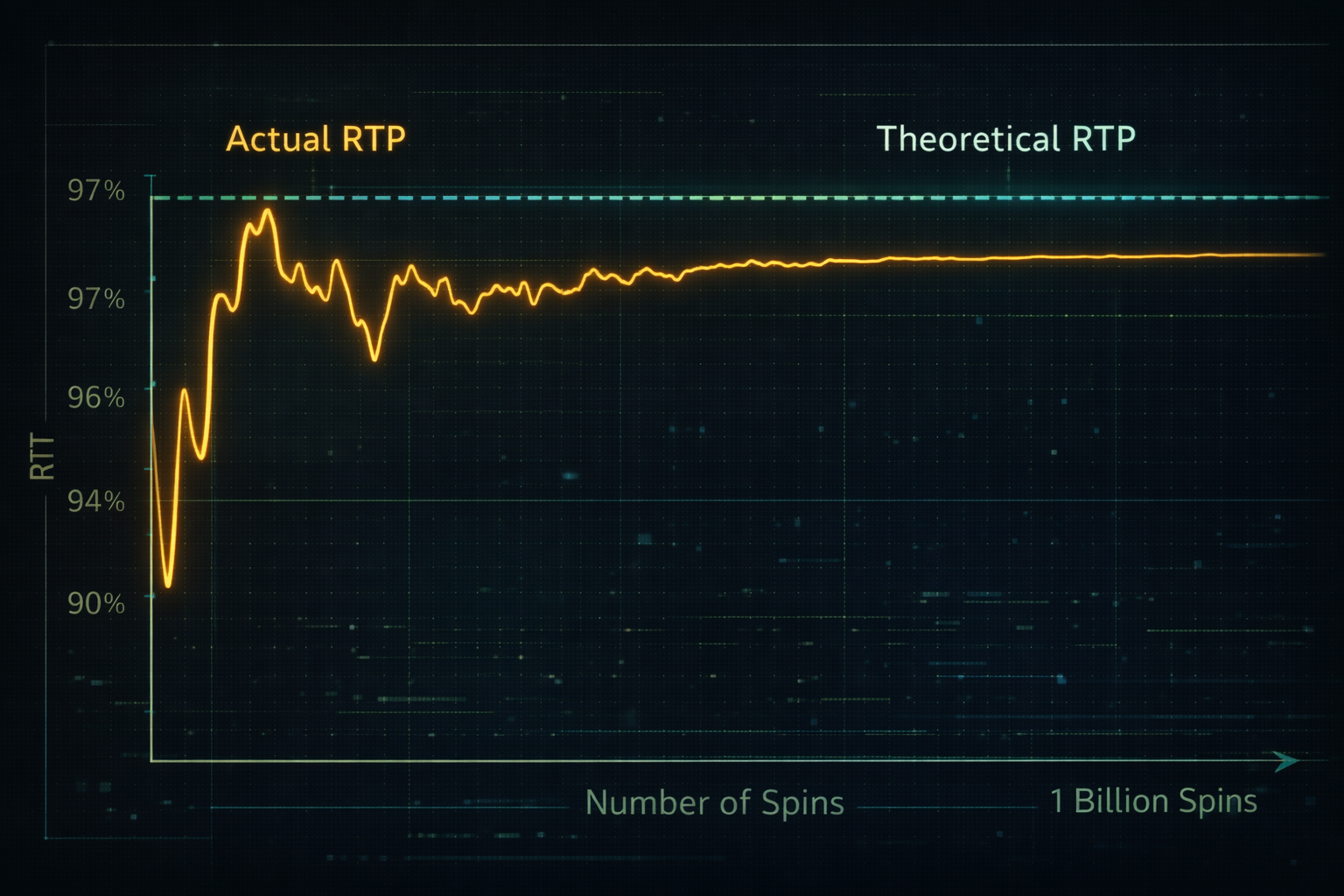
There is a fundamental misunderstanding among casino players regarding Return to Player (RTP). Players see a percentage—96.5%, for instance—and their brain interprets this as a guarantee. They assume that for every $100 wagered, they will receive $96.50 back. In the short term, this is mathematically impossible.
As a game analyst, I run simulations on slot mathematics daily. I look at the PAR sheets (Probability Accounting Reports). I can tell you that RTP is not a prediction of your session. It is a long-term statistical average calculated over billions of rounds. It is the “Theoretical RTP” (TRTP).
In this technical breakdown, we will analyze how RTP is actually calculated, why your “Actual RTP” fluctuates wildly, and the deceptive nature of variable RTP settings in modern online slots.
In this Article
The Formula: How RTP is Calculated
Mathematically, the formula for RTP is simple, yet often misinterpreted. It is the ratio of total money returned to players divided by the total money wagered.
RTP = (Total Amount Returned to Players) / (Total Amount Bet)
However, this formula only holds true over the “Lifecycle” of a slot machine. In game development, we simulate a game for 1 billion to 10 billion spins to verify the RTP. This is the Law of Large Numbers. As the sample size (spins) increases, the actual results converge toward the theoretical probability.
For you, the player, this is irrelevant. You will not play 1 billion spins. You will play perhaps 500 spins in a session. In a sample size that small, the standard deviation dominates the RTP. Your session RTP could easily be 0% or 500%. The 96% figure is a distant mathematical horizon, not a safety net for your wallet.
The House Edge: The Mathematical Inevitability
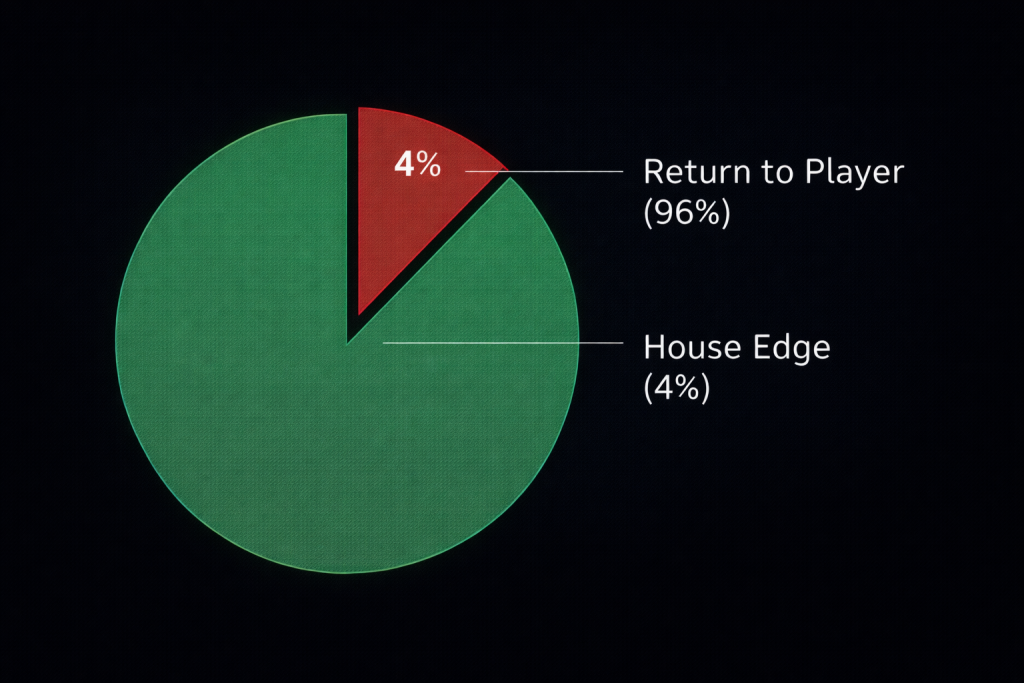
RTP is the inverse of the House Edge. If a slot has an RTP of 96%, the House Edge is 4%. This 4% is the “price” of playing the game.
What players fail to calculate is the “Turnover Cost.” If you deposit $100 and bet $1 per spin, and the game has a 4% house edge, you are statistically paying $0.04 per spin. After 100 spins, you have theoretically paid $4.00 to the casino. But if you keep recycling your winnings (turnover), the house edge eats away at the capital repeatedly.
This is why playing for a long time almost always results in a loss. The math is designed to grind the balance down to zero over time via the House Edge, regardless of the volatility.
Variable RTP: The Hidden Variable
This is the most critical data point for modern players. Ten years ago, an RTP was fixed. Today, many providers—including Pragmatic Play, Play’n GO, and Red Tiger—use “Variable RTP” mechanics.
This means a single game, such as Book of Dead, can be certified at five different RTP levels: 96%, 94%, 91%, 87%, or even 84%. The casino operator chooses which math model to run.
From a mathematical standpoint, the difference between 96% and 94% seems negligible (2%). However, in terms of “Playtime” and “Loss Rate,” the difference is massive. A 94% game drains a bankroll roughly 50% faster than a 96% game over the long term. Always check the “Help” file or “Game Rules” to verify the specific RTP active on the server you are using.
RTP vs. Volatility: Do Not Confuse Them
I often hear players say, “This game has bad RTP” when they are actually experiencing “High Volatility.” These are distinct metrics.
- RTP is the volume of money returned.
- Volatility is the distribution of that money.
A slot can have a very high RTP (e.g., 98%) but extremely high volatility. This means it pays back a lot of money, but only to a tiny percentage of players who hit the jackpot. The vast majority lose. Conversely, a low volatility slot might have a lower RTP (94%) but pay out frequent, small amounts.
When analyzing a game, I look at the “Hit Frequency” alongside RTP. A game with 96% RTP and a 20% Hit Frequency behaves very differently from a game with 96% RTP and a 40% Hit Frequency. The math dictates the experience.
The “Bonusing” Impact on RTP
Another factor in the math is how the RTP is split between the Base Game and the Bonus Features. In many modern slots, up to 30% or 40% of the total RTP is allocated to the Free Spins or Bonus Round.
This creates a “RTP Famine” in the base game. If the total RTP is 96%, but 30% is locked in the bonus, the base game effectively runs at 66% RTP. This explains why your balance plummets while you wait for the “Scatter” symbols. You are playing a mathematically inferior game until the bonus triggers to correct the average.
Conclusion: The Numbers Do Not Lie
RTP is a useful metric for comparing games, but it is not a prediction of your success. It is a certification requirement for regulators like the Malta Gaming Authority to ensure the game is not completely unfair.
However, understanding the math protects you. It teaches you to check the RTP setting before spinning. It teaches you that “Theoretical” does not mean “Actual.” And it reminds you that in the battle between Player and Math, the Math always wins in the long run. Play with that knowledge.
Frequently Asked Questions
Is 96% a good RTP for online slots?
Yes. The industry standard for online slots hovers around 96.00%. Anything above 96.5% is considered excellent (high value). Anything below 95.00% is mathematically poor and should generally be avoided if your goal is maximizing playtime.
Can a casino change the RTP while I am playing?
No. The RTP is determined by the game’s server configuration and cannot be altered mid-session. However, different casinos may host the same game at different RTP settings. Always verify the specific percentage in the game’s information file.
Does a high RTP mean I will win more often?
Not necessarily. Winning frequency is determined by “Hit Frequency,” not RTP. A high RTP game can still have a low Hit Frequency, meaning you win large amounts rarely. A high RTP simply means the house edge is lower over the long term.
What is the difference between TRTP and RTS?
TRTP stands for Theoretical Return to Player (the mathematical code). RTS stands for Return to Player Statistics (the actual data from real spins). Over millions of spins, RTS should match TRTP. In short sessions, they will almost never match.

Senior Slots Analyst & Game Math Expert (Since 2015)
Mission: Flashy graphics don’t pay out; math does. I joined Casino545 to deconstruct online slots and bonuses, revealing the true mathematical value (RTP) behind the marketing hype. My absolute priority is to ensure our readers understand the exact odds and mechanics before they ever press “spin”.
Industry Experience
With a background in Applied Mathematics, I entered the iGaming technical sector in 2015. Instead of marketing or support, I started “under the hood” as a Quality Assurance (QA) Tester for a major European game studio.
Testing slot mechanics, verifying volatility curves, and auditing Random Number Generators (RNG) for true randomness taught me how to read between the lines. I know exactly how to spot manipulated RTP figures and separate fair entertainment from predatory mathematical design.
Core Areas of Expertise
- RTP & Volatility Mathematics: Decompiling provider algorithms to verify actual hit frequencies.
- Bonus Valuation: Calculating the true monetary value of promotions against hidden wagering requirements.
- Game Studio QA: Identifying deceptive mechanics and unverified RNG software.
Review Methodology
- The 1,000 Spin Test: I don’t just read the manual; I run extensive real-money spin sessions to verify if the live volatility matches the developer’s technical sheet.
- Bonus Math Auditing: I calculate the true cost of a bonus. If a 50x wagering requirement makes winning statistically improbable, I flag it immediately.
- Dynamic RTP Tracking: I actively check if casinos are quietly lowering default RTP settings on popular games to protect their own margins.
Commitment to Responsible Gambling
Gambling must be a transparent transaction based on facts, never false hope. I advocate fiercely for clear Terms & Conditions and support industry initiatives that force operators to display live, unaltered RTP figures visibly on every single game interface.